Google (GOOGL) Cloud Revenue Just Surged 48% And May Have Delivered Knockout Blow To OpenAI
Summary:Our AI Investor Podcasts have been counting down the 12 trends that AI investors should be watching in 2026.Recently, Eric Bleeker and Austin Smith focused their attention on the competitive battle between OpenAI and Alphabet. While OpenAI was the early leader…

This post may contain links from our sponsors and affiliates, and Flywheel Publishing may receive compensation for actions taken through them.
Summary:
Our AI Investor Podcasts have been counting down the 12 trends that AI investors should be watching in 2026.
Recently, Eric Bleeker and Austin Smith focused their attention on the competitive battle between OpenAI and Alphabet. While OpenAI was the early leader in artificial intelligence, Alphabet has staged a powerful resurgence and now appears ahead in several dimensions.
“There’s been a large divergence in the performance of companies seen as part of the OpenAI sphere versus the Alphabet sphere,” Bleeker explains. “So when we look at a company like Oracle, they are highly associated with OpenAI. They’re down 50.3%. Meanwhile, stocks that have been associated with Alphabet, such as Celestica, Lumentum and Broadcom really had a great start to the second half of 2025.”
However, Bleeker argues that media coverage of OpenAI has become excessively negative, especially regarding its plans to raise tens of billions of dollars in capital. He suggests that much of Wall Street had already anticipated large capital raises, meaning the headlines may not accurately reflect the underlying financial reality.
“You need to be able to look beyond what’s in the media, and that often provides opportunity because it is non-consensus. You make your money by being non-consensus. As you know, we generally have been non-consensus with AI, and when the trend works, you see the benefits from it.”
Transcript:
Austin: Okay, Eric, this is the moment our listeners have been asking for. They want to hear the discussion of the final four AI trends that you had identified for 2026, and let’s just jump right into the first one. This is our first back-to-back special episode drop here. No need for a special intro.
Talk to me about the battle between OpenAI and Alphabet (NASDAQ: GOOGL) | GOOGL Price Prediction. You and I have discussed Alphabet’s incredible resurgence, first starting late to the AI race and now seemingly being ahead in most dimensions while OpenAI started first. And I wonder if this is a case of the first pioneer getting arrows in their back.
Is that what we are going to see here with OpenAI? And is the second pioneer actually the winner? Tell me what’s going on.
Eric Bleeker: As background, what we’re doing is we’ve been going through our 12 biggest trends for 2026, and at the end we’re going to do a larger portfolio rebalance. Once we conclude episodes, we’ll be able to talk about these trends as establishing factors and how the companies play into them. Then we’ll be able to rebalance the portfolio.
We’ve talked in the past, Austin, about areas like the emergence of CPUs this year, the birth of larger AI factories, and memory. Today we’re going to talk about a few themes that are relatively interconnected. The first one I wanted to talk about was OpenAI versus Alphabet. Listeners of the podcast will know we’ve discussed this before, that there’s been a large divergence in the performance of companies seen as part of the OpenAI sphere versus the Alphabet sphere.
OpenAI has ambitious plans, while Alphabet is really focusing on its TPUs and the unique infrastructure involved in that build-out.
So when we look at a company like Oracle (NYSE: ORCL), they are highly associated with OpenAI. They’re down 50.3%. Meanwhile, stocks that have been associated with Alphabet, such as Celestica (NYSE: CLS), Lumentum (NASDAQ: LITE), and Broadcom (NASDAQ: AVGO), really had a great start to the second half of 2025.
But Austin, what I find interesting here is the media cycle. I went on my rant in the last episode and won’t do as long a rant here, but the media cycle around OpenAI is terrible. It’s reached a fervor where any article about the company can’t be fair.
For example, this week it was announced that they’re going to be looking to raise $50 billion between debt or equity, which led to no shortage of handwringing about the bubble being here and Oracle not being able to afford to do this build-out. But the thing is, most of Wall Street already built into their models that OpenAI would be raising far more than that. This was actually relatively good news if you were an Oracle investor, but you wouldn’t have known that from the headlines.
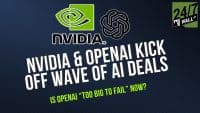
Another headline this week was that The Wall Street Journal ran a story about how Nvidia (NASDAQ: NVDA) was breaking up with OpenAI and wouldn’t be investing a previously stated amount in the company. But the reality is this: OpenAI is in a funding round. They’re looking to raise about $100 billion that’s almost surely going to involve Nvidia. They also have other companies interested in providing large sums of capital like Amazon (NASDAQ: AMZN) and SoftBank.
If they raise $100 billion and are aiming for an IPO in Q4, that probably gives OpenAI several hundred billion dollars’ worth of capital. It gives them the runway that they need.
The final point I want to make here is we’ve been talking about this Claude Code moment and how it’s become the driving narrative of the market in early 2026. Well, who’s the primary competitor to Claude Code? It’s OpenAI’s Codex. The company you don’t really see a lot of discussion about with their coding tools is Alphabet.
So sometimes you have to zag away from market sentiment. I believe this is an area rich with opportunities. There’s a lot of negative sentiment, and I believe companies in the Alphabet ecosystem will still see strong results in 2026. But the negativity is so high on many stocks indexed to OpenAI that I think it’s become a relative zone of opportunity.
This is going to be one of the zones we’re looking at. I want to explain why that is because if we issue recommendations into a lot of these companies, listeners might say, “All I’ve heard is bad things about OpenAI.”
Austin: Mm-hmm.
Eric Bleeker: We need to talk about how the narratives don’t accurately reflect the situation happening at the beginning of 2026.
Austin: Yeah, and you’ve discussed the importance of companies having a good narrative and being able to look through narratives to reality. I’ll give you another example. Alphabet has had a fantastic run post-2025, from the tail end of 2025 through to now, and we’ve talked a lot about that.
They have a lot of great narratives going right now. One of the other ones you’ll hear is that Alphabet owns 7% of SpaceX, Waymo is a $100 billion company in their portfolio, and they have a stake in Anthropic. All of these are true and very impressive.
If you add up the estimated stakes of all of those companies I just mentioned, it’s about $225 billion. That is a lot of money, but it’s against a $4 trillion market cap. So we’re talking about maybe 6% of the company.
This is a case where Alphabet has some shine on it and some good narratives out there. But when you actually start to look through the context and put these numbers against reality, you have to understand how much of this could just be good vibes, good media coverage, and the fact that OpenAI has negative coverage.
I like that you’re trying to look through that to understand the ground truth of whether or not the company is going to be in a good position. If they can raise $100 billion and plan for an IPO, as you said, they’re going to have all the money they need to go fight this AI war for a number of years.
Eric Bleeker: You need to be able to look beyond what’s in the media, and that often provides opportunity because it is non-consensus.
Austin: Mm-hmm.
Eric Bleeker: You make your money by being non-consensus. As you know, we generally have been non-consensus with AI, and when the trend works, you see the benefits from it.
Contact [email protected] for any questions or corrections.