Large Roth Conversions Often Backfire for Retirees Already on Medicare
Converting a traditional IRA to a Roth IRA sounds straightforward: pay taxes now, enjoy tax-free growth later. But the converted amount is added to your adjusted gross income for the year, potentially triggering higher tax brackets, Medicare surcharges, and taxation…

This post may contain links from our sponsors and affiliates, and Flywheel Publishing may receive compensation for actions taken through them.

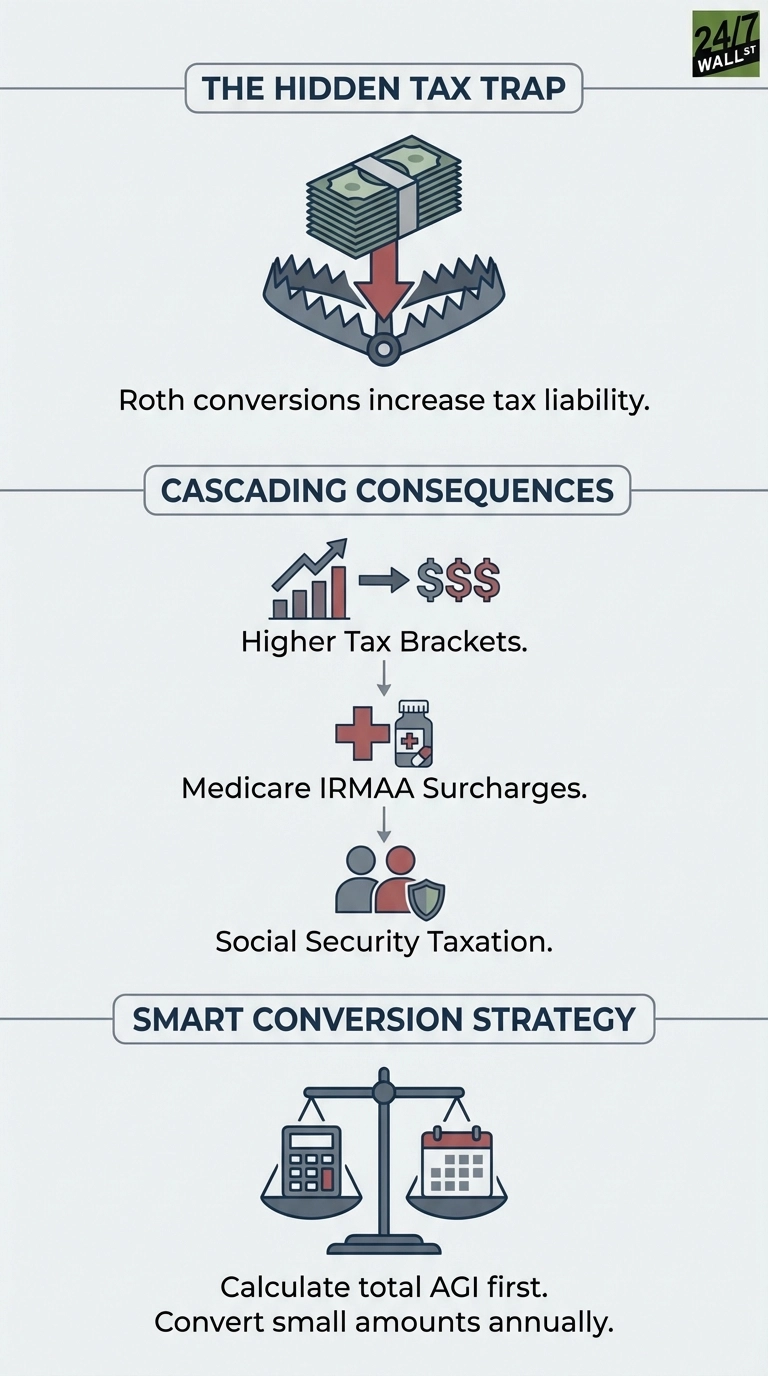
Converting a traditional IRA to a Roth IRA sounds straightforward: pay taxes now, enjoy tax-free growth later. But the converted amount folds directly into your adjusted gross income for the year, potentially pushing you into a higher tax bracket, triggering Medicare surcharges, and pulling more of your Social Security benefits into taxable income. The hidden costs stack up fast, and for retirees already on Medicare, the most painful bill can arrive two full years after the conversion is done.
The Hidden Tax Cascade
When you convert funds from a traditional IRA to a Roth, that amount is treated as ordinary income in the year of conversion. A higher AGI can push you into a steeper marginal tax bracket, erode deductions that phase out at certain income levels, and set off a chain of stealth taxes that multiply the real cost of converting.
For 2026, the 22% bracket for single filers covers taxable income up to $105,700, at which point the 24% rate takes over. A retiree who converts a large IRA balance and crosses that line pays extra not only on the portion of the conversion that spills over the threshold, but on all other income pushed into the higher bracket alongside it. That cascading effect can quietly erase much of the long-term benefit the conversion was meant to create.
Medicare IRMAA: The Two-Year Lookback Trap
For anyone on Medicare or approaching eligibility, Roth conversions carry an added cost that most financial calculators do not flag automatically. Medicare Part B and Part D premiums include Income-Related Monthly Adjustment Amounts (IRMAA) for higher earners. The Social Security Administration determines IRMAA using your modified adjusted gross income from two years prior. A conversion made today shows up in your Medicare premiums two years later, long after the tax return is filed and the money is spent.
In 2026, the IRMAA surcharge begins when a single filer’s MAGI exceeds $109,000, based on their 2024 tax return, or $218,000 for married couples filing jointly. The standard Part B premium is $202.90 per month. Once a single filer crosses the first IRMAA tier, a Part B surcharge of $81.20 per month and a Part D surcharge of $14.50 per month are added on top of that standard premium, generating roughly $1,148 per person per year in additional healthcare costs. Higher tiers impose progressively steeper charges, with the top tier (above $500,000 for single filers) adding $487.00 per month in Part B surcharges alone.
The IRMAA structure operates on a cliff basis, with no phase-in. One dollar over any tier’s boundary triggers the full surcharge for that tier for the entire calendar year. A modest Roth conversion that nudges income just past a threshold can therefore generate a disproportionate and persistent annual cost. For Medicare enrollees, the two-year lookback timing matters as much as the conversion amount itself. One planning relief valve: if a qualifying life event (such as retirement or a significant income drop) has reduced your income since the lookback year, you can file Form SSA-44 with the Social Security Administration to request that your IRMAA be recalculated using more recent income data.
Social Security Taxation Thresholds
Roth conversions also drive up the taxation of Social Security benefits through a two-tier structure that Congress has not adjusted for inflation since the 1980s and 1990s. Benefits become taxable when provisional income (AGI plus tax-exempt interest plus half of your Social Security benefits) exceeds $25,000 for single filers or $32,000 for married couples filing jointly. At that point, up to 50% of benefits can be included in taxable income. Once provisional income surpasses a second threshold of $34,000 for singles or $44,000 for joint filers, up to 85% of benefits can be taxed. Because these thresholds are frozen by law, Social Security cost-of-living adjustments and ordinary investment income push more retirees over the line every year without any change in the tax code.
For many retirees, a large Roth conversion creates a compounding tax hit. The conversion generates its own tax liability while simultaneously pulling a larger share of Social Security benefits into taxable income. That double exposure can turn what looks like a modest marginal-rate increase into a significantly higher effective tax bill on the same retirement dollars.
A New Deduction Worth Knowing
One development that can partially offset Roth conversion costs for some retirees is the senior deduction created by the One Big Beautiful Bill Act, signed into law on July 4, 2025. Taxpayers aged 65 and older can claim an additional $6,000 deduction per person (or $12,000 for a couple where both spouses qualify) for tax years 2025 through 2028. The deduction is available whether the filer itemizes or takes the standard deduction, and it stacks on top of the existing additional standard deduction that seniors already receive.
The deduction phases out at a 6% rate once MAGI exceeds $75,000 for singles or $150,000 for joint filers, and it disappears entirely at $175,000 MAGI for a single filer or $250,000 for a married couple filing jointly. One critical planning consideration: this is a below-the-line deduction, meaning it reduces taxable income rather than AGI. Because IRMAA surcharges and the Social Security provisional income test are both calculated before the standard or itemized deduction is applied, this senior deduction does not directly reduce MAGI for IRMAA purposes and does not reduce provisional income for Social Security taxation. Retirees seeking to lower their AGI and MAGI directly should focus on above-the-line strategies instead. Qualified charitable distributions from an IRA, for example, reduce AGI dollar for dollar and do not count as income at all.
What to Evaluate First
Before converting, calculate your total AGI with the conversion amount included, then check where that figure lands relative to tax bracket thresholds, IRMAA tiers, and the Social Security provisional income levels. Spreading conversions across multiple years often reduces the total tax cost compared to a single large conversion that crosses several thresholds at once. For Medicare enrollees, the two-year lookback makes the timing of each conversion as important as its size. An income spike this year translates directly into premium surcharges starting two years from now, and there is no way to undo that once the tax year closes.
Editor’s note: This pass added the $250,000 MAGI phaseout ceiling for the One Big Beautiful Bill Act senior deduction for married couples filing jointly, which was previously unstated. It also introduced the SSA Form SSA-44 appeal option as a planning tool available to Medicare enrollees whose income has dropped since the IRMAA lookback year.
Contact [email protected] for any questions or corrections.
I am a long time investor and student of business, and believe finding good companies that can become great investments is the best game on earth. After 20 years of writing and researching the public markets it is clear that individuals have never had more tools and information to take control of their financial lives. From ETFs and $0 commissions to cryptos and prediction markets there has never been a greater democratization of access to investing.
I write to help people understand the investments available to them so they can make the best choice for their portfolio, whether they're starting out or looking for income in retirement.