Double, Double, Oil and Trouble: Crude Hits $116 and Here’s What It Means
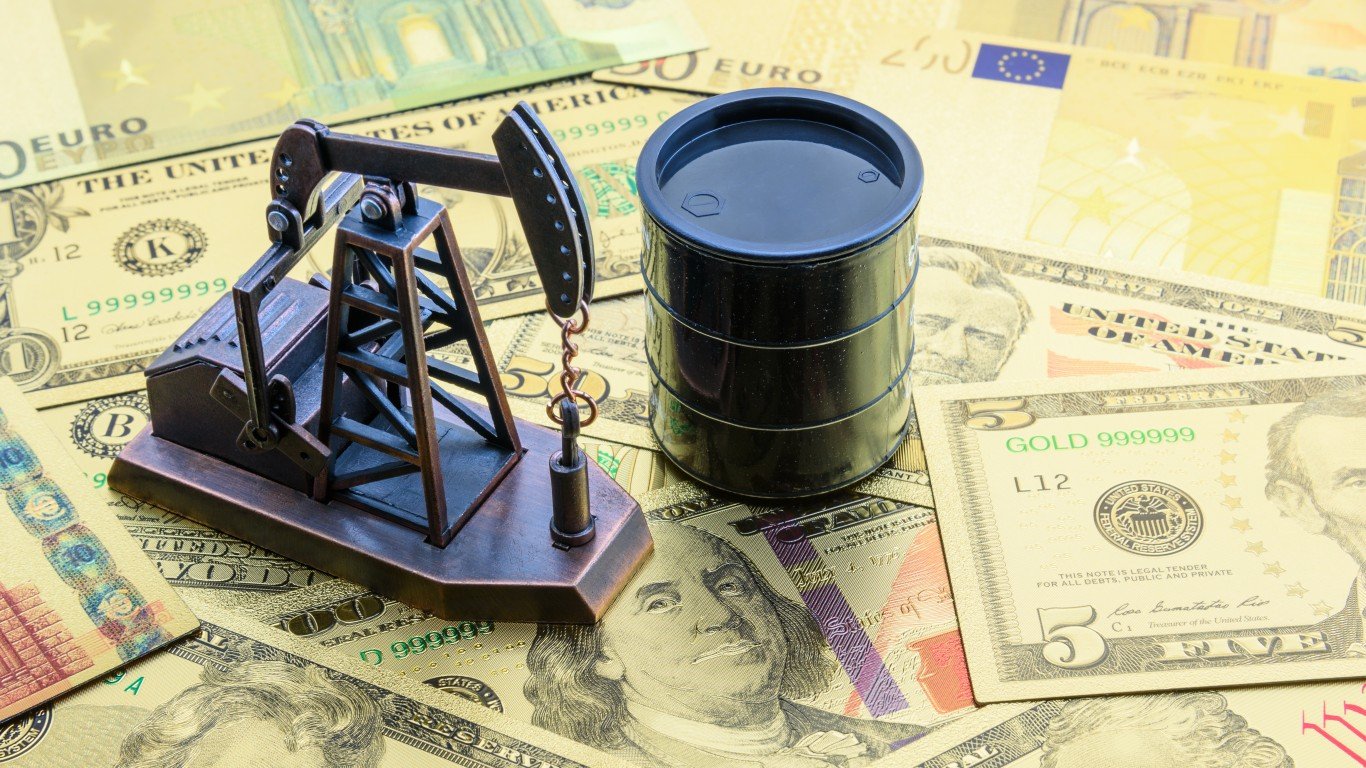
Crude oil is sitting at $116 per barrel right now, and for the energy sector, that number carries significant weight. The last time Brent crude touched this level was March 2022, when it hit $117.25 in the wake of the…


Crude oil is sitting at $116 per barrel right now, and for the energy sector, that number carries significant weight. The last time Brent crude touched this level was March 2022, when it hit $117.25 in the wake of the Russia-Ukraine invasion. Before that, you have to go back to 2011 and 2012 to find comparable prices. This is not normal territory.
To understand what $116 oil means for the majors, you need to know where they were just a few months ago. Chevron’s average Brent crude realization in Q4 2025 was $64 per barrel, down from $75 per barrel a year prior. ConocoPhillips averaged $42.46 per BOE in Q4 2025, a 19% decline year-over-year. These companies built their 2026 plans around a much softer price deck. Now the deck has been reshuffled entirely.
The Baseline Was Already Strong
ExxonMobil (NYSE:XOM | XOM Price Prediction) delivered $82.31 billion in Q4 2025 revenue and record full-year production of 4.7 million barrels of oil equivalent per day, all at prices well below current levels. CEO Darren Woods framed the structural story clearly on the earnings call: “Our transformed company will continue to build on this success in 2026, with higher structural earnings power, stronger mix, lower breakevens, and a portfolio designed to perform across commodity cycles.”
Chevron (NYSE:CVX) CFO Eimear Bonner put a number on the resilience: “Adjusted free cash flow was up over 35% year over year even with oil prices down nearly 15%.” The company also disclosed that its diversified portfolio carries a dividend and capex breakeven below $50 Brent. At $116, that breakeven is a distant memory.
ConocoPhillips (NYSE:COP) actually missed Q4 estimates, with reported EPS of $1.02 against a $1.09 estimate. But investors looked past the backward-looking miss. The stock has climbed 26.01% year-to-date through March 6, essentially in line with Exxon’s 26.52% YTD gain and Chevron’s 25.85%.
What $116 Actually Changes
The operational leverage here is real. Exxon guided for $27 to $29 billion in 2026 capex and a $20 billion share repurchase plan built on conservative price assumptions. Chevron’s 2026 free cash flow guidance from its TCO asset alone assumed $6 billion at $70 Brent. Every dollar above that assumption drops almost entirely to the bottom line. COP has committed to returning 45% of cash flow from operations to shareholders, which means higher oil prices would increase the dollar amount of those distributions based on the formula.
The trio of Exxon, Chevron, and ConocoPhillips entered 2026 having already restructured their cost bases for a lower-price world. They cut costs, locked in production records, and set capital return targets assuming prices well below where crude trades today. At $116 oil, the math gets significantly more favorable across all three. All three companies entered 2026 having restructured their cost bases for a lower-price world, and the year-to-date gains of 26.52% for Exxon, 25.85% for Chevron, and 26.01% for ConocoPhillips reflect how markets have responded to the surge in crude prices.
Contact [email protected] for any questions or corrections.
I write to invest, and I invest to spend more time with nature. Usually all at the same time. I'm a retired equities guy who saw a recession or four, and lives for what comes out of the other side of them.
I cover stocks across the board cause even though I feel like I've seen it all, there's always another way out there to make, and lose money. I want to help you do more of the former, and none of the latter. Making money with friends is my oxygen.
Let's go!