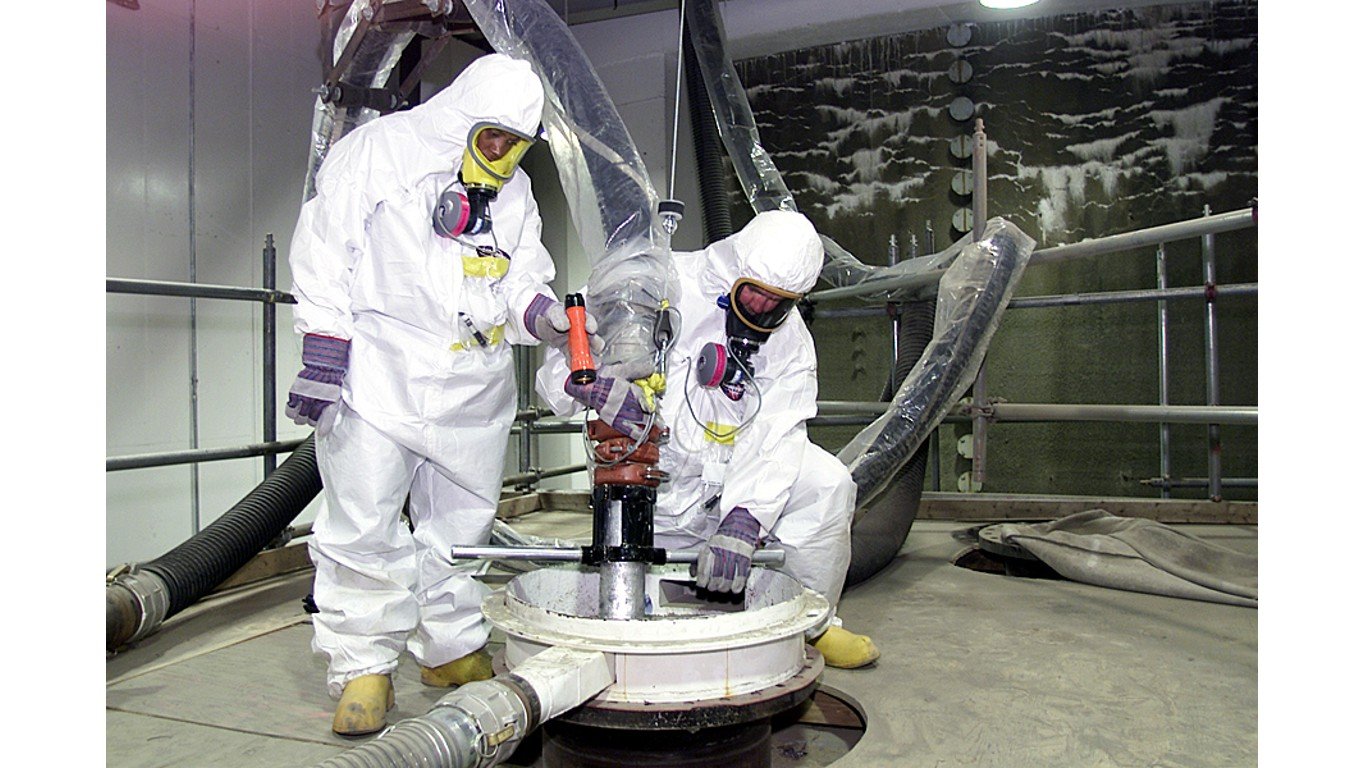
Brookfield Renewable vs. Clean Harbors: Two Clean Economy Plays, One Better Buy
Brookfield Renewable Corp (NYSE:BEPC | BEPC Price Prediction) and Clean Harbors (NYSE:CLH) both wear the “clean economy” label, but they are fundamentally different businesses built for different investor profiles — here is how they compare. Round 1: Yield and Income…

Brookfield Renewable Corp (NYSE:BEPC | BEPC Price Prediction) and Clean Harbors (NYSE:CLH) both wear the “clean economy” label, but they are fundamentally different businesses built for different investor profiles — here is how they compare.
Round 1: Yield and Income
This one is not close. Brookfield Renewable pays a quarterly distribution of $0.392 per unit, annualizing to roughly $1.57. With the stock trading around $39.36, that puts the yield in the neighborhood of 4%, and the company just announced a 5% distribution increase. The next payment hits March 31, 2026.
Clean Harbors pays nothing. Zero. It returns capital through buybacks, repurchasing $250 million in shares during 2025 at an average price of roughly $222. Buybacks have real value, but they do not deposit cash into a retiree’s account every quarter.
Winner: BEPC for income-focused investors, and it is not debatable.
Round 2: Valuation and Financial Health
Here is where Brookfield’s story gets complicated. The company posted a net loss attributable to unitholders of -$19 million for full-year 2025. There is no GAAP P/E ratio because there are no GAAP earnings. The business runs on Funds From Operations, where FFO reached $1.33 billion against a market cap around $7.3 billion. The leverage is real too: $63.4 billion in total liabilities against $98.7 billion in assets.
Clean Harbors is a straightforward profitable business. Full-year 2025 EPS came in at $7.28, and at the current price of $288.83, the trailing P/E sits around 40x. That is not cheap. But the PEG ratio of 0.27 tells you the market is not paying up for stagnant earnings. Shareholders’ equity stands at $2.746 billion with a clean balance sheet and $826 million in cash.
With the 10-year Treasury yielding 4.21% and trending higher, Brookfield’s leveraged infrastructure model faces a real headwind. Higher rates raise its cost of refinancing and compress the premium investors assign to its distribution yield.
Winner: CLH on financial health and valuation clarity.
Round 3: Growth Trajectory
Brookfield’s growth story is genuinely exciting. Distributed energy and storage FFO jumped 90% year-over-year, and the company signed a 3,000 MW Hydro Framework Agreement with Google. Data center power demand is a structural tailwind that could run for a decade.
But Clean Harbors is growing where it matters most for investors who want compounding returns without drama. Free cash flow hit a record $509 million in 2025, up 47.4% year-over-year. The Environmental Services segment delivered its 15th consecutive quarter of adjusted EBITDA margin expansion. CEO Eric Gerstenberg put it directly:
“We topped $6 billion in annual revenues and exceeded $500 million in Adjusted Free Cash Flow for the first time in our history.”
Management guided 2026 adjusted free cash flow of $480 million to $540 million, with PFAS remediation and reshoring manufacturing trends expanding the addressable market. The Kimball incinerator ramp and a $130 million DCI acquisition add incremental capacity without blowing up the balance sheet.
The stock has already rewarded patience: up 538% over the past decade versus roughly 50% for BEPC over the available comparison window.
Winner: CLH on long-term compounding and growth quality.
The Verdict
Brookfield Renewable’s distribution generates quarterly cash income, which some income-focused investors prioritize — though the leverage risk in a rising rate environment is a factor analysts cite, and the renewable energy growth story provides long-term exposure to structural tailwinds.
Clean Harbors, by contrast, generates GAAP profits, expands margins consistently, and compounds free cash flow without depending on rate-sensitive financing. Fifteen straight quarters of margin expansion reflects a business that keeps improving in a growing market — and one that continues to expand its addressable opportunity through PFAS remediation and reshoring trends.
Contact [email protected] for any questions or corrections.
I write to invest, and I invest to spend more time with nature. Usually all at the same time. I'm a retired equities guy who saw a recession or four, and lives for what comes out of the other side of them.
I cover stocks across the board cause even though I feel like I've seen it all, there's always another way out there to make, and lose money. I want to help you do more of the former, and none of the latter. Making money with friends is my oxygen.
Let's go!