





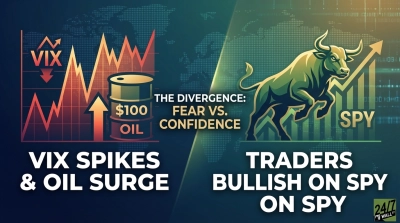
Nasdaq 100 futures slipped 0.98% in Tuesday’s early trading, pulling the index back into negative territory after Monday’s sharp rebound. The retreat reflects a familiar pattern: optimism about Iran peace talks faded after Iranian state media denied that direct negotiations had taken place, reversing the sentiment that had briefly lifted equities. The VIX (the market’s volatility index, which rises when fear increases) remains in elevated territory near 27, signaling investors are not ready to stand down.
The Iran War Is the Dominant Variable Right Now
West Texas Intermediate crude rose 4.26% and Brent jumped above $101 as fighting between Iran and the U.S.-Israeli alliance continued. Higher oil feeds inflation expectations, which pushes Treasury yields higher, and higher yields are particularly punishing for growth stocks. The 10-year Treasury yield spiked 14 basis points in a single session to 4.39% on March 20th, its highest level in months, and has held near that level since. For a Nasdaq loaded with long-duration growth names, that rate environment is a direct headwind.
Amazon Web Services reported its Bahrain region was disrupted due to drone activity, marking the second outage since the Iran war began, prompting major tech companies to reconsider data center expansion plans in the Middle East. The conflict is no longer just a macro backdrop. It is beginning to touch tech infrastructure directly.
Where the Indices Stand After Last Week’s Pressure
The Nasdaq 100, tracked by Invesco QQQ Trust (NASDAQ:QQQ), closed Monday at $588, down 4% year-to-date and off 2% over the past week. The S&P 500, tracked by SPDR S&P 500 ETF Trust (NYSEARCA:SPY), has held up slightly better on a weekly basis but is down nearly 5% over the past month. The Dow, tracked by SPDR Dow Jones ETF (NYSEARCA:DIA), has taken the hardest monthly hit of the three, falling nearly 7% since late February.
Small caps, tracked by iShares Russell 2000 ETF (NYSEARCA:IWM), have been more resilient week-to-week, down less than 1% over the past five days, though they are off 6% over the past month. The relative stability in small caps suggests the selling pressure is concentrated in the large-cap growth names that dominate the Nasdaq.
Tech-Specific Pressure Points
Individual tech names are dealing with company-specific headwinds. One example: JPMorgan cut its price target on Fair Isaac (NYSE:FICO | FICO Price Prediction) from $1,825 to $1,325 on concerns about pricing power erosion and potential regulatory pressure on mortgage credit scoring. The cut reflects growing concern that FICO’s pricing power in mortgage credit scoring may face limits as regulatory scrutiny increases.
What the Fear Gauge Is Telling You
The VIX at almost 27 sits at its 93rd percentile relative to the past 12 months, meaning the market has been this nervous or worse only 7% of the time over the past year. A year ago, the VIX was near 17. The climb reflects a genuine shift in the risk environment. Consumer sentiment reinforces the concern: the University of Michigan’s index sits at 56.4, which is below the 60 threshold historically associated with recessionary conditions.
A domestic router maker surged nearly 20% in overnight trading after the FCC blocked new foreign-made consumer routers on cybersecurity grounds, with overseas manufacturers currently controlling roughly 60% of the U.S. home-router market. That policy-driven catalyst is the exception today, not the rule., with overseas manufacturers currently controlling roughly 60% of the U.S. home-router market. That policy-driven catalyst is the exception today, not the rule.
The Oil-Yield-Tech Chain and What Could Break It
The critical variable remains the Iran conflict. Ceasefire signals have historically reversed oil-driven yield spikes quickly, as seen in prior Middle East escalation cycles. Absent that, if the 10-year yield holds near 4.39% or pushes higher, that level has consistently triggered tech selling in recent weeks. The NYSE also announced a partnership with Securitize to build a 24/7 tokenized securities trading platform, a structural story that will matter more once macro volatility settles.
Contact [email protected] for any questions or corrections.














 Top Gaining Stocks
 Top Losing Stocks