




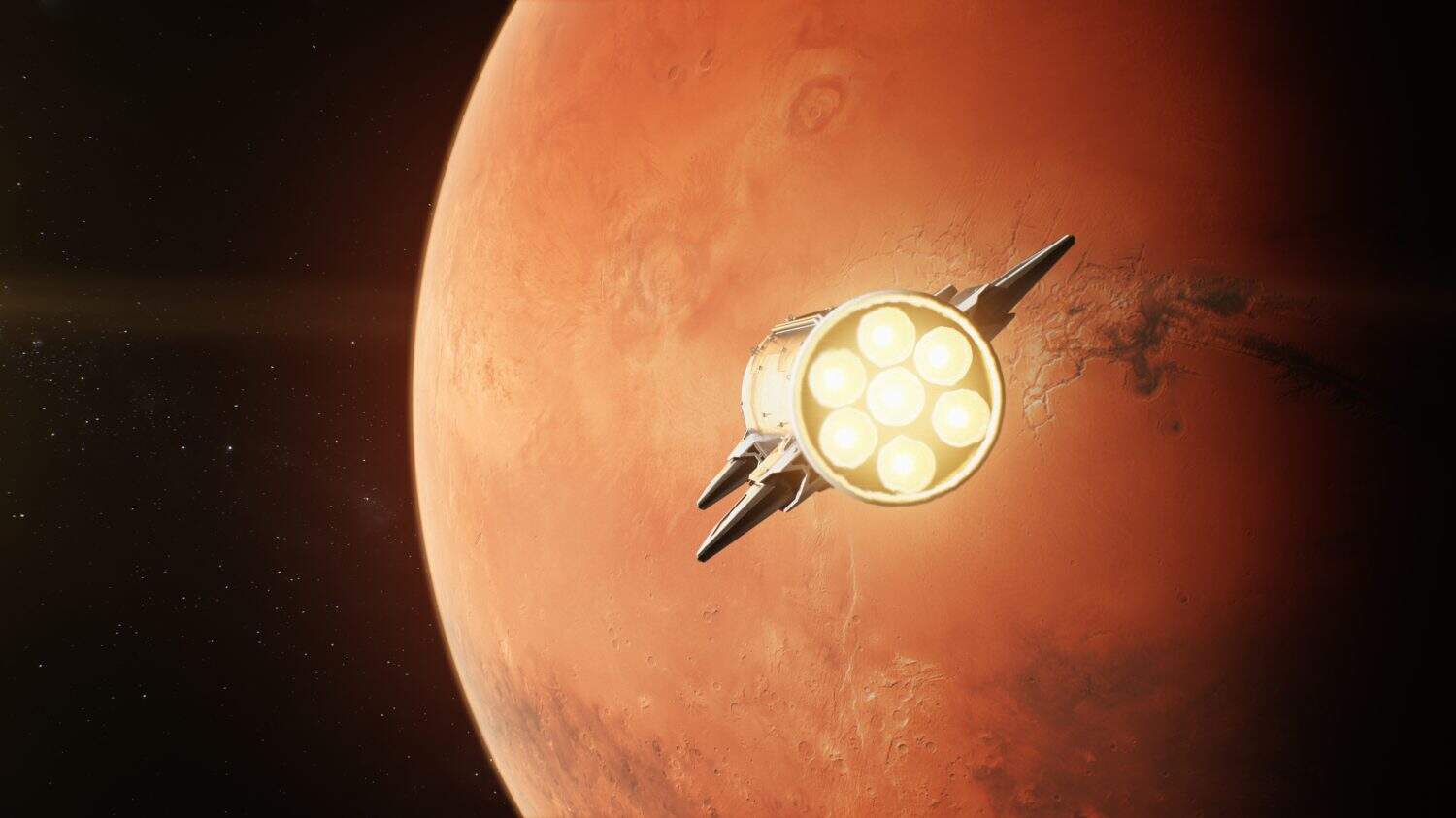
Mars exploration is heating up. NASA eyes sample returns and crewed landings by the 2030s, but its current relay satellites — some decades past design life — struggle with data traffic from rovers, orbiters and future habitats. The Mars Telecommunications Network (MTN) is a $700 million dedicated communications backbone that delivers continuous relay, positioning, navigation and timing services through 2035.
Space stocks have rallied on the theme, yet it’s unclear if smaller players can compete with the giants. Rocket Lab (NASDAQ:RKLB | RKLB Price Prediction) has earned a foot in the door via a NASA study contract. Landing the full MTN award could shift the company from launch specialist to deep-space infrastructure powerhouse — with real revenue upside.
The Mars Telecom Opportunity
In February, NASA’s Goddard Space Flight Center awarded Rocket Lab a $390,936 firm-fixed-price contract for “Mars End-to-End Communication Service Architectures.” The work advances end-to-end solutions for Mars exploration while spotting performance needs and commercial service gaps. While a small amount, Rocket Lab was the sole awardee; no other recipients appear in federal records or subsequent announcements.
That modest study feeds the larger MTN prize. Funded by 2025 legislation and carrying a tight 2028 launch deadline, the program now sits at the draft RFP stage. The winner builds, launches, and operates the network to support Mars Sample Return, surface assets, and human missions.
Rocket Lab proposed its Mars Telecommunications Orbiter, a laser communication satellite in aerosynchronous orbit, designed to ease pressure on existing relays. In a recent company video, one executive stressed the firm’s edge: “Rocket Lab really is the only company that can meet this ambitious timeline,” citing its twin ESCAPADE spacecraft now operating at Mars. That mission, built for NASA, proves the company can deliver planetary orbiters on budget and schedule.
Securing MTN would lock in roughly $700 million in development and operations revenue while opening recurring service fees — a shift from one-off launches to infrastructure cash flows.
Rocket Lab’s NASA and Government Momentum
This Mars play builds on an already robust government book. Rocket Lab supplied the twin ESCAPADE orbiters for NASA plasma studies at the Red Planet, with the spacecraft now in science operations. It also provided solar cells for the just-launched Artemis II mission’s Orion spacecraft that carries the astronauts. Earlier NASA wins include the Aspera astrophysics mission, which is scheduled to launch in early 2026. Those contracts underscore vertical integration: Rocket Lab designs, builds, and operates its own Photon spacecraft bus.
Defense work, though, supplies the real ballast. The company holds an $816 million prime contract from the Space Development Agency for 18 missile-warning satellites, part of a broader defense backlog exceeding $1.3 billion when combined with prior Tranche 2 awards. That helped drive the total contracted backlog to over $2 billion. Space systems now account for 74% of backlog, a higher-margin segment than pure launch services.
Commercially, Electron rockets maintain a steady launch cadence for small payloads, while the medium-lift Neutron vehicle targets its first flight in Q4. It is clear government stability funds the commercial ramp.
On the Launch Pad
The numbers paint a growth story with clear guardrails. Last year, revenue reached $602 million, up 38% from 2024, while Q4 alone delivered $180 million — a 36% rise. GAAP gross margins hit 38% in the quarter, driven by space-systems mix. The company guided Q1 revenue at $185 million to $200 million, implying 57% growth at the midpoint. Trailing 12-month net losses stand at $198 million as investments in Neutron and expansion continue.
Peer comparisons also favor Rocket Lab. Pure-plays like Intuitive Machines (NASDAQ:LUNR) has revenue of $210 million and backlog less than half of Rocket Lab’s. Naturally, larger primes such as Lockheed Martin (NYSE:LMT) dwarf the company in absolute dollars but post single-digit growth in civil-space segments. Rocket Lab’s revenue expansion and backlog surge outpace the category average.
Granted, risks remain plain. MTN competitors include SpaceX, Blue Origin, and Northrop Grumman (NYSE:NOC), and the February study award from the same Goddard office managing MTN could invite protests. Moreover, Neutron’s tank-test failure in January delayed its first flight yet again, and ongoing losses mean dilution risk remains. Yet Rocket Lab’s backlog already funds a 37% conversion rate in the next 12 months — roughly $685 million is locked in for 2026.
Key Takeaway
In short, an MTN win would layer $700 million-plus in high-margin work atop Rocket Lab’s existing momentum, accelerating its shift to profitable infrastructure provider while validating its Mars credentials. With strong revenue and backlog growth, and proven ESCAPADE delivery, the company is in a stronger position than many space peers.
The award decision is due later this year. For investors wanting space exposure without pure speculation, Rocket Lab is worth buying. The data says its trajectory is rising, and execution will decide how far it climbs.














 Top Gaining Stocks
 Top Losing Stocks