Falling Stock Price, Rising Dividend: UnitedHealth Fits the Dogs of the Dow Profile
The Dogs of the Dow is one of the oldest contrarian income strategies in investing. Each January, you identify the 10 highest-yielding components of the Dow Jones Industrial Average at year-end, hold them for one year, then rebalance. The logic…

This post may contain links from our sponsors and affiliates, and Flywheel Publishing may receive compensation for actions taken through them.

The Dogs of the Dow is one of the oldest contrarian income strategies in investing. Each January, you identify the 10 highest-yielding components of the Dow Jones Industrial Average at year-end, hold them for one year, then rebalance. The logic is straightforward: a high dividend yield on a blue-chip stock typically signals a price decline, not a dividend cut. When the price falls far enough, the yield rises, and the stock becomes a candidate for mean reversion.
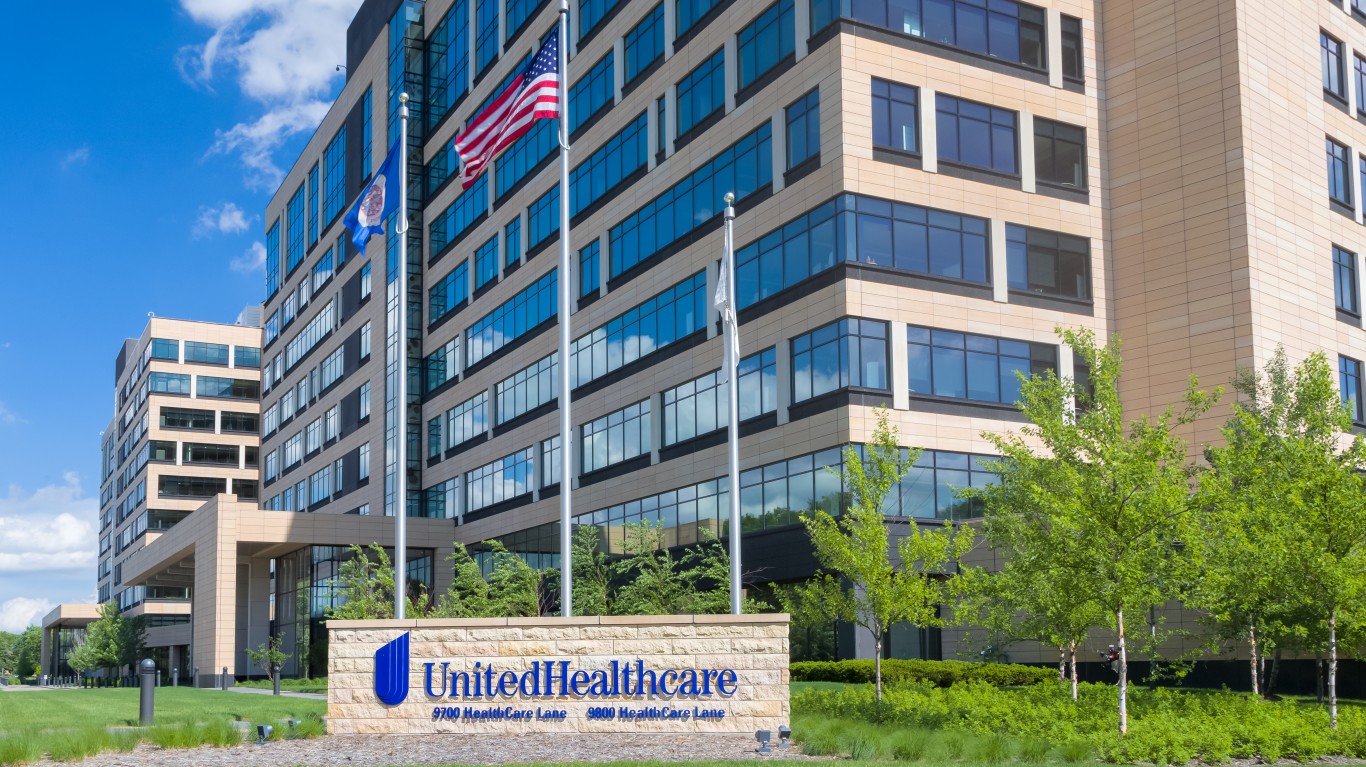
UnitedHealth (NYSE: UNH | UNH Price Prediction) fits that profile almost perfectly right now.

How Beaten Down Is UnitedHealth?
The stock has fallen 46.5% over the past year, sliding from a 52-week high of $594.81 to a current price of $314.19. It is also down 4.8% year-to-date, managing to keep itself above the 52-week low of $234.60 along the way. For a company generating $447.567 billion in trailing revenue, such a steep price drop is exactly the kind of signal the Dogs strategy looks for.
The quarterly dividend currently stands at $2.21 per share, paid most recently on March 17, 2026. That annualizes to $8.84 per share, producing a dividend yield of approximately 2.8% at current prices. UnitedHealth has grown that dividend from $1.25 quarterly in 2020. The company expects to pay approximately $8.0 billion in dividends in 2026, alongside $2.5 billion in share repurchases.
The Turnaround Case

CEO Stephen Hemsley, who returned to lead the company after Andrew Witty resigned, has been direct about the path forward. “We confronted challenges directly and finished 2025 as a much stronger company, giving us the momentum to better serve those who count on us and continue to improve our core performance,” he said after Q4 results.
The 2026 guidance supports that framing. UnitedHealth targets adjusted earnings per share (EPS) above $17.75 for 2026, compared to $16.35 adjusted EPS in fiscal 2025. Operating earnings are targeted at above $24 billion, and cash flows from operations are guided above $18 billion.
Wall Street largely agrees with the recovery narrative, as 23 analysts rate the shares a Buy, five a Hold, and one a Sell, with a consensus price target of $360.96. Insider activity reinforces the thesis: 10 board directors simultaneously acquired shares on April 1, 2026, and the CFO, CEO of Optum, and CEO of UnitedHealthcare all bought shares on March 17, 2026.
Key Risks to Watch
The medical care ratio reached 88.9% in 2025, up sharply from prior years, and 2026 guidance calls for only modest improvement to 88.8% (plus or minus 50 basis points). UnitedHealthcare membership is expected to contract to 46.9 million to 47.5 million in 2026, down from 49.8 million. Justice Department legal actions related to Medicare programs remain an overhang, and quarterly earnings declined significantly year-over-year in 2025.
A Polymarket prediction market gives the stock a 57.5% probability of beating its upcoming quarterly earnings, expiring April 21, 2026. That probability offers a modest edge for the near term.
For investors who believe in the Dogs framework, UnitedHealth checks the boxes: a proven Dow component, a growing dividend backed by substantial cash flow, a management team actively buying its own stock, and a recovery trajectory that 2026 guidance supports. The risk is that near-term headwinds persist longer than the strategy’s one-year horizon assumes.
Contact [email protected] for any questions or corrections.
Trey has been an editor and author at 24/7 Wall St. for more than a decade, where he has published thousands of articles analyzing corporate earnings, dividend stocks, short interest, insider buying, private equity, and market trends. His comprehensive coverage spans the full spectrum of financial markets, from blue-chip stalwarts to emerging growth companies.
Beyond 24/7 Wall St., Trey has created and edited financial content for Benzinga and AOL's BloggingStocks, contributing additional hundreds of articles to the investment community.
Trey's editorial expertise extends across multiple publishing environments. He served as production editor at Dearborn Financial Publishing and development editor at Kaplan, where he helped shape financial education materials. Earlier in his career, he worked as a writer-producer at SVE. His freelance editing portfolio includes work for prestigious clients such as Sage Publications, Rand McNally, the Institute for Supply Management, the American Library Association, Eggplant Literary Productions, and Spiegel.
Outside of financial journalism, Trey writes fiction and has been an active member of the writing community for years, moderating workshop sessions at regional conventions.