Wall Street Sees Recession Risk Fading in 2026, but 2027 Flashing Warning Signs
The economy is sending investors mixed signals again. The stock market continues climbing to fresh highs, corporate profits remain healthy, and the labor market still looks resilient. Yet many Americans walking through the grocery aisle or filling up their gas…

This post may contain links from our sponsors and affiliates, and Flywheel Publishing may receive compensation for actions taken through them.

The economy keeps sending investors contradictory signals. The stock market has climbed to fresh highs, corporate profits remain healthy, and the labor market still looks resilient on paper. Yet many Americans walking through a grocery aisle or filling up their gas tanks would describe an economy that feels far less stable than the headlines suggest. Food prices remain stubbornly elevated, service costs keep rising, and energy markets have turned into a hostage of geopolitics.
So which version of the economy is real: Wall Street’s or Main Street’s?
For 2026, prediction markets are leaning toward cautious optimism. Look further down the road, however, and confidence starts to fracture.
Why Recession Fears Suddenly Collapsed
When this article was first published in May 2026, traders on the prediction market platform Kalshi had just repriced the odds of a U.S. recession in 2026 from roughly 36.9% down to just 17.5%, a collapse in fear that unfolded in barely over a month. That swing traced back to a specific moment in early spring when it looked like the U.S.-Iran conflict might de-escalate and oil prices might stabilize.
Here’s what drove the sentiment shift at that time:
| Economic Indicator | Recent Trend |
| Corporate earnings | Continued beating estimates |
| Unemployment rate | 4.2% as of June 2026 |
| S&P 500 | Reached fresh all-time highs |
| Oil prices | Pulled back from peak war fears |
| U.S.-Iran negotiations | Ceasefire deal, Hormuz Strait reopening |
The biggest swing factor throughout this period has been oil. The Iran conflict has become one of the largest variables hanging over the global economy. Investors understand the transmission mechanism well: a sharp spike in crude prices pushes gasoline higher, lifts shipping costs, narrows airline margins, and drains consumer wallets. Higher oil functions as a stealth tax on every household that drives a car or heats a home.
According to the U.S. Energy Information Administration, every sustained $10 increase in crude oil prices raises gasoline prices by roughly $0.25 per gallon. For households already stretched by food, insurance, and utility bills, that additional pressure arrives quickly.
A deal between the U.S. and Iran to reopen the Strait of Hormuz, through which roughly 20% of global petroleum liquids consumption flows according to the EIA, cooled the worst fears of a prolonged supply disruption. That diplomatic progress drove the initial collapse in recession odds. U.S. airstrikes against Iran resumed in early July, however, briefly reigniting energy market anxiety and pushing consumer sentiment lower before prices stabilized again.
Despite that renewed turbulence, investors have generally remained willing to believe the economy can absorb these shocks, at least through the rest of 2026.
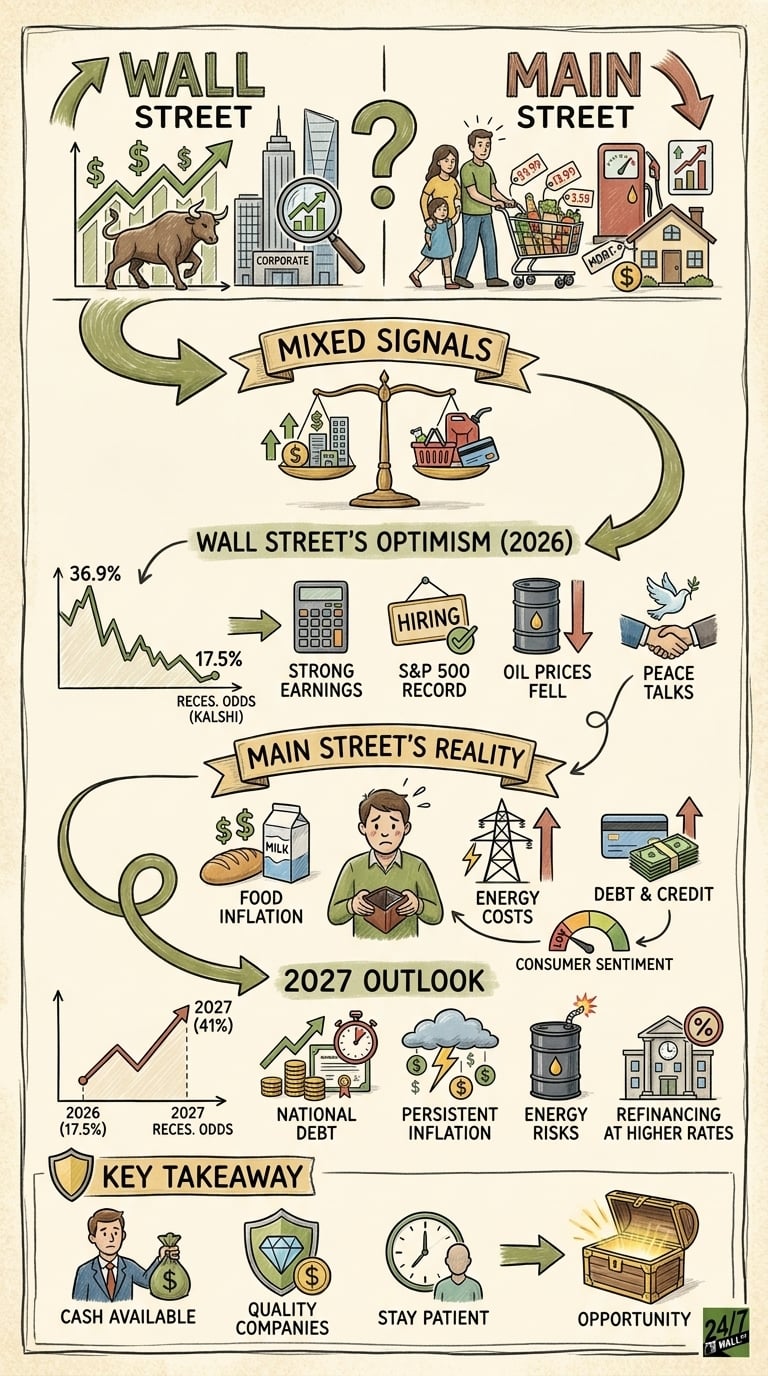 Stocks are soaring, but the grocery aisle tells a different story. Discover why recession fears are elevated for 2027 despite today’s record highs.
Main Street Still Isn’t Buying the Optimism
Consumers remain deeply uneasy, even after a partial recovery in confidence. The University of Michigan’s consumer sentiment index hit an all-time low of 44.8 in May 2026, the worst reading in the survey’s history stretching back to the 1970s. A subsequent rebound, driven largely by falling gasoline prices, lifted the index to 49.5 in June and then to 54.4 in the preliminary July reading. Even at 54.4, though, sentiment sits 12% below where it was a year ago and remains at roughly the 2nd percentile of all historical readings.
Food inflation remains stubborn, and energy costs jumped by double-digit rates year over year earlier in 2026 according to the Bureau of Labor Statistics. Electricity prices continue rising in many states. The 30-year fixed mortgage rate averaged 6.55% as of July 16, 2026 according to Freddie Mac, making homeownership or refinancing difficult for the majority of buyers. The economy is functioning, but it is becoming measurably more expensive to participate in it.
The labor market still provides an important cushion, even as it shows signs of deceleration. The unemployment rate edged down to 4.2% in June 2026, though that improvement partly reflected workers dropping out of the labor force rather than finding jobs. Nonfarm payrolls added just 57,000 positions in June, well below the 115,000 consensus forecast and the weakest monthly gain in four months. Wage growth remains positive after inflation, which keeps spending from collapsing entirely.
Corporate America has also held up better than many economists expected. S&P 500 components posted stronger-than-expected earnings growth this quarter, mega-cap technology companies continue generating billions in free cash flow, and consumer spending, while slower, has not collapsed. Those are not recession-level conditions. But markets are beginning to treat today’s resilience as potentially borrowed time.
Why 2027 Looks Far More Dangerous
When the original article was published, Kalshi traders assigned only a 17.5% chance of recession in 2026 while pricing a 41% probability for 2027. That gap matters. It signals a growing belief that the economy may dodge an immediate downturn only to face a delayed reckoning as structural pressures accumulate.
Several forces are building beneath the surface. Higher federal debt servicing costs, persistent inflation in services, elevated energy risks tied to geopolitics, slowing consumer savings, and corporate refinancing at higher interest rates all pose threats that do not disappear when stock prices rise.
That last item deserves particular attention. Companies that borrowed heavily when rates sat near 0% are now refinancing debt at yields closer to 5% to 7%. The squeeze on margins limits both hiring and capital expansion. Meanwhile, the consumer is leaning harder on credit cards than at any point in recent history. Federal Reserve data from April 2026 showed revolving credit balances at approximately $1.35 trillion, with revolving debt growing at a 10.4% annualized pace, the fastest growth since November 2023. Credit card APRs are averaging around 21%, near historically high levels, meaning that debt is expensive to carry.
None of this guarantees a recession. Many investors last summer believed the economy would already be contracting by now. Instead, the market rallied and growth continued. Prediction markets have also proven volatile: Kalshi’s 2026 recession odds surged as high as 39.2% in late March before collapsing. The lesson is that conditions change fast, in both directions.
Sharp investors understand the practical implication: preparation matters more than prediction.
Key Takeaway
Markets currently believe the U.S. economy can withstand the pressures bearing down on it in 2026. Strong earnings, resilient hiring, and a diplomatic framework aimed at reopening the Strait of Hormuz have helped calm the worst fears from earlier this year.
But 2027 remains a different conversation. The 41% recession odds Kalshi traders priced in for that year suggest a meaningful belief that the cracks forming today will widen over time. Rising debt costs, elevated living expenses, and an ongoing geopolitical oil risk are not going away quickly.
In the end, investors who focus on quality companies with durable free cash flow, maintain some dry powder for volatility, and resist panic during turbulent stretches tend to navigate uncertain cycles better than those who try to pinpoint the exact moment trouble arrives. Whether a recession materializes in 2026, 2027, or not at all, attractive entry points for patient capital tend to appear well before the broader public acknowledges a problem.
Editor’s note: This update refreshes the unemployment rate to 4.2% (BLS, June 2026) from the original 4.3%, updates the 30-year fixed mortgage rate to 6.55% (Freddie Mac, July 16, 2026) from the earlier 6.35%, upgrades the revolving credit balance to approximately $1.35 trillion based on Federal Reserve April 2026 G.19 data, adds context on the University of Michigan consumer sentiment recovery to 54.4 in July after May’s all-time low of 44.8, and notes the resumption of U.S. strikes against Iran in early July and the subsequent U.S.-Iran Hormuz Strait deal.
Contact [email protected] for any questions or corrections.
After two decades of patrolling the dark corners of suburbia as a police officer, Rich Duprey hung up his badge and gun to begin writing full time about stocks and investing. For the past 20 years, he’s been cruising the markets looking for companies to lock up as long-term holdings in a portfolio while writing extensively on the broad sectors of consumer goods, technology, and industrials. Because his experience isn’t from the typical financial analyst track, Rich is able to break down complex topics into understandable and useful action points for the average investor. His writings have appeared on The Motley Fool, InvestorPlace, Yahoo! Finance, Money Morning, and, of course, 24/7 Wall St. He has been featured in both U.S. and international publications, including MarketWatch, Financial Times, Forbes, Fast Company, and USA Today.