Chevron at $196, ExxonMobil at $160: Buy, Sell or Hold?
At $160.49, ExxonMobil (NYSE:XOM | XOM Price Prediction) is a buy and at $196.12, Chevron (NYSE:CVX) is a hold. The two integrated majors have both ripped higher in 2026 on stronger production, capital discipline, and renewed energy demand, yet their…

This post may contain links from our sponsors and affiliates, and Flywheel Publishing may receive compensation for actions taken through them.

At $160.49, ExxonMobil (NYSE:XOM | XOM Price Prediction) is a buy and at $196.12, Chevron (NYSE:CVX) is a hold. The two integrated majors have both ripped higher in 2026 on stronger production, capital discipline, and renewed energy demand, yet their setups now diverge sharply on valuation and earnings power.
Both companies span exploration, refining, chemicals, and increasingly low-carbon ventures. Exxon leans on its 4.6 million oil-equivalent barrel per day production base, with Permian and Guyana now 59% of output. Chevron just absorbed Hess, lifting Q1 production 15% YoY to 3,858 MBOED and adding Guyana exposure of its own.
Why The Bull Case Is Loudest On Exxon
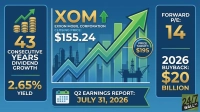
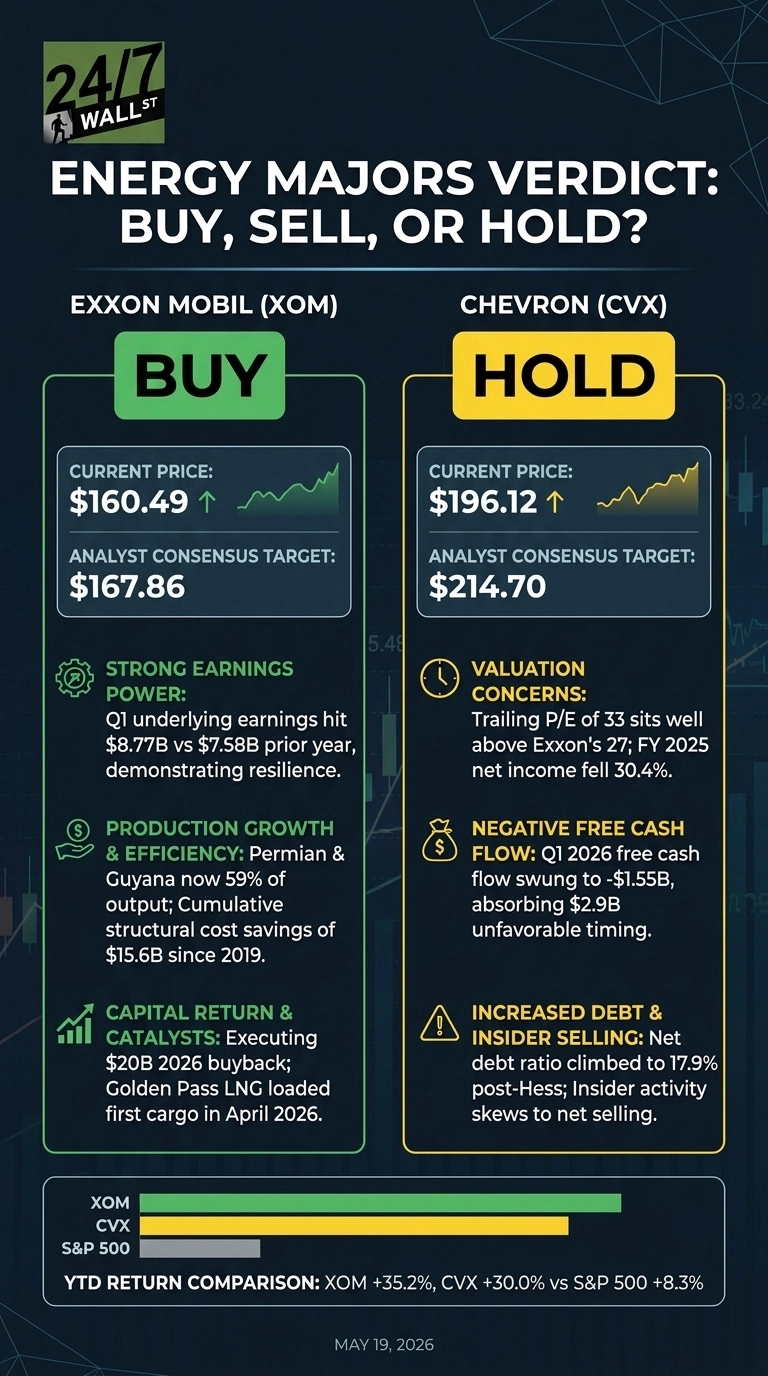
Exxon trades at a trailing P/E of 27 and a forward P/E near 14, with 11% ROE and a fortress balance sheet (net debt/EBITDA 0.55). Q1 underlying earnings hit $8.77 billion versus $7.58 billion a year earlier, and management is executing a $20 billion 2026 buyback. Golden Pass LNG just loaded its first cargo in April 2026, and 10 of 10 key 2025 projects were delivered, adding roughly $3 billion in earnings power.
Chevron’s bull case rests on Hess synergies, a $3 to $4 billion structural cost target by end-2026, and a 3.26% dividend yield backed by 39 consecutive annual increases. CEO Mike Wirth pointed to “record crude throughput in March” and disciplined capital allocation.
Where The Bears Have A Point
Chevron’s trailing P/E of 33 sits well above Exxon’s, even as FY 2025 net income fell 30.4% and Q1 2026 free cash flow swung to -$1.55 billion. Net debt ratio has climbed to 17.9% post-Hess, and Q1 absorbed $2.9 billion in unfavorable timing plus a $360 million legal reserve. Insider activity skews to net selling.
Exxon’s bears flag a Q1 effective tax rate of 40%, $706 million in Middle East supply losses, and weaker chemical margins. Crude price softness remains the swing variable for both.
The Patience Argument
Chevron earns the hold call because the business is improving but the multiple already prices in Hess synergies that will take quarters to validate. A clean quarter showing positive free cash flow, lower derivative noise, and visible cost takeout would tip the verdict toward buy. Persistent Brent weakness below $70 would tip it the other way.

What The Numbers Show
Exxon currently trades at $160.49 against an analyst target of $167.86, implied upside of roughly 4.6%, with 4 Strong Buy, 7 Buy, 13 Hold, and 1 Sell ratings. Chevron trades at $196.12 versus a $214.70 target, about 9.5% upside, with 5 Strong Buy, 13 Buy, 6 Hold, and 1 Sell. Targets are directional signals only.
Year to date, XOM has returned 35.2% and CVX 30%, versus 8.3% for the S&P 500. Exxon yields 2.63% at a forward P/E of 14; Chevron yields 3.26% at a forward P/E of 14.
The Verdict On Both Majors
At $160, ExxonMobil is a buy. The underlying earnings line of $8.77 billion shows the franchise compounding through derivative noise and geopolitical drag. Advantaged barrels from Permian and Guyana, plus the Golden Pass LNG ramp, give a multi-year volume tailwind that pairs with $15.6 billion in cumulative structural savings and a $20 billion buyback. A sustained Brent collapse or further chemical margin erosion would force a reassessment.
At $196, Chevron is a hold. Hess is reshaping the production profile, but trailing earnings have not yet caught up to the multiple, FCF turned negative in Q1, and the dividend, while elite, does not compensate for paying 33 times trailing earnings at cycle-sensitive peers. Watch FCF recovery, Brent direction, and synergy realization quarter by quarter.
Exxon offers the cleaner risk-reward today, while Chevron rewards patient ownership at a better entry.

Contact [email protected] for any questions or corrections.
Vandita Jadeja is a financial publisher with over a decade of experience writing about financial topics, including investment, savings, retirement, insurance and banking. Vandita is a Chartered Accountant who loves to debunk financial concepts for readers.
Her work has appeared on sites that include The Motley Fool, InvestorPlace, and Benzinga. She covers investing and focuses on stock picks and price prediction for 24/7 Wall St.
When not looking for the next stock investment opportunity, she can be found traveling, reading, chasing sunsets and enjoying her iced latte.