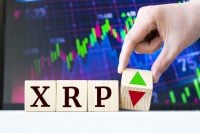
Could a $500 XRP Investment in 2026 Be Worth $50,000 by 2030?
XRP (CRYPTO: XRP) remains well below its all-time high of $3.84, but that has not stopped speculation from returning. As the token steadies around $1.34, investors are asking a bigger question: could a small $500 investment in XRP today realistically…

This post may contain links from our sponsors and affiliates, and Flywheel Publishing may receive compensation for actions taken through them.
XRP (CRYPTO: XRP) remains well below its all-time high of $3.84, but that has not stopped speculation from returning. As the token steadies around $1.34, investors are asking a bigger question: could a small $500 investment in XRP today realistically grow into $50,000 by 2030?
At today’s price, $500 would buy roughly 373 XRP tokens. For that position to reach $50,000 by 2030, XRP would need to deliver a 100x return, which is a stretch for a mature large-cap asset, though not impossible in crypto.
What History Says About XRP Rallying 100x

XRP’s history shows that a 100x move is not impossible. In 2017, XRP was trading around $0.0064, making it one of the cheapest coins in the market. By the end of that year, it had climbed to $2.30, which was a 383x gain in a single calendar year. A $500 investment at $0.0064 would have ended the year worth roughly $180,000.
The biggest move came in Q2 2017, when XRP surged 1,159% quarter-over-quarter. After that, XRP retraced 24.9% in Q3 before rallying another 887% in Q4. The Q3 pullback shook out many holders before XRP’s biggest single-quarter gain of the year.
While that performance proves XRP is capable of extraordinary returns, its more recent history suggests a repeat of 2017 is unlikely. From 2021 through 2025, XRP generated compounded gains of about 8.29x, or roughly 729%, turning a $500 investment into roughly $4,145 by the end of 2025.
Regulatory developments have driven XRP’s biggest rallies and sharpest declines since 2020, and regulation will likely shape the coin’s 2030 outlook the same way.
What Price Does XRP Need to Reach to 100x by 2030?
XRP would need to reach approximately $134 per coin by 2030 for a $500 position (about 373 XRP tokens) to grow into $50,000. That would represent a 100x return from current levels, placing XRP 34.9x above its previous all-time high of $3.84 and 379% above Standard Chartered’s $28 projection for 2030.
While XRP has delivered explosive gains before, especially in 2017, those moves came from a much smaller valuation base. XRP is now one of the largest cryptocurrencies in the market, making another 100x move significantly harder to achieve.
At the current price of $1.34, XRP’s market cap is roughly $83 billion, and a 100x growth would push its valuation to about $8.3 trillion. For context, that would make XRP worth more than any publicly traded company today and more than three times the total crypto market cap, which currently stands at $2.56 trillion.
To justify that level, XRP would need to become a dominant player in institutional settlement, cross-border payments, and tokenized real-world assets. Even with full institutional adoption, the capital inflow required to push XRP to $8.3 trillion in market cap makes a 100x move within normal market cycles extremely unlikely.
The CLARITY Act Could Be XRP’s Most Important 2026 Catalyst

A 100x move is unlikely, but the CLARITY Act could still improve XRP’s momentum in the meantime. The bill has been XRP’s most important catalyst in 2026 because it would permanently codify XRP’s classification as a digital commodity into federal law.
When the Senate Banking Committee advanced the bill with a bipartisan 15-9 vote on May 14, XRP rallied from $1.42 to $1.52 before profit-taking pulled it back.
A full Senate vote in June or July would likely trigger a stronger rally that could push XRP above $2. A House vote and presidential signature soon after could push XRP toward its $3.65 cycle high. If this happens before the end of Q3, XRP would enter Q4 with one of its strongest catalysts of the year, setting up a longer-term move toward $134.
Why $50,000 Is a Stretch, But XRP Still Has Solid Upside Potential
Turning $500 into $50,000 requires XRP to hit $134, a move that has happened in crypto before but is not realistic within four years given today’s market cap. XRP is now a mature large-cap, which is what made its 383x gain in 2017 a one-off rather than a repeatable pattern. Most XRP price targets for 2030 are well below $134, including Standard Chartered’s $28 projection.
That does not mean XRP is a poor option for a small position. Even at lower return multiples, the upside still matters for buyers. A 10x return would turn $500 into $5,000, and a 25x gain would push it to $12,500. Both fall short of the $50,000 target but could still deliver strong returns from a $1.34 entry price.
Anyone looking at XRP today should treat the 100x scenario as a long shot rather than the default expectation. The real catalysts behind XRP through 2026, the CLARITY Act, ETF inflows, and growing institutional adoption, can support a few hundred percent of upside over several years, which is meaningful but very different from turning $500 into $50,000 in four.
Contact [email protected] for any questions or corrections.
Sam Daodu is a crypto analyst and the editor of 24/7 Wall St.'s Crypto Desk, where he covers Bitcoin, XRP, Ethereum, Solana and the altcoins investors search for most. His work focuses on price levels, spot ETF flows, on-chain data and the regulatory decisions that move crypto markets, written so a first-time buyer and a seasoned trader can both use it.
Sam has written about crypto professionally since 2019 and has published more than 2,000 articles. Before joining 24/7 Wall St., he wrote for crypto media outlets and Web3 companies and ghostwrote for crypto founders and token launches. His analysis is syndicated on Yahoo Finance, MSN and AOL and has been cited by other crypto news sites. He also founded MacLabs Marketing, a content and personal branding agency for crypto founders and executives.
When he isn't reading charts, Sam is usually at the gym or watching One Piece, a series he maintains has better tokenomics than most altcoins.