




A share of Amplify Commodity Trust (NYSEARCA:BWET), the fund most people know as the Breakwave Tanker Shipping ETF, cost $10.55 on May 29, 2025. Twelve months later it closed at $158.86, a roughly 1,406% one-year gain that, for a brief window in mid-May, looked even larger before the fund gave back roughly 9% in a single week. If you put $10,000 in on that day in 2025 and walked away, you came back to roughly fifteen times your money in a non-leveraged ETF that most brokerages will let you buy with a single click. That kind of number shows up only when something specific breaks.
The arithmetic, on a price-only basis
BWET is a futures-based commodity fund with a 3.5% expense ratio, and it does not pay a meaningful distribution, so the headline percentage and the total-return figure track each other closely. The cleanest framing is share-price to share-price. Year-to-date through May 29, 2026, the fund went from $19.26 on December 31, 2025 to $158.86, a roughly 725% move in five months. Across the wider news cycle the YTD figure has been quoted at 243% in early March, 450% by late March, 620% by early April, and 860% on May 19, which gives you a sense of how fast the slope steepened and how recent the giveback is. A starting stake of $10,000 on the first trading day of 2026 was, at the May 19 peak near $173.78, worth something on the order of nine times that. Today it is worth a bit less than that, but not by much.
The reason the math is so loud is that BWET is small, illiquid, and structurally narrow. It rebalances annually into 90% Very Large Crude Carrier (VLCC) freight futures and 10% Suezmax contracts, and those contracts moved a long way in a short time. The market it tracks did the work.
What actually did the work
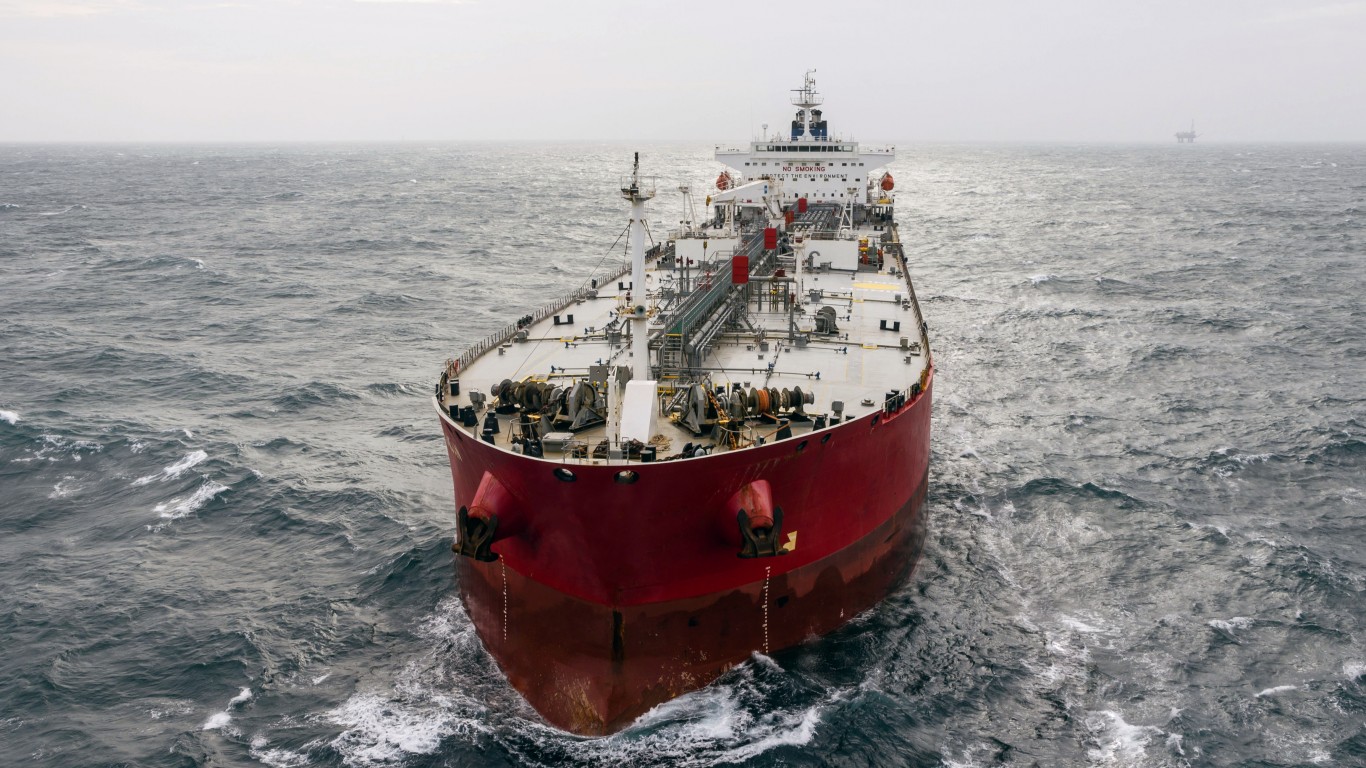
One sentence covers it. The Strait of Hormuz was effectively closed in February 2026 as the US-Iran conflict escalated, and crude oil tanker freight rates went vertical because tankers suddenly had to take longer routes to deliver the same barrels, which tightens VLCC supply, which prices in instantly to the near-dated freight futures BWET holds.
That is the whole mechanism. Geopolitics took a chokepoint offline, ton-miles per barrel jumped, tanker capacity was the binding constraint, and a fund that holds nothing but the right to lock in tomorrow’s tanker day-rate became the best non-leveraged ETF in the world. Bloomberg called it exactly that in early March, when the YTD figure was still hovering near 200%. ETF.com described BWET in early March as the best-performing ETF of 2026, surging 243% year-to-date due to a spike in tanker freight rates following geopolitical conflicts in the Middle East. By the time Mint reported an 860% YTD return on May 19, the underlying freight curve had been compounding on itself for three months without a real correction.
A few features of the fund amplified the move. Annual rebalancing means BWET did not trim winners into the rally, so the VLCC allocation rode the spike with full exposure. The futures it holds are thinly traded, so the marks-to-market on the way up were not absorbed by deep liquidity. And the fund itself is small, with average daily volume around 77,311 shares, which means flows in either direction move the share price more than they would in a larger vehicle.
The pullback, and what it is telling you
The recent week is the first real data point on the other side of the trade. BWET fell from $173.78 on May 22 to $158.86 on May 29, with a roughly 4% drop on the final session alone. The 14-day RSI, which sat at 87.38 on March 2 in deeply overbought territory, has since come back to 47.68, which is neutral with a downward bias. Crude itself sold off in tandem. WTI peaked at $112.25 on May 18 and fell to $97.63 by May 26, a sharp reversal that markets generally read as easing supply-disruption fear.
Short interest tells you who is positioning for the next leg. Short interest rose roughly 142% to 17,938 shares by February 27, 2026, with a days-to-cover ratio of 0.2. That last number matters more than the first. A quarter of a day to cover means short sellers are trading the headline rather than committing structurally. The position can flip in an afternoon.
What would have to be true for this to repeat, or to unwind
The forward look is unusually clean here because there is one variable that drives almost everything. If the Strait of Hormuz stays effectively closed, ton-miles stay elevated, the VLCC fleet stays tight, and BWET’s freight futures stay bid. If the strait reopens or if a credible diplomatic path emerges, the same futures curve that compounded on the way up compounds on the way down, and it does so against a 3.5% expense ratio that quietly eats whatever is left.
The bear case is the more honest one to articulate, because it has already been written down. A 24/7 Wall St. piece in early May noted that BWET’s 1,331% surge rests on a single geopolitical event that could reverse overnight, and that peace talks or a reopening of the strait could cause a rapid reversal, compounded by the fund’s high expense ratio and illiquid underlying contracts. Tradewinds News in mid-December 2025 flagged oil markets pricing in real progress in Ukraine-Russia peace talks, which is a different conflict but a useful reminder that diplomatic optionality is always live and rarely telegraphed.
The bull case worth taking seriously is structural rather than geopolitical. Sahm Capital reported in April that global shipping order books had reached a 17-year high, primarily driven by a boom in the tanker segment, which is a slow-moving variable that does not unwind because of a ceasefire. Some analysts cited by The Business Times argue that gains may partially persist even with peace due to underlying structural tightness in the shipping market. The fleet is old, newbuilds take years, and a normalized strait would still leave the global tanker pool tighter than it was at the start of 2025. Partially is the operative word. A return to anything resembling pre-conflict freight rates implies a share price that starts with a 2 or a 3, not a 1.
The one thing to watch
Forget the RSI and the daily candles. The leading indicator for BWET is the headline status of the Strait of Hormuz, and behind it the Baltic Dirty Tanker Index and the front-month VLCC route quotes published by the Baltic Exchange, which the freight futures price off. When those routes start printing lower fixtures, BWET’s NAV is already moving, and the share price will follow before the news catches up. The fund is a clean expression of one variable, and that variable is currently the most reversible kind of bullish.
The honest read is that the math worked once, for reasons that are still in place this morning and may not be in place by the next news cycle. A fund up roughly 1,406% in a year is not a fund you size like a normal position, and the people who got there from $10.55 are mostly not the ones reading this. The people reading this are deciding what to do with a chart they already missed. The answer is to watch the strait, not the ticker.













 Top Gaining Stocks
 Top Losing Stocks