Three Free Cash Flow and Quality ETFs Quietly Beating Every Other Smart Beta Strategy in 2026
Smart beta had a confusing first half of 2026, as momentum cooled after a strong 2025, low-volatility lagged a market that kept grinding higher, and dividend growth funds got squeezed by another leg up in yields. The strategies that held…

This post may contain links from our sponsors and affiliates, and Flywheel Publishing may receive compensation for actions taken through them.

Smart beta had a confusing first half of 2026, as momentum cooled after a strong 2025, low-volatility lagged a market that kept grinding higher, and dividend growth funds got squeezed by another leg up in yields. The strategies that held their ground share a common screen: companies that generate real cash and earn returns above their cost of capital. That puts three funds at the center of the conversation: the Pacer US Cash Cows 100 ETF (NASDAQ:COWZ), the iShares MSCI USA Quality Factor ETF (NASDAQ:QUAL), and the VanEck Morningstar Wide Moat ETF (NYSEARCA:MOAT).
Each fund expresses the same underlying idea but does so through a different lens. COWZ buys the highest free cash flow yields in the Russell 1000. QUAL screens the U.S. market for high return on equity, stable earnings, and low leverage. MOAT holds an equal-weighted basket of companies that Morningstar analysts believe have durable competitive advantages trading at reasonable prices. Ultimately, you have three different methodologies, and one shared belief: cash and quality outlast narratives.
Why this corner of smart beta is working
The macro setup explains a lot: the Federal Reserve has held its target range at 3.75% since December 11, 2025, and the 10-year Treasury yield is at 4.43%, with a 12-month average of about 4.2% and a percentile rank of 90.8. Borrowing remains expensive, and refinancing risk is real. Businesses that self-fund their growth tend to outperform those that lean on capital markets.
AI capital intensity also matters, as JPMorgan’s 2026 outlook notes that S&P 500 earnings are expected to grow 13% in 2026, with provisions in the One Big Beautiful Bill Act improving free cash flow for R&D and capex-heavy sectors. That tailwind disproportionately benefits companies already producing cash, since they can plow tax savings into reinvestment without dilution.
COWZ: a pure free cash flow yield play
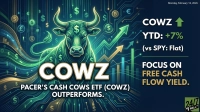
COWZ is the most mechanical of the three, as the fund screens the Russell 1000 for the 100 names with the highest trailing free cash flow yield, then weights them by dollar FCF subject to a cap. The largest positions are Qualcomm, Ford, CVS, and Altria, each carrying roughly a 2% weight, with ConocoPhillips, Pfizer, Gilead, and Uber rounding out the top ten. The top ten combined sit at roughly 22% of net assets, which keeps single-name risk in check.
When rates are elevated, a company that generates a 10% FCF yield can buy back stock, retire debt, or fund capex without going to the bond market. COWZ is up about 9% year-to-date and about 25% over the trailing year, with a five-year gain of roughly 67%. The expense ratio is 0.49%, reasonable for a rules-based factor strategy of this concentration.
The tradeoff is sector tilt, with COWZ skewing heavily toward energy, telecom, healthcare, and consumer staples, where high FCF yields cluster. When energy rolls over, COWZ tends to roll with it.
QUAL: quality at scale
QUAL is the broadest of the three, as it tracks the MSCI USA Sector Neutral Quality Index, which screens for high return on equity, stable year-over-year earnings growth, and low financial leverage. Sector neutrality is the keyword. QUAL holds roughly the same sector weights as the parent U.S. index, so active risk shows up in stock selection rather than sector bets. Information Technology sits at 33%, Financials at 13%, and Consumer Discretionary at 10%.
The portfolio is anchored by mega-cap technology. Apple, Nvidia, and Microsoft anchor the top of the book, with Meta, TJX, Eli Lilly, Visa, Lam Research, KLA, and Mastercard filling out the top ten. The fund manages $47.1 With billion in net assets and a 0.15% expense ratio, one of the lowest in the factor ETF universe.
Performance has tracked the AI-driven cohort it overweights. QUAL is up about 9% year to date, about 23% over one year, and roughly 280% over the past decade. The dividend yield is modest at 0.87%, reflecting the growth tilt rather than an income mandate. The trade-off is concentration in names whose business quality is real but whose valuations carry an AI premium that could be compressed by any cyclical disappointment.
MOAT: the contrarian quality pick
MOAT is the least obvious of the three. The fund tracks the Morningstar Wide Moat Focus Index, which starts with companies that Morningstar’s equity analysts have assigned a wide economic moat rating, then selects the most attractively valued names from that universe and equal-weights them. When a wide-moat name runs up, MOAT rotates out. When one gets cheap, MOAT rotates in.
That methodology is why MOAT is up only about 1% year-to-date, while the S&P 500 is up about 11% over the same stretch. The fund tends to be underweight the leading segment and overweight the out-of-favor segment. Over longer windows, the discipline shows up: about 19% over one year and roughly 259% over ten years.
The tradeoff with MOAT is patience, as it can lag for quarters when the market rewards momentum and concentration. Wide-moat companies bought at reasonable valuations tend to compound through cycles, and the equal-weight rebalance discipline forces selling strength and buying weakness.
Which fund fits which investor
At the end of the day, COWZ suits the investor who wants an explicit cash-flow yield and is comfortable with cyclical sector tilts toward energy, telecom, and pharma. QUAL is the core holding for an investor who wants quality exposure without giving up the AI-driven megacaps that have led the market, and at 0.15%, it competes on cost with broad index funds. MOAT is the contrarian sleeve, useful for investors who want a discipline that systematically leans into discounted quality, accepting that the strategy can trail in years like 2026 when the broad market and small caps, with the Russell 2000 up about 17% year to date, run hot. The three together cover the spectrum from yield to growth quality to value-of-moat.
Contact [email protected] for any questions or corrections.
David Beren has been a Flywheel Publishing contributor since 2022. Writing for 24/7 Wall St. since 2023, David loves to write about topics of all shapes and sizes. As a technology expert, David focuses heavily on consumer electronics brands, automobiles, and general technology. He has previously written for LifeWire, formerly About.com. As a part-time freelance writer, David’s “day job” has been working on and leading social media for multiple Fortune 100 brands. David loves the flexibility of this field and its ability to reach customers exactly where they like to spend their time. Additionally, David previously published his own blog, TmoNews.com, which reached 3 million readers in its first year. In addition to freelance and social media work, David loves to spend time with his family and children and relive the glory days of video game consoles by playing any retro game console he can get his hands on.