Can Wall Street Absorb $3.5 Trillion in New IPOs? SpaceX and Anthropic Could Trigger the Biggest Liquidity Stress Test
The stock market has spent the past two years rewarding one theme above all others: artificial intelligence. Capital has flowed into a relatively small group of companies, pushing the valuations of AI leaders to levels few investors would have imagined…

The stock market has spent the past two years rewarding one theme above all others: artificial intelligence. Capital has flowed into a relatively small group of companies, pushing the valuations of AI leaders to levels few investors would have imagined in 2023. But what happens when two of the world’s most anticipated private companies suddenly become investable at the same time?
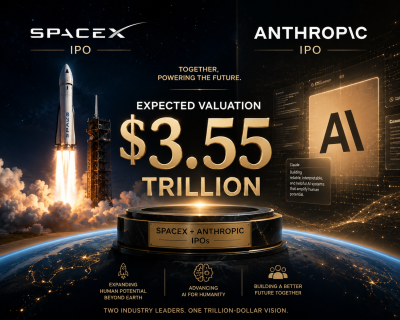
That’s the question facing investors as SpaceX prepares for an IPO scheduled for next week and AI powerhouse Anthropic has confidentially filed to go public. Together, the two companies are expected to command roughly $3.55 trillion in combined market value. That’s larger than the entire economies of several developed countries combined. The real question isn’t whether investors want these stocks. It’s whether the market can absorb that much supply without pulling money from somewhere else.
A $3.5 Trillion Capital Magnet
To put that into perspective, the $3.55 trillion combined market caps would instantly create two of the largest publicly traded companies in the U.S.
According to Anthropic’s confidential filing and private-market funding rounds, investors are already assigning enormous value to its position in generative AI. Meanwhile, SpaceX has become the dominant force in commercial space launch through Falcon 9 and Starship while building a global communications network through Starlink.
Granted, valuation alone doesn’t require $3.55 trillion of new cash. Existing shareholders will retain most shares. Yet index funds, pension funds, ETFs, mutual funds, and institutional investors will still need to establish positions. That creates a powerful demand shock.
Where Does the Money Come From?
Markets don’t operate in a vacuum. Most large investors manage fixed pools of capital. When a must-own company arrives, something else often gets sold.
That creates the possibility that SpaceX and Anthropic become financial black holes, attracting capital that might otherwise flow into existing technology stocks, smaller AI companies, speculative growth names, or even cryptocurrencies.
Consider today’s market structure:
- The AI trade already dominates equity inflows.
- Passive index funds account for a growing share of market activity.
- Mega-cap technology companies have absorbed much of the market’s gains in 2025 and 2026.
Adding two companies worth more than $1.7 trillion each could force major portfolio reallocations. Funds tracking broad indexes would eventually need exposure. Active managers who underweight either company could face performance pressure if the stocks outperform.
In short, capital doesn’t need to leave the market entirely. It simply needs to rotate.
A Liquidity Stress Test for Risk Assets
Surprisingly, crypto markets may be among the most exposed. Many investors currently view cryptocurrencies and high-growth technology stocks as competing destinations for speculative capital. If investors suddenly gain access to publicly traded ownership in SpaceX and Anthropic, some money now parked in crypto could shift toward those opportunities.
That doesn’t mean a collapse is inevitable. Far from it. The U.S. equity market is worth roughly $70 trillion, according to Federal Reserve and exchange data. Daily trading volume regularly exceeds hundreds of billions of dollars. The market has the capacity to absorb large offerings.
That said, concentration risk is already elevated. If investors collectively decide that SpaceX and Anthropic represent the next decade’s defining growth stories, other sectors could experience weaker demand, at least temporarily.
Key Takeaway
The biggest risk from the SpaceX and Anthropic IPOs isn’t that investors won’t buy them. It’s that investors may buy them so aggressively that capital gets pulled from other corners of the market.
A combined valuation approaching $3.55 trillion would create one of the largest liquidity events in market history. Regardless of how you look at it, this will be a real-world stress test of how much concentration today’s markets can handle.
For smart investors, the lesson isn’t to fear these IPOs. It’s to recognize that whenever capital rushes toward one opportunity, another opportunity is often left behind. Those overlooked corners of the market may ultimately become just as interesting as the new arrivals grabbing all the headlines.
Contact [email protected] for any questions or corrections.
After two decades of patrolling the dark corners of suburbia as a police officer, Rich Duprey hung up his badge and gun to begin writing full time about stocks and investing. For the past 20 years, he’s been cruising the markets looking for companies to lock up as long-term holdings in a portfolio while writing extensively on the broad sectors of consumer goods, technology, and industrials. Because his experience isn’t from the typical financial analyst track, Rich is able to break down complex topics into understandable and useful action points for the average investor. His writings have appeared on The Motley Fool, InvestorPlace, Yahoo! Finance, Money Morning, and, of course, 24/7 Wall St. He has been featured in both U.S. and international publications, including MarketWatch, Financial Times, Forbes, Fast Company, and USA Today.