Nvidia’s CEO Sees Marvell Becoming the Next $1 Trillion Company. Shares Gained Another 5% Today.
It’s not every day the most influential CEO in artificial intelligence publicly anoints another semiconductor company as the next trillion-dollar stock. That is what happened when NVIDIA’s Jensen Huang praised Marvell Technology (NASDAQ:MRVL | MRVL Price Prediction) onstage at the…

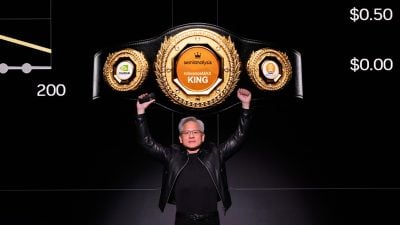
It’s not every day the most influential CEO in artificial intelligence publicly anoints another semiconductor company as the next trillion-dollar stock. That is what happened when NVIDIA’s Jensen Huang praised Marvell Technology (NASDAQ:MRVL | MRVL Price Prediction) onstage at the Computex AI Exhibition in Taiwan. After Huang’s quotes, a CNBC Halftime Report segment dove into what Huang said that sent Marvell shares up 29% in a single session. The endorsement carries weight because NVIDIA (NASDAQ:NVDA) holds a $2 billion investment in Marvell, and the chipmaker explicitly cited a strategic partnership with Marvell via NVLink Fusion and silicon photonics collaboration in its most recent earnings release.
Marvell now carries a market cap of roughly $276 billion, with shares closing at $316.43 today The stock is up 254% year-to-date and 377% over the past year. The path to $1 trillion is still steep, but Wall Street is rapidly recalibrating what Marvell’s normalized earnings could look like.
Why The Stock Exploded
Three drivers stacked on the same day. One CNBC panelist summed up Marvell’s recent quarter: “It was an inline quarter, but the guidance was really substantial.” Marvell reported Q1 FY2027 revenue of $2.42 billion, up 27.6% year over year, and guided Q2 to $2.70 billion, implying roughly 35% YoY growth. CEO Matt Murphy noted in the company’s May 27 release that the company is seeing “exceptional AI-related bookings” across optics, switching, and custom XPU solutions.
The desk also flagged caution. The stock was already up 232% coming into the move, and even owners on the panel questioned whether a 29% one-day reaction was fully justified. Reddit sentiment captured the same ambivalence, swinging from a very bullish 84 right after the announcement to a very bearish 15 by the next evening. It’s worth noting that Marvell has kept growing after that 29% jump. After adding another 4.9% gain today, shares are up 55% across the past week.
The Optical Thesis
Marvell’s optical connectivity business for AI inference is growing 50% to 55%. As AI clusters scale toward a million accelerators per site, moving data between chips and across data centers becomes the bottleneck, and optical interconnect is how that bottleneck breaks. The panelists compared the setup to the memory boom, a component category that went from commodity to critical and saw valuations re-rate sharply.
The comparison extends across the supply chain. Corning (NYSE:GLW), named by NVIDIA alongside Marvell as a silicon photonics partner, is up 299.72% over the past year on similar optical-for-AI momentum.
The Custom ASIC Thesis
Marvell and Broadcom (NASDAQ:AVGO) together hold roughly 80% of the custom ASIC market, the chips hyperscalers design for their own AI workloads. That business is growing 20% now, with the desk expecting it to reach 100% growth by fiscal 2029. Broadcom’s own AI semiconductor revenue hit $10.8 billion in Q2 FY2026, up 143% YoY, with the company guiding $16 billion in AI semiconductor revenue for Q3. Both companies sit on the same secular tailwind.
The Earnings Power Re-Rating

The most striking data point came from one panelist: “This company very likely could do $10 in earnings power. I mean, it was just like a month ago, I thought maybe $5.” Wall Street currently projects Marvell to make $4.05 in adjusted earnings in 2027, before that number skyrockets up to $14.47 in 2030.
When the Street’s view of normalized earnings soars, the justified market cap moves with it. That revision, more than any single guidance number, is the analytical engine behind the trillion-dollar path.
Marvell currently trades at a forward P/E of 72, a multiple that already prices in significant execution. The optical and custom ASIC narratives are credible, NVIDIA’s endorsement is real, and Marvell sits at the center of two of AI’s fastest-growing non-GPU niches. The entry point now carries elevated expectations, the same expectations-reset risk that just hit Broadcom on its June 3 earnings report. Investors should keep an eye on the stock as Marvell heads into its August Q2 report, where the substantial guidance will need to be backed by optimism and more product wins.
Contact [email protected] for any questions or corrections.
Thomas Richmond is a financial writer and content strategist with 5+ years of experience covering stocks and financial markets. He has published over 500 articles focused on individual stock analysis, helping investors better understand business fundamentals, stock valuations, and long-term opportunities.
Thomas previously served as a Content Lead at TIKR, a stock research platform, where he helped scale the company’s blog to hundreds of articles per month and contributed to a weekly newsletter reaching more than 100,000 investors.
Outside of work, Thomas enjoys weight lifting and soccer.