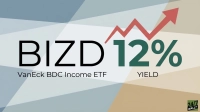
Forget JEPI: Three Business Development Company ETFs Yielding Over 12% From Private Credit Loans
Many retirees who decided to buy the JP Morgan Equity Premium ETF (NYSE: JEPI) were wowed by its 8% yield and JP Morgan pedigree after seeing it advertised on Fox Business News and MS Now. While that’s certainly a…


Many retirees who decided to buy the JP Morgan Equity Premium ETF (NYSE: JEPI) were wowed by its 8% yield and JP Morgan pedigree after seeing it advertised on Fox Business News and MS Now. While that’s certainly a solidly high yield, there are some more adventurous investors who have been receiving double-digit yields with an added tax advantage over JEPI. These investments are Business Development Companies (BDC), and they serve an important role in the financing of small and medium sized corporations across the US.Three examples of ETFs and stocks to consider and research are (quotes based on market price at the time of this writing)::
- VanEck BDC Income ETF (NYSEARCA:BIZD): 13.65%
- Putnam BDC Income ETF (NYSEARCA:PBDC): 11.50%
- Blackstone Secured Lending Fund (NYSE: BXSL | BXSL Price Prediction): 13.07%
Filling the Banking Void

The 2008 subprime mortgage banking meltdown was a full scale financial bloodbath. Venerated firms like Bear, Sterns, Merrill-Lynch, Lehman Brothers, and 2nd tier banks like Wachovia Bank all went under and were swallowed up by larger entities. Small and mid-sized $2-$30 million dollar corporate accounts, which were the bread and butter clients for these firms, were all told post-merger that they were too small and risky for future servicing consideration.
The result was a huge financial hole in the sector that generated the majority of US employment. Small manufacturers, mid-tier service companies, family owned firms, restaurants, and a host of other businesses lost their revolving credit lines, factoring, invoice financing, and interim financing resources overnight. Enter the Business Development Company.
BDCs have been in existence for decades, but were usually considered a niche for companies whose cash flows were too erratic or for those considered too risky for conventional bank consideration. They are categorized as a major segment of the larger Private Credit sector. With this new banking void, BDC’s superior term repayment flexibility, ability to create hybrid financing structures on a reduced scale, and to utilize different levels and forms of debt, even including convertible debt to equity, were a godsend for these businesses and quickly became a financial lifeline to keep a great many of them afloat.
In order to access the capital markets, BDCs register with the SEC under similar governing rules to REITs: 90% of profits have to be remitted back to shareholders.However, only about ⅓ or BDCs are publicly traded. The rest are privately held and avoid the scrutiny and public disclosure requirements of their listed cousins. In the aggregate, the BDC industry has grown tremendously. AUM expansion in the past year was roughly 51%, swelling to $500 billion with a CAGR of 28% since 2020.
VanEck BDC Income ETF (NYSEARCA: BIZD): 13.65% yield
BIZD passively tracks the MVIS US Business Development Companies Index, a market-cap-weighted basket of US-listed BDCs. The majority of BDCs in the BIZD portfolio are financing their clients with Senior Secured Floating-Rate loans, with some variations and hybrids on a case-by-case basis. Payouts are quarterly.
| Net Assets | $1.57 billion | YTD Return | -6.87% |
| Yield | 13.65% | Expense Ratio | 0.42% (9.69%)* |
| Avg. Daily Volume | 4.04 million shares | NAV | $12.68 |
| 52-week range | $11.97- | 1-Year Return | -10.55% |
* BIZD officially lists a 9.69% expense ratio because the SEC treats it as a “fund of funds”, so operating expenses have to be reported, although the actual cost to the investor is 0.42%.
Putnam BDC Income ETF (NYSEARCA: PBDC): 11.50% yield
Unlike BIZD, PBDC is actively managed. It uses the S&P BDC Index and the Russell 3000 Index for its benchmarks, but the portfolio is not tied specifically to either index. PBDC’s portfolio is also dominated by Senior Secure Floating-Rate loans. Payouts are quarterly.
| Net Assets | $275.5 million | YTD Return | -7.50% |
| Yield | 11.50% | Expense Ratio | 0.13% (13.49%)* |
| Avg. Daily Volume | 168,028 shares | NAV | $27.55 |
| 52-week range | $26.22-$35.18 | 1-Year Return | -7.90% |
*PBDC officially lists a 13.49% expense ratio because the SEC treats it as a “fund of funds”, so operating expenses have to be reported, although the actual cost to the investor is 0.13%.
Blackstone Secured Lending Fund (NYSE: BXSL): 13.07% yield
BXSL is a standalone BDC company, rather than an ETF. As such, it lacks the diversification factor, but on the plus side, it doesn’t have an expense ratio. 97% of its lending is in the form of Senior First Lien Secured debt. It has over $13 billion in performing loans on its books.
| Net Assets | $13 billion+ | YTD Return | -7.49% |
| Yield | 13.07% | Expense Ratio | n/a |
| Avg. Daily Volume | 2.53 million shares | NAV | n/a |
| 52-week range | $22.47-$32.81 | 1-Year Return | -16.72% |
Pros and Cons and Choices To Make

BDCs are essentially a debt vehicle with a secondary growth component. JEPI or similar vehicles are equity vehicles with a dividend boost component. Other considerations when making comparison should also factor in the following:
- The entire private debt sector has been compressed due to a prospective interest rate cut, oil prices rising due to the Iran War, and, ironically, the threat of A.I. drastically taking business away from many SaaS companies who comprise a sizable percentage of BDC clientele. While the sector has been absorbing these events, confidence is expected to be restored, since defaults have remained low, despite returns in the red.
- Investments that use options for added yield report those dividends as non-qualified, so they are subject to regular income tax. BDC yields are qualified dividends, which are taxed at the lower capital gains rate.. Depending on one’s tax bracket, the difference can mean that more of the BDC money stays in an investor’s pocket. Income tax can go as high as 37%, while capital gains is capped at 20% for those in the highest bracket.
Essentially, investing in BDCs now is an “income while waiting” scenario until the sector gets back on track, at which point it will be an “income while winning” proposition.
Contact [email protected] for any questions or corrections.
After 15 years on Wall Street with 7 of them as Director of Corporate and Municipal Bond Trading for a NYSE member firm, I started my own project and corporate finance consultancy. Much of the work involves writing business plans, presentations, white papers and marketing materials for companies seeking budgetary allocations for spinoffs and new initiatives or for raising capital for expansion or startup companies and entrepreneurs. On financial topics, I have been published under my own byline at The Motley Fool, 247wallst.com, DealFlow Events’ Healthcare Services Investment Newsletter and The Microcap Newsletter, among others. Additionally, I have done freelance ghostwriting writing and editing for several financial websites, such as Seeking Alpha and Shmoop Financial. I have also written and been published on a variety of other topics from music, audiophile sound and film to musical instrument history, martial arts, and current events. Publications include Copper Magazine, Fidelity (Germany), Blasting News, Inside Kung-Fu, and other periodicals.