Wall Street Slept on This Amazon-Proof Business Model. It’s Now at a 5-Year Discount.
While the market obsesses over every NVIDIA earnings whisper, an unglamorous parts retailer in Memphis has quietly become one of the most interesting contrarian setups of 2026. On a recent Barron’s Streetwise episode, host Jack Hough and D.A. Davidson analyst…

While the market obsesses over every NVIDIA earnings whisper, an unglamorous parts retailer in Memphis has quietly become one of the most interesting contrarian setups of 2026. On a recent Barron’s Streetwise episode, host Jack Hough and D.A. Davidson analyst Michael Baker laid out a thesis that cuts against the current AI mania: AutoZone is “the opposite of what the market is fixated on right now,” and the price tag has finally come down to meet the opportunity.
The “Consult to Sell” Moat Wall Street Keeps Underestimating
The easy short pitch on auto parts retailers was simple: Amazon will eat them. Baker’s response is that the experiment already ran. Amazon pushed aggressively into auto parts back in 2017, and the incumbents kept compounding right through it.
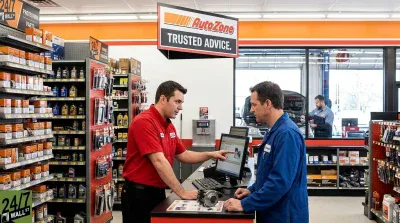
The most damning evidence for the Amazon bear case comes from the retailers’ own pricing. AutoZone (NYSE:AZO | AZO Price Prediction) and its peers offer steep online discounts, typically $20 off a $100 order shipped to your door, yet only 1% to 2% of sales actually happen that way. As Baker put it on the podcast, “Customers are actually paying an extra $20 to go into the store because they need to talk to the associates.”
That is the moat. Baker calls it “consult to sell.” Even experienced DIY mechanics want a human to confirm they are buying the right caliper for a 2014 Silverado. Add in the professional mechanic who needs the part in 30 minutes, and the e-commerce delivery model breaks down. “If they were going to be impacted by Amazon, we would’ve seen it already,” Baker said.
A Five-Year Valuation Discount
AZO is down 16% over the past year and down 8% year to date, while the SPY is up 24% over the same one-year stretch. The forward P/E sits at 18 with a trailing P/E of 21, against an analyst target of $3,937. AutoZone’s forward P/E has fallen to 18, below its five-year average of more than 19, and that compression is happening while earnings estimates have been moving up. Wall Street projects double-digit earnings gains in the fiscal years ahead.
The Business Is Actually Working
In Q3 FY2026, reported May 26, AutoZone delivered diluted EPS of $38.07 against a $36.17 consensus, with revenue of $4.84 billion, up 8.4% year over year. The commercial business serving professional mechanics is the crown jewel: domestic commercial sales hit $1.40 billion, up 10.4%, with average weekly sales per program climbing to $18,500 from $17,700.
CEO Phil Daniele said the company “returned to an operating margin north of 19% for the quarter” while opening 82 new stores globally. The buyback machine kept humming, with $586.3 million repurchased at an average price of $3,582. Cumulative repurchases since 1998 now sit at $38.9 billion, against a current market cap of roughly $51 billion.
Insiders Are Reading the Same Signal
I have been watching AutoZone for years as a textbook example of a financially engineered compounder, and the insider activity got my attention. Director Brian Hannasch bought 165 shares on May 29, 2026 at $2,987, near the 52-week low of $2,928. On March 31, a coordinated group including CEO Phil Daniele, CFO Jamere Jackson, and four other senior executives all acquired shares at $3,377.78.
What to Watch From Here
O’Reilly Automotive (NASDAQ:ORLY) just posted 8.1% comparable store sales growth in Q1 2026 at a $74 billion market cap, so the industry tailwinds are real and AutoZone is trading at a discount to its closest comp.
The Baker and Hough thesis comes down to this: if you believe physical store associates and same-day parts delivery remain irreplaceable for both weekend wrenchers and professional shops, AutoZone is currently being priced as if Amazon will finally win a fight it has been losing for nine years. As Hough said, the hope is “there’s a path where stocks like these can bounce back without chip stocks tumbling.” You do not need an AI thesis to own a parts counter that prints cash.
Contact [email protected] for any questions or corrections.
I've been writing about stocks and personal finance for 20+ years. I believe all great companies are tech companies in the long run, and I invest accordingly.