Forget the 4% Rule: Why Dividend Hunters Are Taking a Massive Gamble on ULTY
The YieldMax Ultra Option Income Strategy ETF (NYSEARCA:ULTY) advertises distributions so generous they make the 4% retirement withdrawal rule look like a punchline. That is precisely the trap. Dividend hunters piling into ULTY are buying a fund whose holdings rotate…

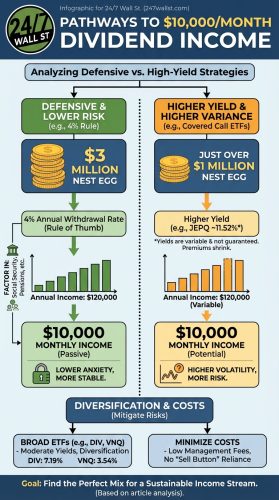
The YieldMax Ultra Option Income Strategy ETF (NYSEARCA:ULTY) advertises distributions so generous they make the 4% retirement withdrawal rule look like a punchline. That is precisely the trap. Dividend hunters piling into ULTY are buying a fund whose holdings rotate constantly across the most volatile corners of the market, and whose total return since inception has trailed the S&P 500 by a margin that should make any retiree reconsider.
What ULTY is actually doing with your money
The fund sells call options against a basket of volatile growth equities and routes the premium income to shareholders as weekly distributions. Technology accounts for roughly 52.5% of the portfolio, and the top holdings skew aggressively speculative. As of mid-July 2026, the fund held positions in names like Fortinet, Robinhood Markets, Lam Research, AMD, and Astera Labs, each representing roughly 4% to 5% of assets.
The return engine has two components. The first is option premium, which is richest precisely because these underlying stocks swing violently. The second is the underlying equity exposure, capped on the upside by the calls ULTY sells. When markets rally sharply, ULTY investors collect their premium and watch the runaway gains flow to whoever bought those calls. When markets fall, the premium cushions the blow only so far before the NAV absorbs the rest.
One development that deserves attention: on December 1, 2025, ULTY executed a 1-for-10 reverse split. Ten shares became one, the share price jumped tenfold overnight, and the chart looked tidier. The account balances of existing holders did not change. That mechanical reset is worth knowing when looking at any pre-split price history.
The performance gap nobody on FinTok mentions
Here is where the 4% rule conversation matters. Wes Moss, on the Clark Howard podcast in January, made the point that dividends should do half to two-thirds of the work of a 4% withdrawal, with appreciation handling the rest. ULTY inverts that ratio entirely. Distributions do essentially all the work, and price appreciation does almost none.
The math on a total-return basis is difficult to ignore. ULTY’s trailing one-year total return is approximately -2.55% even if you reinvested every distribution. Over that same period, the SPDR S&P 500 ETF Trust (NYSEARCA:SPY) delivered roughly 22% including dividends. Since ULTY’s February 28, 2024 inception, the average annual return has been approximately 1.23%. The S&P 500 has compounded at a far higher rate over any comparable window. A retiree drawing 4% from SPY watched principal grow underneath them. A retiree drawing 4% from ULTY collected sizable checks while their capital base stayed flat or shrank.
ULTY also shifted its payment cadence from monthly to weekly distributions in 2026, which keeps the paycheck feel intact but makes it harder to track whether the payout rate is actually holding up. It has not held up uniformly: the weekly per-share distributions have varied significantly with implied volatility in the underlying stocks, shrinking when markets settle and rebounding when they spike.
The tradeoffs
- Expense ratio. ULTY carries a net expense ratio of 1.30% (gross 1.40% before a fee waiver), which is roughly 14 times what you would pay for a plain S&P index fund. For an income strategy that has yet to demonstrate meaningful capital appreciation, that fee is a permanent headwind compounding against you every year.
- Concentration in speculative names. The top holdings are nearly all high-volatility growth stories whose option premiums attract ULTY’s managers in the first place. If the AI capex cycle cools or quantum-computing enthusiasm fades, implied volatility across those names collapses, call premiums shrink, and ULTY’s NAV falls at the same time its distributions shrink.
- Capped upside, uncapped downside. The covered-call overlay means ULTY participates in rallies only up to the strike price of the calls it has sold. Drawdowns receive only partial protection from the premium collected. The asymmetry runs in the wrong direction for a long-term wealth-building vehicle.
Who ULTY actually fits
ULTY makes sense as a narrow income sleeve, perhaps 3% to 5% of a portfolio, for an investor who already accepts that they are trading growth for cash flow and who genuinely needs weekly distributions to cover current spending. That is a specific and limited use case.
Retirees building a conventional 4% withdrawal plan will find the fund’s structure works against them. The classic rule assumes a balanced portfolio whose equity sleeve compounds over time while you spend a portion of the gains. ULTY’s price chart since inception confirms the compounding engine is largely absent. A Schwab US Dividend Equity ETF (NYSEARCA:SCHD) or a straightforward SPY plus bond allocation delivers income growth alongside capital appreciation, which is what the withdrawal math actually requires.
Editor’s note: This article has been updated to reflect ULTY’s trailing one-year total return of approximately -2.55% (revised from 0.05%), the fund’s current technology sector weighting of roughly 52.5% (down from 58%), the December 2025 1-for-10 reverse split, the shift from monthly to weekly distribution payments, and the net expense ratio of 1.30% against a gross expense ratio of 1.40%.
Contact [email protected] for any questions or corrections.
Omor Ibne Ehsan is a writer at 24/7 Wall St. He is a self-taught investor with a focus on growth, cyclical, and dividend equities that have strong fundamentals, value, and long-term potential. He also has an interest in high-risk, high-reward investments such as penny stocks.