A Surprising Way to Get More Yield (And Less Volatility) Than Treasury Bonds
Here is a thesis that flips the bond world on its head: the volatility everyone fears in emerging markets has migrated to developed markets, while the yield premium for owning EM debt has stayed put. That is the case Eric…


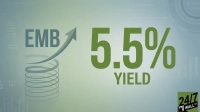
Here is a thesis that flips the bond world on its head: the volatility everyone fears in emerging markets has migrated to developed markets, while the yield premium for owning EM debt has stayed put. That is the case Eric Fine, portfolio manager at VanEck, made on a recent Animal Spirits “Talk Your Book” episode. Fine runs EM bond strategies at VanEck, so the pitch comes with an obvious caveat. The data behind it, though, is worth understanding before you assume your 60/40 portfolio is doing what you think it is.
The Setup: Treasuries Are Not Quite Doing Their Job
Start with the benchmark. The 10-year Treasury yield sits at 4.48% as of June 12, 2026, having traded between 3.97% and 4.67% over the past 12 months. The 2s/10s spread has compressed to 0.40%, down from a 12-month average of 0.555%, leaving investors with a flat curve and roughly 4.07% on the 2-year vs. 4.47% on the 10-year. You take duration risk and get paid little extra for it.
Fine’s opening salvo is aimed straight at that math. The traditional balanced portfolio, he argues, “had the wrong 40. They’re up to their necks in developed market bonds like the Agg and Treasuries, which are generally characterized by governments that have too much debt.”
Pillar One: The Fiscal Flip
Fine’s first pillar is a debt-to-GDP inversion. Many EM sovereigns now run lower debt-to-GDP ratios than their developed-market peers, which scrambles the legacy assumption that EM means weaker balance sheets. Goldman Sachs Asset Management hits a related note in its 2026 outlook, citing continued easing across emerging market economies, supported by a subdued US dollar and lower oil prices. BlackRock is on the same page, going overweight EM hard currency on the back of a weaker dollar, lower U.S. rates, and effective EM fiscal and monetary policy.
Pillar Two: The “Absence of Fiscal Dominance”
The second pillar is political. Fine describes a shift toward central bank independence and budget stability, what he calls the “absence of fiscal dominance.” His point: EM leaders with 60-80% popularity ratings have explicitly promised budget discipline and independent central banks, producing “really healthy politics where you’re just not going to get a lot of these more risky economic ideas infecting EMs.”
He adds an Asia-specific tailwind: central banks are now buying Asian EM bonds, a structural bid that did not exist a decade ago.
The Decade Claim
Fine’s headline performance pitch, attributed entirely to him: the Agg and Treasuries are “basically up zero over the last 10 years,” while his benchmark is up 2.5% and his fund “a lot more.” For reference, the VanEck J.P. Morgan EM Local Currency Bond ETF (NYSEARCA:EMLC) is the local-currency vehicle he manages. The hard-currency analog from a competitor, the Vanguard Emerging Markets Government Bond ETF (NASDAQ:VWOB), carries an expense ratio of 0.15% and is up 11.07% over the trailing one year and 2.36% year-to-date as of June 15, 2026.
The Pushback
Co-hosts Michael Batnick and Ben Carlson did not let the pitch stand unchallenged. Batnick offered the conventional rebuttal: “emerging market, everything, stocks are more volatile, the currencies are more volatile, the bonds are more volatile.” Carlson drew a parallel to equities, noting EM stock index composition has transformed over 20 years, and asked whether the bond side is telling a similar story of structural change.
What to Watch
With the VIX at 16.20, in the lower quartile of its 12-month range, risk appetite is hospitable to carry trades. The real test for Fine’s thesis is the next dollar spike or EM political flare-up. Currency, liquidity, and political risk in EM debt have not been repealed. But the idea that the “40” in a 60/40 deserves a closer look, especially with U.S. investment-grade spreads sitting near 70 basis points versus a historical average of 132, is hard to dismiss. Whether you agree with Fine or not, the legacy framing of EM bonds as the volatile cousin of Treasuries deserves an update.
Contact [email protected] for any questions or corrections.
I've spent more than 15 years inside enterprise software, working alongside the finance, sales operations, and HR leaders who run the revenue engines at some of the largest tech companies in the country.
My day job is helping enterprise executives make smarter decisions about retention, compensation, and growth. These are the same operational levers that show up in every earnings report investors actually read. That perspective shapes my writing for 24/7 Wall St.
The headline numbers are easy. The interesting stuff is underneath: how companies make money, what executives are worried about, and what any of it means for the person checking their 401(k) on a Sunday afternoon. I write about personal finance and business as someone who has spent her career inside the rooms where these decisions get made.