‘I’d Be Shocked If Within a Year Sam Altman Is Still Running OpenAI’
Jordi Visser of 22V Research made a striking call on The Pomp Podcast with Anthony Pompliano: the most recognizable face in artificial intelligence may not be in the corner office a year from now. “I’d be shocked if within a…

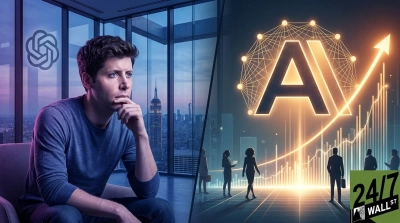
Jordi Visser of 22V Research made a striking call on The Pomp Podcast with Anthony Pompliano: the most recognizable face in artificial intelligence may not be in the corner office a year from now. “I’d be shocked if within a year, if he’s still running OpenAI. That’s just me,” Visser said of Sam Altman. The comment anchored a broader thesis on where leadership, talent, and capital are migrating inside the AI race.
Investors should care because OpenAI and Anthropic are still private companies, which means equity exposure flows mostly through partners, vendors, and the cloud platforms underwriting their compute. In addition, OpenAI has confidentially filed for an IPO. It’s expected that any IPO from the company could command a valuation in the $1 trillion range. A leadership shake-up at the category’s most visible lab would reset assumptions across that entire stack.
The case against Altman
Visser’s argument rests on two pillars. First, on the people side, he claimed Altman has “nobody who seems to really like him.” Second, on strategy, he argued OpenAI made a structural error by choosing the consumer side over enterprise. Consumer monetization in AI is brutal: low willingness to pay, viral churn, and token costs that scale linearly with engagement. Enterprise contracts, by contrast, lock in multi-year revenue and command pricing power.
Pompliano pushed back on the prediction directly, asking “Because he doesn’t want to run or because they may ask him to step down?” Visser’s answer was “both,” pointing to personal pressures weighing on Altman and to Dario Amodei’s shrewder political positioning at Anthropic.
Anthropic as the talent magnet
The talent flow is doing some of the storytelling. Visser cited Andrej Karpathy’s move to Anthropic as a tell on where elite researchers see the strongest hand. Karpathy, a co-founder of OpenAI and the former director of AI at Tesla (NASDAQ:TSLA | TSLA Price Prediction), is now listed as doing R&D at Anthropic. When the people who built the modern stack vote with their badges, capital usually follows.
Visser’s conclusion was blunt: “I just think at the end Anthropic is the winner of the battle from my perspective.” Pompliano largely agreed, conceding Anthropic is “definitely the winner today.”
The unit economics problem nobody is solving
Even if Anthropic wins the perception war, Visser flagged a structural issue that hits every model lab. The cost of producing tokens, he said, is “4 times where it was a year ago.” That is the wrong direction for any company trying to demonstrate operating leverage. Worse, he read the simultaneous capital raises across the major AI players as a coordinated tell, signaling distress rather than confidence. When everyone needs to fundraise at once, no one has the luxury of patience.
Demand going exponential, supply lagging
Pompliano added a real-time data point from his own AI product, Sylvia. Usage moved from “6 questions per week per user” to “15” per user, an illustration that demand is “going exponential” while supply is not keeping pace. His warning to Visser tied the threads together: “The problem you’re identifying today is actually getting worse.”
That is the squeeze: token costs rising, end-user demand accelerating, capital markets being tapped simultaneously across the cohort, and one of the most prominent CEOs in the sector facing internal headwinds. None of those pressures resolve through a single quarter of product launches.
What investors should track
Since OpenAI and Anthropic are not publicly traded, the readthrough lives in their hyperscaler partners, their chip suppliers, and the secondary markets where late-stage AI equity changes hands. Leadership stability at OpenAI, the cadence of enterprise wins at Anthropic, and the trajectory of per-token costs are the three variables that will validate or refute the framework Visser laid out. If his call on Altman holds, the governance discount currently embedded in OpenAI’s ecosystem could be repriced quickly. If it does not, the consumer bet may still pay off. Either way, the next twelve months will settle the argument.
Contact [email protected] for any questions or corrections.
I've spent more than 15 years inside enterprise software, working alongside the finance, sales operations, and HR leaders who run the revenue engines at some of the largest tech companies in the country.
My day job is helping enterprise executives make smarter decisions about retention, compensation, and growth. These are the same operational levers that show up in every earnings report investors actually read. That perspective shapes my writing for 24/7 Wall St.
The headline numbers are easy. The interesting stuff is underneath: how companies make money, what executives are worried about, and what any of it means for the person checking their 401(k) on a Sunday afternoon. I write about personal finance and business as someone who has spent her career inside the rooms where these decisions get made.