Got $1,500? 1 Core Portfolio Cornerstone With an Unshakable Economic Moat to Buy on the Dip
Waste Management (NYSE:WM) is often discussed as a long-duration retirement holding for the next two or three decades because it is the closest thing the public markets offer to a regulated economic utility with private-sector pricing power. The forever case…


Waste Management (NYSE:WM | WM Price Prediction) is often discussed as a long-duration retirement holding for the next two or three decades because it is the closest thing the public markets offer to a regulated economic utility with private-sector pricing power. The case for owning it indefinitely rests on three pillars: a network that cannot be rebuilt, an income stream that compounds through every cycle, and a business that does not need a strong economy to function.
Pillar 1: A network competitors cannot replicate
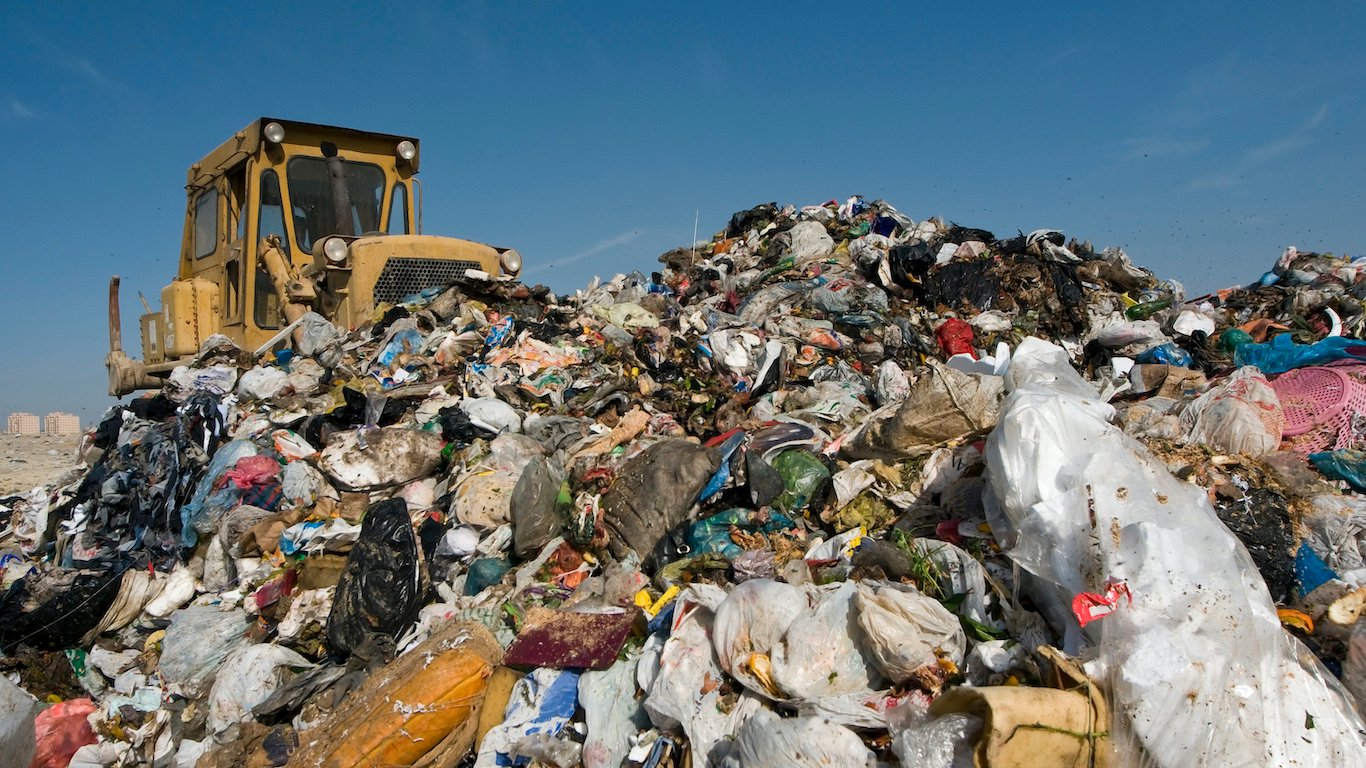
WM operates the largest network of landfills and transfer stations in North America, and that asset density is the moat. Strict regulatory hurdles and intense environmental opposition make it nearly impossible for new entrants to build landfills near major metropolitan hubs. CEO Jim Fish framed the consequence on the Q1 2026 earnings call: “As landfill capacity slowly comes offline for the industry or moves to more center-U.S. locations away from big cities, we end up in a better position because our lives, our landfill lives, are longer than the rest of the industry. It gives us the ability to raise price.” That scarcity showed up in core pricing of 6.3% and MSW yield of 6.9%, driving 110 basis points of margin expansion in the Collection and Disposal segment.
WM is simultaneously extending its infrastructure edge through a $3 billion sustainability investment program running from 2022 through 2026, targeting 20 new company-owned renewable natural gas facilities and 39 new or upgraded recycling centers across the country. The RNG buildout converts landfill gas into pipeline-quality fuel, adding a recurring energy revenue stream that layers on top of the core collection and disposal business.
Pillar 2: Income that compounds quietly
The dividend has risen every year for 23 consecutive years, climbing from $1.70 annualized in 2017 to $3.78 in 2026, with the latest quarterly payout at $0.945 per share. Coverage is strong: dividend payouts have run at 22% to 24% of operating cash flow for years, which means the payout is funded many times over by the cash the business generates. On top of the dividend, management plans roughly $2 billion in buybacks during 2026 and targets returning over 90% of free cash flow to shareholders. Free cash flow nearly doubled in Q1 2026 to $920 million, and in Q2 2026 it grew 35% year over year to $1.1 billion, reinforcing that the capital return program rests on a durable foundation.
Pillar 3: Survival through every cycle
Trash collection is non-discretionary. Households and businesses generate waste in expansions and recessions alike, and roughly 40% to 45% of revenue is indexed to inflation measures that reset quarterly. The stock carries a beta of around 0.45, a figure that reflects how tightly bounded its swings are compared to the broader market. Operating cash flow grew from $2.5 billion in 2015 to $6.0 billion in 2025, advancing through a pandemic, a rate-hike cycle, and a regional banking scare without a single missed dividend. WM also broke a structural cost barrier in 2025, pushing operating expenses below 60% of revenue for the first time in company history, even while absorbing the Stericycle healthcare waste acquisition.
The scenario where it lags
In sharp risk-on rallies led by high-beta tech and discretionary names, WM underperforms. The twelve-month trailing return has been negative while the S&P 500 advanced, as recycled commodity prices ($65 per ton versus $88 per ton in the prior year) and Renewable Fuel Standard credit volatility added quarter-to-quarter noise to the headline numbers. In Q2 2026, revenue of $6.68 billion grew 4% year over year and adjusted EPS came in at $2.02, beating consensus estimates, yet the company slightly trimmed its full-year revenue outlook, sending shares lower in the immediate aftermath.
None of that disturbs the long-term thesis. The moat lives in the landfill network, the recycling spot market is quarterly noise, and a low-beta compounder lagging during euphoric rallies is precisely the trade-off that allows it to hold up during the drawdowns that follow.
Shares trade near $220, well above the 52-week low of $194.11 but below the 52-week high of $248.13, with a forward P/E of 26 and a dividend that has never been cut. One notable development since the original publication: WM announced on August 26, 2026, that CEO Jim Fish will retire effective January 4, 2027, with company President John Morris named as his successor. The planned transition follows more than a decade under Fish and reflects a standard succession process rather than any operational disruption. For an investor focused on stability over a long horizon, the underlying profile of consistent income, pricing power, and low volatility relative to the broader market remains intact.
Editor’s note: This update corrects the 52-week high to $248.13 and the 52-week low to $194.11, adds Q2 2026 results (revenue $6.68 billion, adjusted EPS $2.02, free cash flow up 35% year over year), incorporates WM’s CEO succession announcement (Jim Fish retiring January 4, 2027; John Morris named successor), notes that WM pushed operating expenses below 60% of revenue for the first time in 2025, and includes context on the company’s $3 billion sustainability investment program targeting 20 new RNG facilities and 39 recycling centers through 2026.
Contact [email protected] for any questions or corrections.
Alex Sirois is a financial writer with experience spanning both retail and institutional investing. He has written for InvestorPlace and held roles at BNY Mellon and Bernstein, giving him a perspective that bridges Main Street portfolios and Wall Street analysis.
Alex holds an MBA from George Washington University and has built his career across multiple industries, including e-commerce, education, and translation — a breadth of experience that informs how he breaks down complex financial topics for everyday investors. His writing is conversational, actionable, and grounded in long-term, buy-and-hold investing principles.
At 247 Wall St., Alex focuses on delivering analysis that is both accessible and useful, with a clear emphasis on helping readers make more informed decisions with their money.