SQQQ’s Silent Killer: How Daily Resets Have Erased 99.97% Since Launch
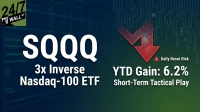
If you bought ProShares UltraPro Short QQQ (NASDAQ:SQQQ) a year ago to hedge a tech selloff, your bet against the Nasdaq-100 has cost you most of your money. The fund is down 62.69% over the past year, while the index…

This post may contain links from our sponsors and affiliates, and Flywheel Publishing may receive compensation for actions taken through them.
If you bought ProShares UltraPro Short QQQ (NASDAQ:SQQQ) a year ago to hedge a tech selloff, your bet against the Nasdaq-100 has cost you most of your money. The fund is down 62.69% over the past year, while the index it shorts, tracked by QQQ, is up 36.56%. The marketing calls SQQQ a tactical tool. The math calls it an expensive way to be right and still lose.
What You’re Actually Paying
SQQQ’s headline cost is the expense ratio, 0.95% net. On a $10,000 position, that’s skimmed off the top, before you account for the fund’s daily reset mechanics. Compare that to Invesco QQQ Trust (NASDAQ:QQQ) at roughly 0.20%, or about $20 per $10,000 [verify before publishing]. Over a decade, that gap alone compounds into hundreds of dollars in pure friction, and that’s before the real damage starts.
The real damage is structural. SQQQ is designed to deliver -3x the daily return of the Nasdaq-100 on a single-session basis only. Each night, the fund rebalances. In choppy or trending-up markets, that daily reset grinds the NAV down even when your long-term thesis is correct. Over five years, SQQQ is down 96.15%. Over ten years, it has lost 99.97%. One analyst at Invezz noted in April 2024 that SQQQ had fallen by almost 99% since inception, calling it “a highly risky investment due to its leveraged nature, high expense ratio, and the long-term upward trend in technology stocks.”
The Part the Factsheet Doesn’t Highlight
Volatility is the silent tax. The CBOE Volatility Index sits at 18.44 as of June 17, 2026, but it peaked at 31.05 on March 27, 2026. Every spike like that accelerates SQQQ’s decay because the daily reset compounds losses on the way down and gives back gains on the way up. AskTraders put it plainly back in 2021: “Most retail investors are advised to avoid this inverse ETF due to features like time decay and high fees.”
Then there’s the reverse-split illusion. SQQQ has executed multiple reverse splits, including a 1-for-5 reverse stock split that propped up the share price without restoring lost value. Holders see the ticker quote and feel calm; the cumulative chart tells the truth. Seeking Alpha issued a Sell rating on the fund in April 2026, arguing “NDX forward valuations are near historical averages, diminishing the aggressive short-bet thesis.”
The Cheaper Mirror
If your goal is bearish Nasdaq-100 exposure without paying the leverage tax, ProShares Short QQQ (NYSEARCA:PSQ) delivers -1x the daily index return at a lower structural cost. You give up the dream of a 3x payoff during a single bad week, and you accept a smaller hedge per dollar deployed. In exchange, you sharply reduce the daily-reset decay that has gutted SQQQ holders. For investors with a portfolio-level hedge in mind, simply trimming long QQQ exposure or holding more cash costs nothing at all, no expense ratio, no compounding decay, no reverse-split optics.
What This Means for You
SQQQ is a stopwatch product priced like a portfolio holding. The question to ask before sending another dollar into it: am I holding this for tomorrow’s session, or am I quietly paying the expense ratio, plus volatility decay, plus the math of a daily reset, to be a long-term bear? The fund’s own ten-year chart, down 99.97%, suggests the second answer rarely ends well.
Contact [email protected] for any questions or corrections.
I am a long time investor and student of business, and believe finding good companies that can become great investments is the best game on earth. After 20 years of writing and researching the public markets it is clear that individuals have never had more tools and information to take control of their financial lives. From ETFs and $0 commissions to cryptos and prediction markets there has never been a greater democratization of access to investing.
I write to help people understand the investments available to them so they can make the best choice for their portfolio, whether they're starting out or looking for income in retirement.