What Honeywell’s and DuPont’s Reverse Stock Splits Mean for Investors
Two major industrial restructurings have reshaped share counts at DuPont de Nemours (NYSE: DD) and Honeywell Technologies (NASDAQ: HON). Both companies completed reverse stock splits tied to portfolio breakups rather than fundamental valuation shifts. DuPont executed a 1-for-3 reverse split…

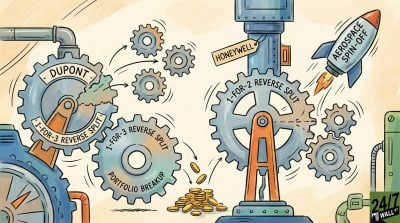
Two major industrial restructurings have reshaped share counts at DuPont de Nemours (NYSE: DD | DD Price Prediction) and Honeywell Technologies (NASDAQ: HON). Both companies executed reverse stock splits tied to portfolio breakups rather than fundamental valuation shifts. Here is what actually changed for shareholders.
DuPont’s 1-for-3 Split
DuPont completed its 1-for-3 reverse split on June 24, 2026. Stockholders had approved the measure at the company’s annual meeting on May 21. At the effective time, every three issued and outstanding shares were automatically combined into one share, reducing the company’s outstanding share count from roughly 405 million to approximately 135 million. Authorized shares were simultaneously cut from approximately 1.67 billion to about 556 million. The stock continues to trade on the New York Stock Exchange under the ticker DD with a new CUSIP of 26614N 201, and shareholders who would have received fractional shares received cash in lieu from transfer agent Computershare.
Honeywell’s 1-for-2 Split and Three-Way Breakup
Honeywell’s reverse split was the smaller piece of a much larger restructuring. The company had already spun off its advanced materials division as Solstice Advanced Materials in October 2025. Then, on June 29, 2026, it completed the spin-off of its Aerospace Technologies business as Honeywell Aerospace, which now trades independently on Nasdaq under the ticker HONA. Immediately following that distribution, the remaining automation-focused entity rebranded as Honeywell Technologies and executed a 1-for-2 reverse split, cutting issued and outstanding shares from roughly 634 million to approximately 317 million and reducing authorized shares from 2 billion to 1 billion. The par value of common stock did not change, and all equity-based awards were proportionately adjusted.
Shareholders of record as of June 15, 2026 received one HONA share for every two HON shares held, with cash paid in lieu of fractional shares. The distribution was structured to be tax-free for U.S. federal income tax purposes, except for any cash received in lieu of fractional shares.
What the Splits Mean for Shareholders
A reverse split does not change the economic value of a holding. Investors ended up with fewer shares at a proportionally higher price, leaving their total ownership stake unchanged. Both moves were designed to recalibrate per-share prices after divestitures, bringing the remaining businesses into a price range that is more typical for large-cap institutional holdings.
Since the splits closed, the two remaining companies have traded on meaningfully different trajectories. Honeywell Technologies, now a pure-play automation business, reported its first standalone quarterly results in July 2026. Revenue for the second quarter came in at $5.2 billion, up 3% from the prior-year period, with organic sales growing 4% and segment margin expanding 100 basis points to 19.0%. Adjusted earnings per share of $1.95 came in above analyst expectations, and management raised its full-year 2026 adjusted EPS guidance to a range of $8.05 to $8.35. HON shares have traded near $198 in mid-September 2026. DuPont, now focused on water technology, healthcare materials, and diversified industrials, trades near $127 on a split-adjusted basis, reflecting a one-year gain of approximately 33%.
Investors watching both names going forward should monitor Honeywell Technologies’ integration of the Johnson Matthey Catalyst Technologies business (acquired July 17, 2026), the closed divestitures of its Warehouse and Workflow Solutions and Productivity Solutions and Services units, and post-split trading liquidity across all three successor entities. For DuPont, the ongoing portfolio focus on water filtration, biopharma processing, and specialty materials will be the key driver of long-term performance after the structural reset.
Editor’s note: This article has been updated to reflect that both reverse splits have been completed. DuPont’s outstanding share count (reduced from approximately 405 million to 135 million) and DuPont’s current split-adjusted stock price (near $127) have been added or corrected, as have Honeywell’s rebranding as Honeywell Technologies, the completed three-way corporate breakup including the October 2025 Solstice Advanced Materials spin-off, Honeywell’s Q2 2026 results (adj. EPS $1.95, raised full-year guidance to $8.05 to $8.35), and HON’s current share price near $198.
Contact [email protected] for any questions or corrections.
Trey has been an editor and author at 24/7 Wall St. for more than a decade, where he has published thousands of articles analyzing corporate earnings, dividend stocks, short interest, insider buying, private equity, and market trends. His comprehensive coverage spans the full spectrum of financial markets, from blue-chip stalwarts to emerging growth companies.
Beyond 24/7 Wall St., Trey has created and edited financial content for Benzinga and AOL's BloggingStocks, contributing additional hundreds of articles to the investment community.
Trey's editorial expertise extends across multiple publishing environments. He served as production editor at Dearborn Financial Publishing and development editor at Kaplan, where he helped shape financial education materials. Earlier in his career, he worked as a writer-producer at SVE. His freelance editing portfolio includes work for prestigious clients such as Sage Publications, Rand McNally, the Institute for Supply Management, the American Library Association, Eggplant Literary Productions, and Spiegel.
Outside of financial journalism, Trey writes fiction and has been an active member of the writing community for years, moderating workshop sessions at regional conventions.