Ripple Almost Shut Down in 2020, Now XRP Makes History on a Jersey Patch
Ripple's CEO recently admitted the company came within a decision of vanishing entirely, with a plan ready to hand away every XRP token and leave the SEC with nothing to sue. What happened next put that same token somewhere no…

This post may contain links from our sponsors and affiliates, and Flywheel Publishing may receive compensation for actions taken through them.
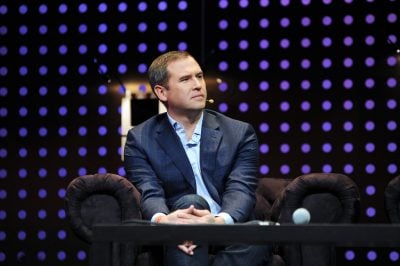
In December 2020, the SEC sued Ripple, claiming it had sold XRP (CRYPTO:XRP) as an unregistered security. Major U.S. exchanges delisted the token, and the XRP price crashed. This week, Ripple’s CEO revealed that the company came even closer to the end than anyone knew.
Speaking at the University of Kansas, Brad Garlinghouse said that back then Ripple weighed a plan to make XRP disappear on purpose by handing every token it held to shareholders, then telling the SEC there was nothing left to sue over. But Ripple never went through with it.
At that same university, just days before he spoke, XRP became the first cryptocurrency ever stitched onto the jerseys of a major college team. Here’s how XRP went from a token Ripple almost gave away to one a major school proudly wears on its jerseys.
Ripple Almost Shut Down in 2020

For most of 2020, Ripple looked like one of crypto’s quieter successes—a payments company with banking partners and a token comfortably in the market’s top five. Then, three days before Christmas, the SEC sued Ripple, claiming the company had sold XRP as an unregistered security. Shortly after, U.S. exchanges pulled XRP off their platforms, the price collapsed, and holders were told to sell before it went to zero.
“We almost decided to shut down the company when the SEC sued us,” Garlinghouse told an audience at the University of Kansas this week. Winding Ripple down and handing its XRP to shareholders had been on the table, a way to leave the agency with nothing left to sue over. The SEC had “infinite power and resources,” he said, and surviving a fight like that was far from guaranteed.
David Schwartz, Ripple’s CTO at the time, said the pressure ran deep, with the company’s lawyers telling leadership Ripple was “done and unsavable,” and that they should cut a deal to save themselves. Schwartz also thinks the SEC named Garlinghouse and co-founder Chris Larsen personally on purpose, because going after two men rather than a faceless company is the quickest way to pressure them into folding.
Why Ripple Chose to Fight
Ripple had grown into a company of hundreds of people by then, and those jobs tipped the decision. Shutting the doors to escape the lawsuit would have put all of them out of work. Walking away was the easier outcome, Garlinghouse said, but a bad one, and that made the call hard even if it looks obvious in hindsight.
Part of what pushed them to fight was how unfair the case felt. Garlinghouse said he had met with the SEC four separate times between 2017 and 2019, without a lawyer, thinking he was just explaining how the technology worked. Not once did anyone warn him XRP might be treated as a security. Then the agency sued him for it, personally. So Ripple fought a case it believed should never have been filed, spending roughly $150 million over four years to do it.
In 2023, Judge Analisa Torres ruled that XRP on its own is not a security, and the token briefly spiked as much as 96% that same day before settling lower. By 2025, the SEC gave up its appeal and the case settled, with Ripple paying about $50 million of the $125 million penalty a court had ordered—a long way down from the $2 billion the SEC first went after.
For years, big institutions had stayed away from XRP because no one could say for certain whether it was legal to hold, and that ruling cleared the doubt for good.
Now XRP Makes History on a Jersey

In the years after the lawsuit, XRP went from a token most people had written off to one climbing back up the market, and this week it reached a place no crypto had been before. Under a five-year deal, the Kansas Jayhawks will carry an XRP patch on their uniforms, making XRP the first cryptocurrency ever to appear on the jersey of a major U.S. college team.
The milestone was only possible because the NCAA cleared Division I programs to wear corporate logos this year, and Kansas is among the first schools to act on it. The deal is with Garlinghouse’s old university, and just days later, he stood on that same campus and described how close Ripple once came to folding.
Back in 2020, exchanges couldn’t drop XRP fast enough and holders were told to sell before it hit zero. Five years later, a major university puts that same token on its uniforms in front of millions of sports fans. Schools protect their brand carefully, so one agreeing to wear a crypto logo for the first time in college sports shows how far XRP has come, from a token too toxic to list to one a public institution is happy to back.
What’s Ahead for Ripple?
The company that spent four years fighting the U.S. government now wants to plug straight into the same government’s financial plumbing. Ripple has won conditional approval to run a national trust bank, which lets it hold and manage client money under federal rules instead of relying on other banks to do it. It’s also chasing a Federal Reserve master account, and that one is bigger.
Right now, when Ripple moves money for a client, it has to pass through commercial banks that stand between it and the Fed’s payment system, and that adds cost and delay. A master account would let Ripple settle straight through the Fed’s own rails—the same ones the biggest U.S. banks use—cutting those middlemen out. Its RLUSD stablecoin has already passed $1.6 billion, and Ripple has spent heavily buying firms that handle settlement and treasury work.
That said, most of this helps Ripple, the company, and its stablecoin first, not the token. XRP’s job is to act as a bridge, bought for a few seconds to move money between two currencies and then sold again, since a single transaction settles in about four seconds for a fraction of a cent. Barely any of it needs to be held for the system to run, which is why Ripple can keep growing while XRP’s demand stays flat, as it did all through 2026.
Moreover, the Fed has paused new crypto account decisions until late 2026, and figures like Senator Elizabeth Warren are pushing to keep firms like Ripple out. Even so, the company that once weighed making XRP disappear to escape the government now wants to become a permanent part of its financial system.
Contact [email protected] for any questions or corrections.
Sam Daodu is a crypto analyst who's spent nearly a decade making blockchain understandable—no easy task when most whitepapers read like fever dreams. He writes for 24/7 Wall St., covering Bitcoin, altcoins, and crypto market analysis for investors. Before crypto, he was a tech writer (back when explaining "the cloud" was peak innovation). Since 2018, he's written for CoinTelegraph, Yahoo Finance, The Block, Cryptonews, Zypto, Rain, and more—basically anywhere people want crypto news without the headache. Sam runs MacLabs Marketing, a content agency for crypto brands tired of sounding like AI wrote their website. He also publishes free crypto education on his site for Web3 enthusiasts who think "gas fees" is a typo. When he's not writing or staring at charts, Sam's either: - Watching anime (currently convinced One Piece has better tokenomics than most altcoins) - At the gym sculpting himself into a Greek god - Listening to the music your mum warned you only bad boys listen to Connect: LinkedIn | Email | MacLabs Marketing