Fidelity’s FDVV Charges 0.15% but Delivers Tech Upside Most Dividend Funds Skip
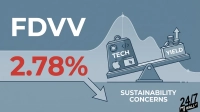
FDVV owns Nvidia, Apple, and Microsoft at the top of a fund marketed as a dividend play, and that unusual construction forces a real choice between tech-driven compounding and the straightforward income that cheaper rivals promise.


The Fidelity High Dividend ETF (NYSEARCA:FDVV) charges 0.15% a year and now manages $9.80 billion across 112 holdings. That fee sits above the category’s cheapest options, so the question for income investors is whether Fidelity’s tilt justifies the premium. This piece weighs FDVV against two of the funds it most often gets shopped against: the Schwab U.S. Dividend Equity ETF (NYSEARCA:SCHD) and the Vanguard High Dividend Yield ETF (NYSEARCA:VYM).
A fourth option worth naming, the iShares Core Dividend Growth ETF (NYSEARCA:DGRO), rounds out the comparison for readers who care more about payout expansion than headline yield. The four funds sound similar in marketing copy. Under the hood, they are built to do different things.
Why the Fee Question Matters More Than It Looks
A 0.15% expense ratio is modest in absolute terms, but it becomes a live question when the closest peer, SCHD, charges 0.06%. On a $100,000 balance, that gap runs about $90 a year, small in isolation but compounding for decades in a taxable account or IRA. The fee only justifies itself if FDVV’s construction produces something SCHD’s does not: a different sector mix, a different yield profile, or a different return pattern.
FDVV screens for companies that combine yield with dividend growth and payout consistency, then weights by market cap within those buckets. The result is a portfolio that looks less like a pure yield screen and more like a large-cap core fund with a dividend overlay.
FDVV: A Dividend Fund That Still Owns the Megacaps
The clearest way to understand FDVV is to look at what sits on top. NVIDIA, Apple, and Microsoft together account for 16% of net assets, with Broadcom, JPMorgan Chase, and Alphabet close behind. Most dedicated dividend funds screen out those names because their yields are below 1%. Fidelity includes them by leaning on total shareholder return criteria and buyback intensity alongside dividends.
That construction shows up in the numbers. FDVV returned 20% over the past year and 93% over five years, well ahead of most yield-first competitors. The 2.8% yield is the tradeoff: lower than SCHD or VYM, but paired with the growth engine of megacap tech. Shares trade near $62, up about 11% year-to-date, with a beta of 0.88.
The income profile is stronger than the yield suggests. Trailing twelve-month distributions total $1.729, and the June 2026 payment of $0.519 was the largest quarterly distribution in FDVV’s history. Annual payouts have moved from $1.283 in 2022 to $1.636 in 2025. That trajectory is the practical case for the fee. Investors are paying up for a portfolio that provides tech exposure within a dividend wrapper, and the distributions have compounded alongside the price.
The tradeoff worth understanding: FDVV will look less like a defensive income sleeve during tech drawdowns. When Nvidia, Apple, and Microsoft sneeze together, this fund catches the cold in a way SCHD does not.
SCHD: The Cost Leader With a Different Job
Schwab’s flagship dividend fund runs $71.6 billion and tracks the Dow Jones U.S. Dividend 100 Index, which requires 10 years of dividend payments and screens for cash flow-to-debt, return on equity, and yield. The top of the book reflects that Bristol-Myers Squibb, Merck, ConocoPhillips, Lockheed Martin, and Chevron anchor the fund, each with nearly 4% of assets.
The Schwab US Dividend Equity ETF delivered a 22% return over the past year and 53% over five years, trailing the Fidelity fund over the longer window despite matching it recently. The reason is composition. This Schwab fund owns almost none of the megacap tech that pulled the Fidelity product higher. What it offers instead is a higher starting yield, a lower fee, and a portfolio that behaves more like a value fund during growth-led corrections. For an investor whose goal is durable cash flow rather than total return, this structure aligns with the mandate.
VYM: Breadth as the Defining Feature
Vanguard’s high-yield fund holds more than 300 positions, making it the most diversified in the group by a wide margin. That breadth caps single-stock risk, though Broadcom at 8% is now large enough to be a meaningful driver on its own. The rest of the top ten reads like a roll call of dividend staples: Exxon Mobil, JPMorgan Chase, Johnson & Johnson, Chevron, and Coca-Cola.
The Vanguard High Dividend Yield ETF returned 22% over the past year and 77% over five years. The fund sits between its competitors in most dimensions: broader than either, less tech-concentrated than the Fidelity offering, and less quality-screened than the Schwab fund. It is the default option when an investor cannot decide which factor matters most and wants exposure to the entire high-yield universe at Vanguard’s cost structure.
DGRO: The Growth-First Alternative
The iShares Core Dividend Growth ETF tracks a dividend growth index rather than a yield screen, requiring five years of consecutive increases and excluding companies with payout ratios above 75%. That produces a lower starting yield than the Schwab or Vanguard competitors, but a portfolio explicitly biased toward companies that raise distributions. For an investor whose income need is decades away, that structural bias toward growers, not payers, can matter more than the current yield line on a fact sheet. It belongs in the conversation for the same reason the Fidelity product does: it solves a different problem than the two obvious peers.
Choosing Between the Four
The Fidelity High Dividend ETF makes sense for an investor who wants dividend exposure without sacrificing the compounding engine of the largest U.S. companies and is willing to pay 0.15% for that construction. The Schwab fund is the choice when the priority is a higher starting yield, strict quality screens, and the lowest possible fee. The Vanguard high-yield product fits the investor who wants the widest net at a low cost, without a strong view on which dividend factor will lead. The iShares dividend growth fund addresses the accumulator who values the history of raises over the current payout. The Fidelity fund’s fee is defensible, though not automatic. It earns its keep only if the reader actively wants the tech tilt the fund is built to deliver.
Contact [email protected] for any questions or corrections.
David Beren has been a Flywheel Publishing contributor since 2022. Writing for 24/7 Wall St. since 2023, David loves to write about topics of all shapes and sizes. As a technology expert, David focuses heavily on consumer electronics brands, automobiles, and general technology. He has previously written for LifeWire, formerly About.com. As a part-time freelance writer, David’s “day job” has been working on and leading social media for multiple Fortune 100 brands. David loves the flexibility of this field and its ability to reach customers exactly where they like to spend their time. Additionally, David previously published his own blog, TmoNews.com, which reached 3 million readers in its first year. In addition to freelance and social media work, David loves to spend time with his family and children and relive the glory days of video game consoles by playing any retro game console he can get his hands on.