This Is Why I Can’t Stop Buying AMD
AMD keeps landing on the buy list every quarter, and the reasons have less to do with hype than with a specific set of contracts, cash flow numbers, and a rack-scale bet that changes what kind of company AMD actually…


I keep hitting the buy button on AMD (NASDAQ:AMD | AMD Price Prediction) because the projections analysts were sketching a year ago are showing up in the filings, in the customer names, and in the cash flow. Every quarter I tell myself I have enough. Every quarter I add more.
The Thesis I Cannot Shake
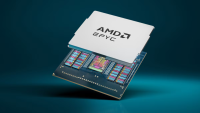
AMD currently captures just 5% to 7% of global hyperscaler AI accelerator spend, and Wall Street projects that share will expand to 20% to 25% between 2027 and 2028. What convinced me the arithmetic will actually happen is the Helios rack-scale platform, integrating 72 Instinct MI455X GPUs, 6th-Gen EPYC Venice CPUs, and UALink open networking. That turns AMD from a chip vendor into a full-stack system supplier, which is what hyperscalers buy. Multi-gigawatt commitments from Microsoft, Meta, and OpenAI convert a projected share gain into contracted pipeline.
The Receipts
Q1 FY2026 gave me three reasons in one filing. Revenue hit $10.253 billion, up 37.85% year over year, with Data Center alone at $5.775 billion, up 57%. Non-GAAP EPS of $1.37 beat the $1.2939 consensus, extending a pattern of revenue beats in all four recent quarters.
Second, the cash is real. Free cash flow reached $2.566 billion, up 252.96% year over year, on top of a full-year FY25 free cash flow of $5.519 billion. Balance sheet: $5.585 billion in cash against a debt/equity ratio of 0.07. That is a fortress underwriting the buildout.
Third, the market Lisa Su is chasing keeps getting larger. On the call, she said “we now expect the server CPU TAM to grow at greater than 35% annually, reaching over $120 billion by 2030,” nearly double the pace outlined months earlier. Q2 guidance calls for roughly $11.2 billion, about 46% year-over-year growth.
Why Not the Obvious Alternative
Readers ask why I do not just own NVIDIA (NASDAQ:NVDA). I own some. I am not adding at these levels because AMD is the share-gain story, and the valuation gap matters. AMD trades at a P/E near 164, but the earnings growth underneath it is net income up 95.06%. As for Intel (NASDAQ:INTC), AMD is taking the business directly. Su noted “our fourth consecutive quarter of record server CPU revenue” with cloud and enterprise each up more than 50%. EPYC cloud instances grew to more than 1,600. Intel is the donor here.
The Risk I Will Not Wave Away
The real risk is the valuation itself and China. U.S. export controls on MI308 cost AMD roughly $800 million in Q2 25 charges and $440 million net for FY25. Another round of policy tightening would sting. It has not changed my thesis because the Helios pipeline is North American and European hyperscaler demand, and Su said customer MI450 forecasts are running “above our initial plans that we had planned for 2027”.
Why the Buy Button Stays Live
Su told analysts AMD has “a clear path to exceed our long-term financial targets, including delivering more than $20 in EPS over the strategic time frame.” Against a current price of $503.57, that math is the entire argument. Projections stopped being projections the day Meta signed for 6 gigawatts. I am buying the company that delivers them.
Contact [email protected] for any questions or corrections.
Alex Sirois is a financial writer with experience spanning both retail and institutional investing. He has written for InvestorPlace and held roles at BNY Mellon and Bernstein, giving him a perspective that bridges Main Street portfolios and Wall Street analysis.
Alex holds an MBA from George Washington University and has built his career across multiple industries, including e-commerce, education, and translation — a breadth of experience that informs how he breaks down complex financial topics for everyday investors. His writing is conversational, actionable, and grounded in long-term, buy-and-hold investing principles.
At 247 Wall St., Alex focuses on delivering analysis that is both accessible and useful, with a clear emphasis on helping readers make more informed decisions with their money.