AMD Has an Agentic AI Advantage Over Nvidia That Keeps Me Buying Again and Again
Agentic AI rewires what an AI server actually needs, and most investors are still thinking about this race the wrong way. The company that quietly controls the missing piece keeps landing the biggest hyperscaler contracts in the industry.


I keep buying Advanced Micro Devices (NASDAQ:AMD | AMD Price Prediction) because agentic AI is rewiring what an AI server needs, and the market still prices AMD like it only sells GPUs. It sells the CPU that runs tool calls, the memory that holds context, and the accelerator that does reasoning. That combination keeps my finger on the buy button.
The Thesis: Agentic AI Moves the Bottleneck
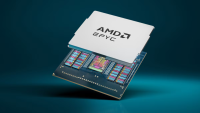
A standard chatbot query is a one-shot GPU pass. An agent is a loop: GPU reasoning, then a CPU tool call or database query, then a KV-cache update, then the next step. The GPU sits idle while the host CPU runs sandboxed Python, hits SQL, and pings legacy microservices. The CPU stops being a background component and becomes the active traffic controller. That is exactly the workload AMD sells into with EPYC plus Instinct plus ROCm, and it is why Lisa Su told investors on the Q1 call that “inferencing and agentic AI drive increasing demand for high-performance CPUs and accelerators.” AMD owns the x86 server CPU franchise that this stack requires, an advantage its accelerator rivals lack.
The Receipts
Data Center revenue hit $5.775 billion, up 57% year over year, in Q1 FY2026, and total revenue landed at $10.253 billion, up 37.85%. Free cash flow ran $2.566 billion, a 252.96% jump. Management guided Q2 to roughly $11.2 billion, about 46% growth, with gross margin widening to around 56%. The balance sheet carries net cash, with debt/equity at 0.071, so this cash flow is not servicing leverage.
The customer roster: OpenAI selected AMD to deploy 6 gigawatts of GPUs, Meta signed for up to 6 gigawatts of Instinct GPUs, and Oracle is standing up a 50,000-GPU Helios cluster. Reddit’s r/stocks caught it too: the top post this month read, “AMD’s Anthropic and Microsoft deals reinforce that AI infrastructure spending remains strong.”
Why Not Just Buy NVIDIA?
I own some NVIDIA (NASDAQ:NVDA). Jensen Huang said “Agentic AI has arrived, doing productive work, generating real value and scaling rapidly across companies and industries”, and the numbers are staggering: $81.615 billion in Q1 FY2027 revenue, up 85.2%, with 75.0% non-GAAP gross margin. NVIDIA also owns the interconnect story with NVLink and a purpose-built ARM CPU roadmap in Vera Rubin.
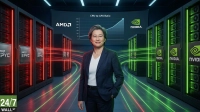
The problem is the base. NVIDIA is a $5.06 trillion company. AMD is $887.7 billion. NVDA trades at price-to-book of 25.69; AMD sits at 13.77. AMD’s PEG is 1.276, and analysts carry 5 Strong Buy, 37 Buy, and zero Sell ratings. I want the CPU-plus-GPU rack that hyperscalers are diversifying into, at a book multiple roughly half of NVIDIA’s.
The Risk
Trailing P/E is 182. That is rich. U.S. export controls on the MI308 already cost AMD an ~$800 million inventory charge in Q2 2025. What keeps the thesis intact is the forward P/E of 76 against 91.2% quarterly earnings growth, and the fact that current guidance excludes China MI308 revenue entirely. The multiple compresses if execution holds.
Why I Keep Buying
Polymarket currently prices AMD’s next earnings beat at a 91.5% probability. The 1-year return is 240.18%. I add because the agent loop needs a CPU and a GPU under the same roof, and AMD is the only U.S.-listed name selling both at scale.
Contact [email protected] for any questions or corrections.
Alex Sirois is a financial writer with experience spanning both retail and institutional investing. He has written for InvestorPlace and held roles at BNY Mellon and Bernstein, giving him a perspective that bridges Main Street portfolios and Wall Street analysis.
Alex holds an MBA from George Washington University and has built his career across multiple industries, including e-commerce, education, and translation — a breadth of experience that informs how he breaks down complex financial topics for everyday investors. His writing is conversational, actionable, and grounded in long-term, buy-and-hold investing principles.
At 247 Wall St., Alex focuses on delivering analysis that is both accessible and useful, with a clear emphasis on helping readers make more informed decisions with their money.