“I Saw the Movie. I Don’t Want the Sequel.” Jim Cramer Warns Nvidia’s $250 Billion Deal Is How Companies Died in the Dot-Com Bubble
Jim Cramer watched a nearly identical financing arrangement detonate an entire sector in 2000, and he says the same pattern is now unfolding around Nvidia's biggest customer. The deal he warned about on July 27, 2026 was later finalized at…

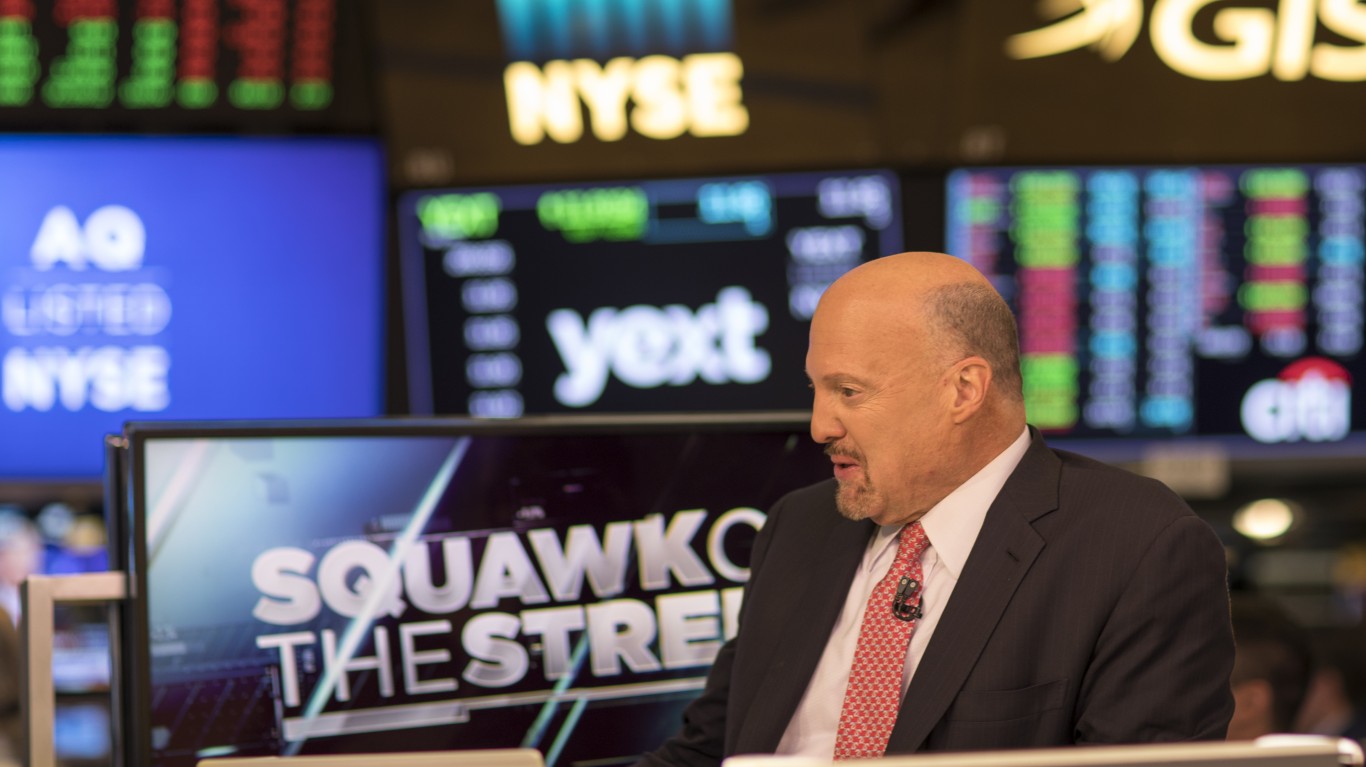
Jim Cramer opened Mad Money on July 27, 2026 with a warning pulled directly from his own trading history. “A spectre is haunting this market. The spectre of the year 2000,” he told viewers, before turning to the deal that had become the flashpoint of the current AI cycle: NVIDIA (NASDAQ:NVDA | NVDA Price Prediction) and its reported financing arrangement with OpenAI.
At the time Cramer spoke, Nvidia was in discussions to provide a backstop of up to $250 billion that would help OpenAI lease a new AI data center campus in Pike County, Ohio. The project was being developed by SB Energy, the energy subsidiary of SoftBank, and the total cost including chips was projected to exceed $500 billion. OpenAI needed outside credit support because it is a private, unprofitable company with no investment-grade credit rating, making it unable to secure the necessary debt on its own terms.
The deal’s structure changed materially in the weeks that followed. On August 17, 2026, Nvidia formally announced it had agreed to provide credit support capped at $105 billion for the initial phase of the Ohio campus, a significant reduction from the $250 billion figure that triggered Cramer’s warning. The finalized agreement covers an initial 4.25 gigawatts of computing capacity, with an option on a further 3.75 gigawatts. Nvidia also invested $1.5 billion directly in SB Energy and secured exclusivity: the entire facility will run Nvidia hardware under a 20-year lease to OpenAI. The first 800 megawatts of capacity are expected to come online in 2028.
Cramer’s concern, though, is about the pattern rather than the exact dollar figure. He argues the structure mirrors the vendor financing arrangements that detonated the telecom equipment sector during the dot-com collapse. “Makes sense given that OpenAI is one of their big customers,” he said. “But there is history. Boatloads of it. And it is very negative.”
The Vendor Financing Trap Cramer Says He Lived Through
The core lesson Cramer took from 2000: “What we learned in 2000 is that you don’t lend to customers who buy your goods. They might default and your earnings get smashed.” Back then, telecom equipment suppliers booked enormous revenue by financing customer purchases, only to watch their stocks take decades to revisit prior highs after those customers defaulted.
His argument is that OpenAI fits the risk profile investors ignored during the last cycle. OpenAI burns significant cash, has not gone public, and its ability to repay is uncertain. Cramer contends that is exactly the kind of counterparty risk that looks manageable right up until it isn’t. That said, OpenAI is reportedly on track for an IPO as early as late 2026, which would change its capital access picture considerably.
He extended the critique to the broader customer base. “So many of the buyers of Nvidia AI chips had tremendous balance sheets a year ago. That’s no longer the case now. Some desperately need more money to finish their data center buildouts, and it might not be available,” he said. Cramer noted that his own hedge fund exited 2000 tech stocks about a week before the peak by watching buyer balance sheets deteriorate.
The Nvidia-OpenAI arrangement splits into two separate financing structures: one covering the data center lease and construction, and another covering Nvidia’s own chips. The original $250 billion figure applied to the lease and construction side and explicitly excluded Nvidia’s chips, which were the subject of a separate financing discussion that could reach $350 billion. When the deal was finalized, the lease-side backstop was reduced to $105 billion. That distinction matters for understanding the scale of contingent liability Nvidia assumed and the degree to which the initial reports overstated its exposure. As of late April 2026, Nvidia’s total assets stood at $259.5 billion and equity at $195.5 billion, which put the original $250 billion guarantee figure roughly equivalent to the company’s entire asset base. The finalized $105 billion cap represents a more manageable fraction of that balance sheet.
The Numbers Behind the Warning
Nvidia itself remains a financial juggernaut by any measure. The company reported record Q1 FY2027 revenue of $81.6 billion, up 20% from the prior quarter and 85% from a year ago. Data Center revenue reached $75.2 billion, up 92% year over year and 21% sequentially, driven by Blackwell system deployments across hyperscalers, sovereign customers, and AI-native cloud providers. Non-GAAP EPS came in at $1.87 against a $1.77 consensus, and non-GAAP gross margin held at 75.0%. The board also approved an additional $80.0 billion in share repurchase authorization and raised the quarterly dividend from $0.01 to $0.25 per share. Full details appear in the company’s Q1 FY27 8-K filing.
CEO Jensen Huang has framed the moment as generational, calling the “buildout of AI factories the largest infrastructure expansion in human history.” Yet Nvidia’s total supply-related commitments have reached $119.0 billion, with multi-year cloud service commitments of $30.0 billion. Those capital obligations anchor Cramer’s concern about counterparty risk, since the same customers buying Nvidia chips are now also the companies Nvidia is financing.

The Market Is Already Reacting
Cramer argued the tape was already confirming the risk on the day he spoke. Nvidia stock fell 10 points despite positive news, and supplier stocks finished sharply lower that Friday despite large deal announcements. NVDA closed at $196.51 on July 27, down 4.99% on the session and 3.33% for the week.
Cramer also referenced a broader Wall Street concern about the AI trade’s structure. Jason Hunter, JPMorgan’s chief technical strategist, told clients the current divergence in AI stocks mirrors what happened in the months before the dot-com bubble burst in 2000. The parallel drawn to 1999, when communications equipment makers rallied while heavy capital spenders fell before the 2000 crash, adds a historical risk marker without JPMorgan explicitly calling a bubble. At the time of Cramer’s broadcast, the Philadelphia Semiconductor Index had risen 87% in 2026 and posted its best-ever quarter, while the Roundhill Magnificent Seven ETF was down 7% from its peak, with Meta and Microsoft down 5% and 18% year to date, respectively.
The macro backdrop added fuel to Cramer’s unease: oil fell 9% in one session in the days around his broadcast, helping move interest rates lower and stocks higher. That kind of tape rotation, Cramer noted, can obscure deeper structural concerns until they surface in earnings.
Since that July 27 broadcast, Nvidia has reported Q2 FY2027 results that blew past expectations. The chipmaker posted $96.2 billion in revenue for the quarter ended July 26, up 106% from a year earlier. The data center division generated $89.0 billion, up 117% year over year. Non-GAAP EPS came in at $2.22, beating the LSEG consensus of $2.10 by $0.12. Looking ahead, Nvidia forecast Q3 FY2027 revenue of $108 billion, within a 2% range, with gross margin expected around 74%. The blowout numbers have quieted some near-term bear arguments, but they do not resolve Cramer’s structural concern, which centers on the financing chain rather than chip demand itself.
Separately, scrutiny of circular financing deepened in mid-August 2026 when Nvidia partnered with six major financial institutions, including BlackRock, to launch compute financing platforms targeting more than $500 billion in third-party capital for AI infrastructure. Huang pushed back directly on the circular-financing characterization, saying Nvidia is using “its scale and long-term visibility” to help, and that the Ohio deal was not circular financing. Critics countered that the overlap between Nvidia’s customers, its investors, and its financing counterparties creates structural risk regardless of how the deals are labeled.
Cramer’s Bottom Line
Cramer emphasized he still regards Nvidia as an exceptional company. His objection is to the financing pattern, not to the business. “I saw the movie. I was in a movie. Bottom line, I don’t want the sequel. Nvidia shouldn’t make these guarantees, even if it has all the money in the world. Just history. That’s all. Just history,” he said.
Whether the analogy holds depends on a question Cramer raised but cannot fully answer: at what point does a chip supplier’s financing guarantee become so large that a customer’s inability to pay threatens the supplier’s own balance sheet? In 2000, that question went unanswered until it was too late. The scale and circular nature of today’s AI commitments, where suppliers, customers, and investors overlap, has prompted comparisons to the late-1990s tech bubble. Whether the underlying fundamentals are different this time remains the central debate.
Editor’s note: This article has been updated to reflect that the deal initially reported at $250 billion was finalized at $105 billion on August 17, 2026, covering an initial 4.25 gigawatts of capacity at a facility now sized at up to 8 gigawatts, with Nvidia also investing $1.5 billion in SB Energy and securing exclusivity as the sole chip supplier under a 20-year OpenAI lease. Q2 FY2027 figures have been added: revenue of $96.2 billion (+106% year over year), Data Center revenue of $89.0 billion (+117%), non-GAAP EPS of $2.22, and Q3 guidance of $108 billion.
Contact [email protected] for any questions or corrections.
AJ spent 10 years writing about financial markets at The Motley Fool. His coverage centers on technology stocks and the broader macroeconomic trends, from interest rates to geopolitics, that shape where markets are headed next. AJ is drawn to the stories where big-picture economics and individual companies collide.