Live Coverage Updates appear automatically as they are published.

Live: NVIDIA Creates a $500 Billion AI Financing Pool. These Stocks Could Win

Photo of Thomas Richmond
By Thomas Richmond Published

Quick Read

  • NVIDIA now co-finances the AI data centers it supplies chips to, while CoreWeave carries $50.8 billion in liabilities against a $100 billion backlog.

  • KKR and Goldman Sachs absorb 75% of AI infrastructure financing risk on deals where NVIDIA backstops only 25%.

  • Boockvar warns Chinese AI rivals have turned infrastructure operators from price makers into price takers, threatening returns for builders over users.

  • Don't wait: the analyst who called NVIDIA in 2010 just revealed his top 10 AI stocks. See the full list FREE now.

Live Updates

Investment Giants May Gain a New High-Yield AI Credit Market

Live

The six financial institutions working with NVIDIA (Apollo, BlackRock, Blackstone, Brookfield, Goldman Sachs, and KKR) could gain access to a massive new market for AI infrastructure credit.

By treating GPUs and AI factories as revenue-producing infrastructure assets, these firms could package the loans into standardized securities and distribute them to pensions, insurers, sovereign wealth funds, and other institutional investors seeking long-duration yields.

Usage-linked revenue streams and NVIDIA’s potential residual-value support could make the underlying assets more attractive to lenders. If a liquid secondary market eventually develops, the firms arranging these transactions could benefit from lending income, management fees, structuring fees, and securities-trading activity.

For Wall Street, NVIDIA’s $500 billion initiative could transform AI infrastructure into a scalable asset-backed credit platform rather than a collection of one-off private loans.

CoreWeave and Nebius Could Gain Access to Cheaper AI Financing

Live

Neocloud operators like CoreWeave and Nebius may be the most direct beneficiaries of NVIDIA’s $500 billion AI financing initiative. CoreWeave shares gained 1.6% following the announcement, while Nebius jumped 2.6%.

Both companies must spend heavily to acquire GPUs, secure power, and expand data center capacity. However, as non-investment-grade borrowers, they face higher financing costs than established hyperscalers.

Bloomberg Intelligence analyst Vasu Kasibhotla said support from private capital “can ease financing constraints for CoreWeave, Nebius and other neocloud and power-site operators.”

He added that “for CoreWeave, cheaper and deeper credit can ease funding pressure from its heavy capital-spending plan. For Nebius, greater capital availability would strengthen the funding base for expansion.”

Access to deeper and potentially cheaper credit could allow both companies to expand faster, compete for scarce power capacity, and purchase additional NVIDIA systems without relying as heavily on dilution.

NVIDIA Could Be the Biggest Winner From Its $500 Billion AI Financing Pool

Live

NVIDIA may emerge as the biggest winner from this new financing solution because the framework shifts most of the lending risk to its private capital partners.

BofA analyst Vivek Arya, who maintains a Buy rating and $320 price target, explained that, The burden sits with the consortium, not NVDA’s balance sheet. NVDA guarantees asset quality, not the debt, turning the bear’s depreciation worry into the enabling feature.”

BofA estimates NVIDIA’s previous vendor-financing exposure represented roughly 15% of the $470 billion or so in free cash flow it could generate across 2026 and 2027.

Moving that burden to outside investors could preserve more cash for stock repurchases. Consensus estimates currently project that NVIDIA will deploy roughly $73 billion in buybacks in 2026 and $106 billion in 2027.

Wells Fargo analyst Aaron Rakers, who rates NVIDIA Overweight with a $315 price target, believes the company is playing “a much bigger game than just a supplier in AI infra build-outs.”

By helping establish AI factories as an investable infrastructure class, NVIDIA could expand access to financing while supporting demand across a market BofA estimates could reach $1.7 trillion by 2030.

BlackRock CEO Larry Fink Sees Massive Demand for AI Infrastructure Financing

Live

BlackRock CEO Larry Fink believes Wall Street can help provide the enormous amount of capital required to finance the global AI infrastructure buildout.

“We’re trying to find different ways to raise or to participate in raising the enormous amount of capital that’s necessary to fund this infrastructure buildout,” Fink said.

He specifically highlighted the potential for “asset-based financing against this infrastructure,” arguing that the equipment supporting AI development has tangible value. “These are real assets. They have real value… and there’s a lot of capital out there.”

Standardizing GPUs as collateral could create a new asset class and reduce borrowing costs. “It’s not sitting on somebody’s balance sheet as private credit does,” CNBC’s David Faber said. “That conceivably will lower the cost of the capital.”

Jensen Huang Says NVIDIA GPUs Have Become Investable Infrastructure Assets

Live

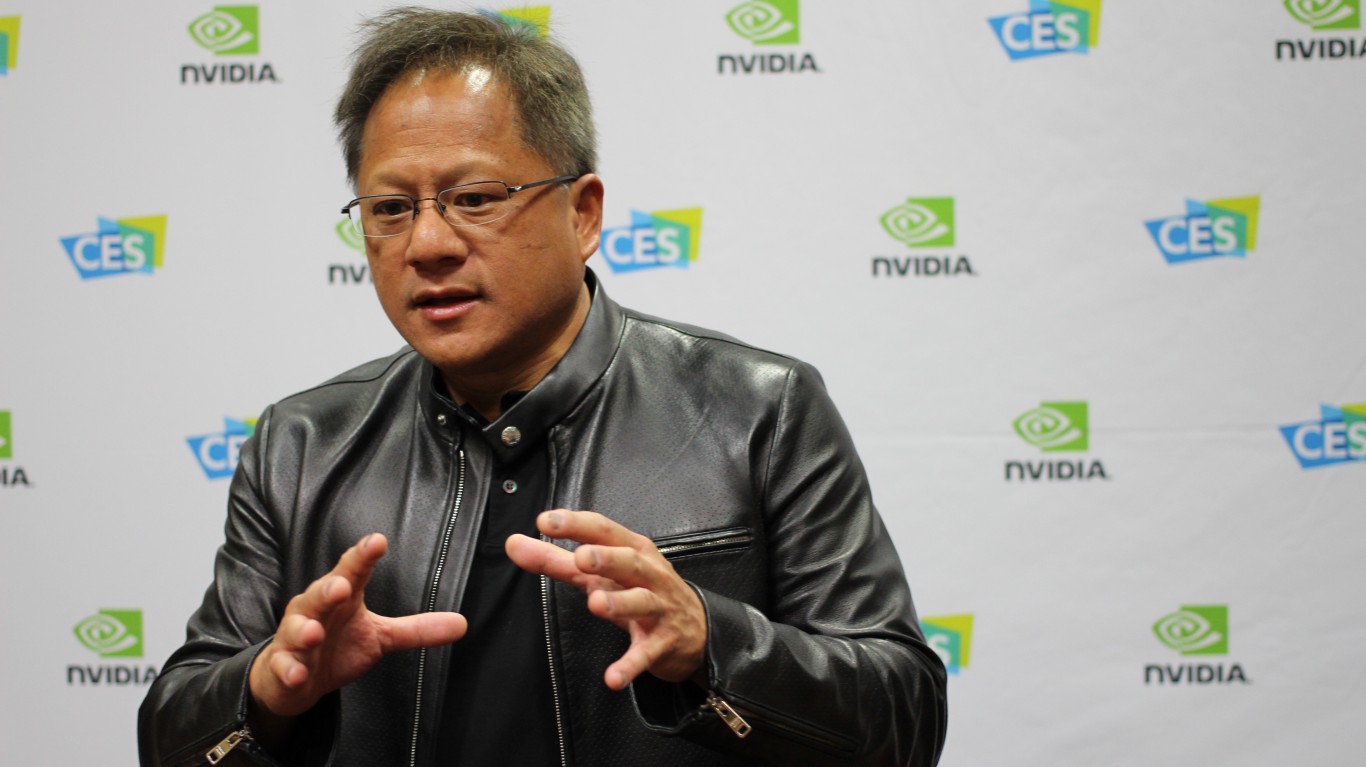
NVIDIA CEO Jensen Huang believes GPUs have the characteristics needed to support an entirely new infrastructure asset class.

“These partnerships are going to pull together independent long-term capital to fund and support AI infrastructure build-out, Huang said. “This is the first time in some 60 years that the computing industry is going through a fundamental platform shift.”

Huang also explained why NVIDIA GPUs can function as collateral for large infrastructure loans. It produces revenue, serves a broad market, improves in performance over time, and can be redeployed.”

NVIDIA could provide residual-value support of up to 25% on individual projects, while stable or rising GPU rental rates may help support the value of the underlying collateral.

Jim Cramer Compares NVIDIA’s AI Financing Push to the Auto Securitization Boom

Live

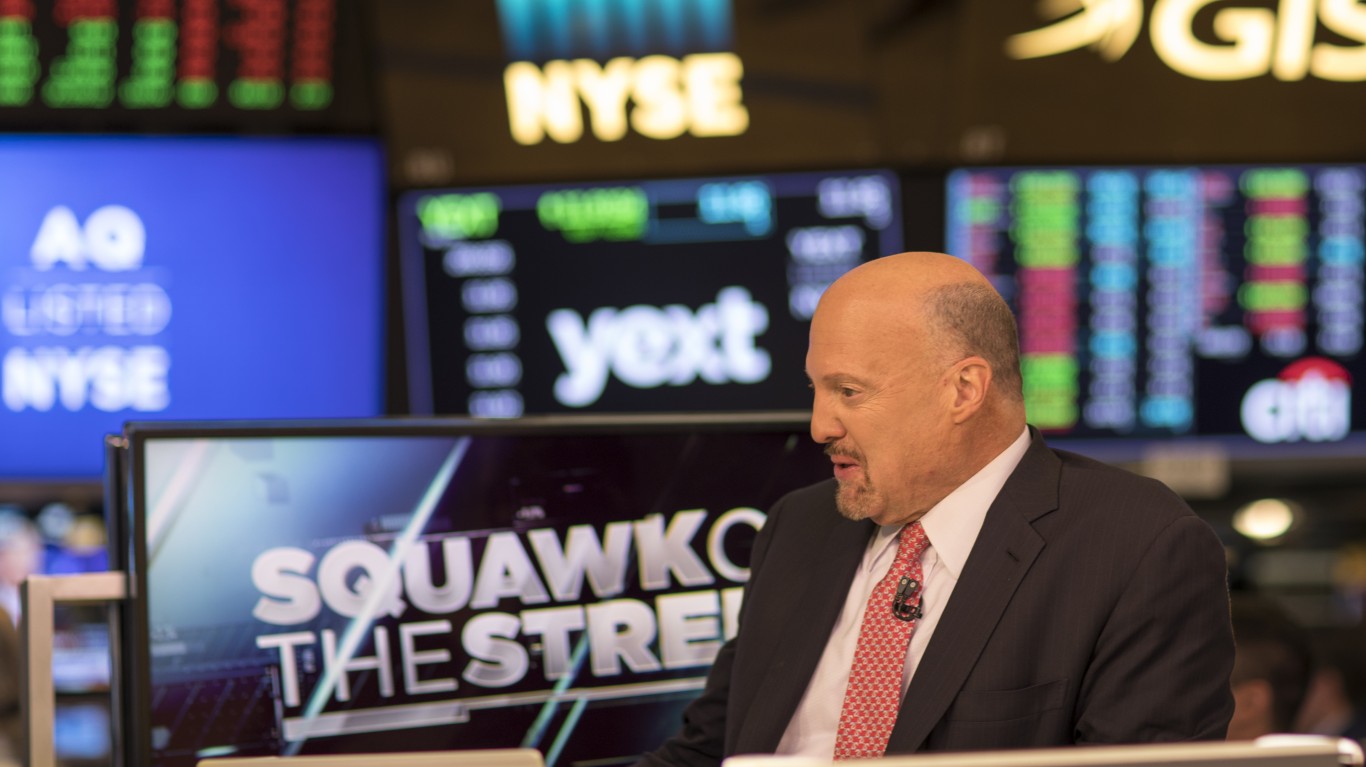
Jim Cramer believes NVIDIA’s new AI financing push could evolve into something resembling the auto securitization market.

Cramer recalled that when Goldman Sachs bankers pitched securitizing auto loans in 1985, skeptics argued that “autos don’t last that long.” NVIDIA’s chips are valuable assets, but they depreciate as newer, more powerful generations enter the market.

However, the higher yields on these securitized auto loans attracted investors, which helped turn auto-backed securities into a massive asset class. “It turned out that auto securitization is almost a $1 trillion market,” Cramer said. “I think this is like that.”

The comparison suggests that loans backed by NVIDIA GPUs could eventually be standardized, packaged, and sold to institutional investors, unlocking significantly more capital for the AI infrastructure buildout.

CoreWeave's Backlog Near $100 Billion, but Its Debt-Fueled AI Buildout Comes at a Cost

Live

The clearest case study is CoreWeave (NASDAQ:CRWV), the neocloud that NVIDIA has invested in and supplied. NVIDIA closed a $2 billion Class A common stock investment in the company, layered on top of a $6.3 billion strategic collaboration, and named CoreWeave its NVIDIA Exemplar Cloud for GB200 NVL72 inference. CoreWeave has since pioneered asset-backed lending models against Nvidia chips.

The scale is striking. CoreWeave’s CEO Michael Intrator said in the Q1 2026 release: “This was the strongest bookings quarter in CoreWeave’s history, with revenue backlog reaching nearly $100 billion.”

Revenue jumped 111.7% to $2.078 billion. However, capex was $7.695 billion in a single quarter, net loss was $740 million, interest expense doubled to $536 million, and total liabilities were $50.814 billion. Shares are down 31.93% over the past year despite a 23.15% year-to-date rebound.

NVIDIA Is Generating the Cash to Finance the Largest Infrastructure Buildout in History

Live

NVIDIA’s Q1 FY2027 revenue was $81.615 billion, up 85.2%, with Data Center revenue of $75.246 billion and free cash flow of $48.554 billion.

The company disclosed $119.0 billion in supply-related commitments and $30.0 billion in multi-year cloud service commitments. CEO Jensen Huang described the moment as “the buildout of AI factories, the largest infrastructure expansion in human history.”

NVIDIA’s upcoming Q2 FY2027 results on August 26 will offer the next major indication of whether AI demand can sustain its current momentum. Management is guiding for $91.0 billion in revenue, and a 75.0% non-GAAP gross margin, excluding China Data Center compute sales.

Polymarket traders assign a 96.1% probability that Data Center revenue exceeds $80 billion, compared with only an 18.5% chance that it surpasses $90 billion.

The stock currently trades at a forward P/E of 21.8, with an analyst target price of $302.83 against a current quote of $219.59. Insiders have been net sellers, with CEO Jensen Huang disposing of 445,723 shares in mid-June and director Mark Stevens moving more than 3.2 million shares across the June-August window.

A CNBC Morning Call Sheet roundtable on Tuesday, August 11, highlighted a shift that’s been building all year. NVIDIA (NASDAQ:NVDA | NVDA Price Prediction) is now helping to underwrite the AI buildout itself, standing alongside KKR, Goldman Sachs, and BlackRock as a co-financier of the data centers that will consume its own chips.

Defiance ETFs’ Sylvia Jablonski framed the pivot bluntly: Nvidia is now the Wall Street ecosystem financier. So what they’re doing is they’re pretty much bringing balance sheet, Wall Street balance sheet, to AI companies and to hyperscalers that want to spend but don’t want to use their own balance sheet.” Her follow-on captured the big concern right now among investors: “It feels a little bit circular, right, where they’re not only the provider of the actual chips themselves, but also now the financing for this build out.

NVIDIA’s 25% Backstop and Why It Matters

Options Play’s Tony Zhang zeroed in on the deal architecture: “After this news came out yesterday, Nvidia is only backstopping 25% of this particular deal. And I think it’s interesting that it’s moving on to Wall Street balance sheets as opposed to keeping them on the hyperscalers or Nvidia’s.” NVIDIA keeps skin in the game, but the bulk of the credit exposure rides with alternative-asset managers and banks that arrange the financing.

NVIDIA signed memorandums of understanding with Blackstone, BlackRock, Apollo Global Management, Brookfield Asset Management, Goldman Sachs, and KKR to create financing platforms for its customers.

The financial firepower is substantial. KKR & Co. (NYSE:KKR) closed Q2 2026 with $796.49 billion in AUM and $143 billion in uncalled commitments. BlackRock (NYSE:BLK) reported record $15.34 trillion in AUM and added roughly $230 million in private-credit fees through its HPS platform. Goldman Sachs (NYSE:GS) posted Q2 investment banking fees of $3.40 billion, up 55% year over year on leveraged finance and IPO activity tied to AI buildout.

The Chinese Price War Wildcard

Peter Boockvar of One Point BFG Wealth Partners tied the financing structure to a demand-side threat: “The companies that are going to be leasing these facilities like OpenAI and Anthropic, they’re now in a price war. When you look at the price of the models that are being sold, the Chinese are creating a war. And this is project finance.”

He thinks this could be dangerous for the builders of AI: “These companies that are going to be providing the computing power are no longer price makers. They are price takers because of the Chinese. So this is one big bet. We all hope it’s going to work out. I think it’s going to work out for the users of the technology, but I’m questioning whether it’s going to work out for the builders of the infrastructure.

What to Watch Next

NVIDIA’s Q2 FY2027 earnings report on August 26 will provide the next major test. The company expects $91.0 billion in revenue and a 75.0% non-GAAP gross margin, excluding China Data Center compute sales. Polymarket currently gives NVIDIA a 96.1% chance of exceeding $80 billion in Data Center revenue, but just an 18.5% chance of topping $90 billion.

CoreWeave’s Q2 results will offer another important signal by showing whether its massive backlog is converting into deployed computing capacity on schedule. Together, these reports should help investors determine whether AI demand is growing quickly enough to justify the enormous infrastructure investments now being financed by NVIDIA and Wall Street.

Contact [email protected] for any questions or corrections.

Photo of Thomas Richmond
About the Author Thomas Richmond →

Thomas Richmond is a financial writer and content strategist with 5+ years of experience covering stocks and financial markets. He has published over 250 articles focused on individual stock analysis, helping investors better understand business fundamentals, stock valuations, and long-term opportunities.

Thomas previously served as a Content Lead at TIKR, a stock research platform, where he helped scale the company’s blog to hundreds of articles per month and contributed to a weekly newsletter reaching more than 100,000 investors.

He specializes in breaking down complex companies into clear, actionable insights for everyday investors, with a focus on fundamentals-driven research.

His work has also been featured on platforms including Seeking Alpha and Sure Dividend.

Outside of work, Thomas enjoys weight lifting and soccer.

Live: NVIDIA Creates a $500 Billion AI Financing Pool. These Stocks Could Win

© BenBen Lam via YouTube

Continue Reading

Top Gaining Stocks

KKR
KKR Vol: 3,040,512
APO Vol: 2,759,891
AXON Vol: 727,301
JBL Vol: 368,004
BX Vol: 4,287,946

Top Losing Stocks

CTRA Vol: 73,319,495
DECK Vol: 1,411,455
VTR Vol: 1,687,548
ORCL Vol: 16,873,460
HON Vol: 2,627,760