





Baby boomers reassessing income positions this August face a familiar challenge: how do you build a paycheck-replacement portfolio that keeps paying regardless of market conditions? The answer is owning a mix of dividend structures, each doing a different job. A defensive compounder anchors the base. A midstream MLP layers in higher cash yield. A business development company stretches for double-digit income where the risk premium justifies it.
Here are three dividend stocks, one from each bucket, that a retiree could reasonably hold for the rest of their life.
Procter & Gamble (PG): The Wealth Preservation Anchor
Procter & Gamble (NYSE:PG | PG Price Prediction) is the closest thing to a bond substitute in the equity market. The consumer staples giant carries a market cap of roughly $335 billion, a beta of 0.38, and a dividend record almost no company on Earth can match. P&G has paid dividends for 136 consecutive years since 1890 and raised the payout for 70 straight years. Custom research this summer put the raise streak at 71 consecutive years. Either way, this is Dividend King territory.
The most recent quarterly payout is $1.0885 per share, up from $1.0568, with the next payment scheduled for August 17, 2026. The dividend yield sits at 2.92%, modest on paper but backed by $15.84 billion in fiscal 2026 free cash flow and a planned $10 billion in dividends plus $5 billion in buybacks in FY2027.
Q4 core EPS came in at $1.43 versus $1.41 estimates, the fifth straight beat. CEO Shailesh Jejurikar framed the year this way: "Fiscal 2026 was a year of foundation building while continuing to grow sales and profit and return high levels of cash to shareowners despite a very challenging geopolitical and economic environment."
The risk: management flagged a roughly $1 billion after-tax headwind from commodity, energy, and transport costs in FY27, and Q4 net income fell 14.8% year over year. P&G is wealth preservation. Every retirement portfolio needs an anchor like that.

Enterprise Products Partners (EPD): The High-Yield Midstream Workhorse
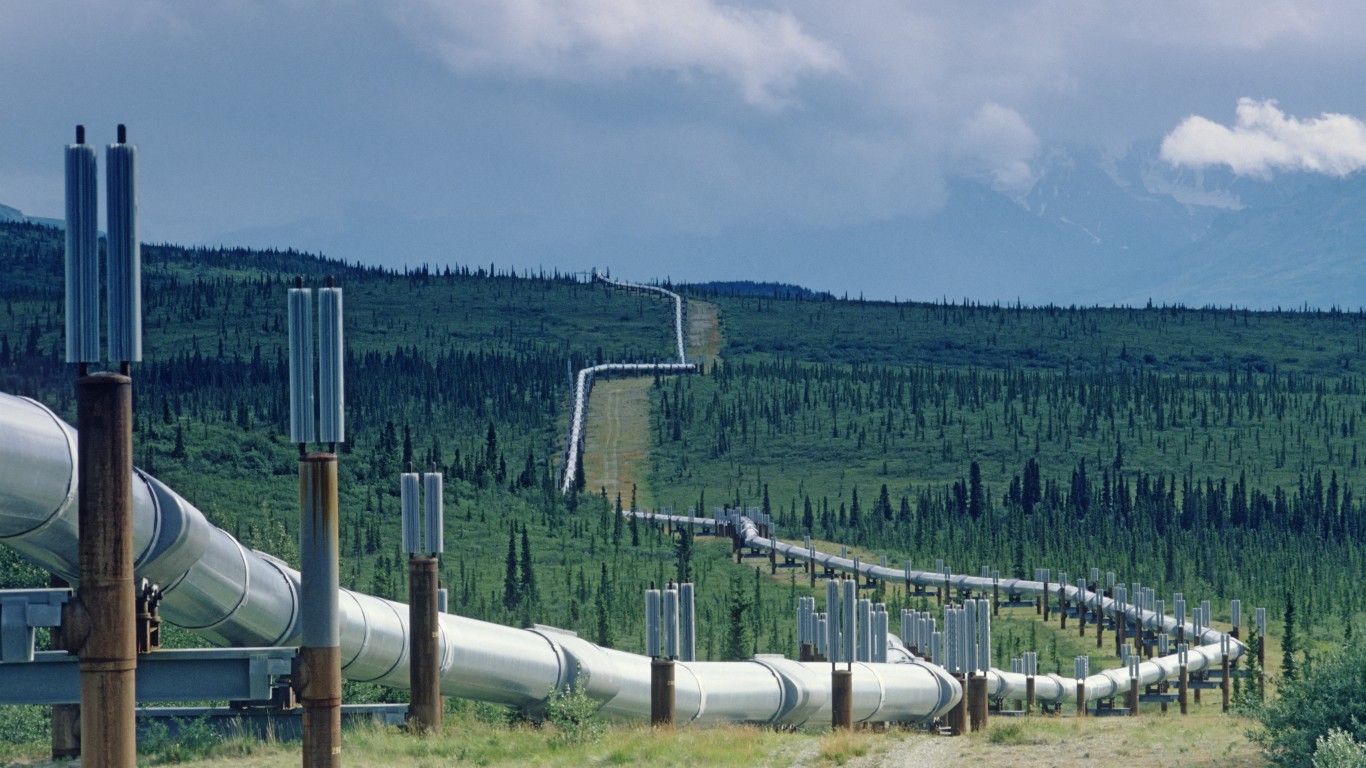
Enterprise Products Partners (NYSE:EPD) is a master limited partnership (which issues a K-1 tax form instead of a 1099, worth flagging for retirees). It sits on a 27-plus year streak of distribution growth and just raised its quarterly payout to $0.56 per unit, an annualized $2.24. At current prices, that translates to a dividend yield near 5.67%.
Q2 was a record quarter: adjusted EBITDA of $2.83 billion, up 17% year over year, operational distributable cash flow of $2.3 billion (up 21%), and a distribution coverage ratio of 1.9x. Pipeline volumes hit a record 14.7 million barrels per day, and marine terminal volumes jumped 33% YoY. This is fee-based cash flow, not a commodity price bet.
Unitholders are being paid handsomely. EPD has returned 30.73% over the past year and 140.41% over the past five, with a $6.5 billion organic growth backlog anchored by Permian gas plants and an LPG export terminal expansion coming online by year-end 2026.
CEO Jim Teague summarized the quarter: "Enterprise reported strong volumes, earnings and cash flow for the second quarter of 2026. The partnership handled record pipeline and marine terminal volumes during the quarter due in part to strong international demand for U.S. energy…"
The risk: the K-1 filing complexity, $34.2 billion in debt, and exposure to global shipping disruption. For income investors willing to handle a K-1, the coverage cushion makes the distribution one of the most defensible high yields in energy.
Ares Capital (ARCC): The Double-Digit BDC Yield
Ares Capital (NASDAQ:ARCC) is the largest publicly traded business development company. BDCs are required to distribute substantially all taxable income to shareholders, which is why the structure produces such high yields. Ares delivers a 10.3% dividend yield on a $0.48 quarterly payout, or $1.92 annualized. The next payment lands on September 30, 2026.
What separates Ares from the yield-trap crowd is longevity. The company has 17 consecutive years of stable or increasing regular quarterly dividends, and the r/dividendinvesting community has flagged the same point, noting the yield "has held for 67 consecutive quarters" with a bullish sentiment score of 72.
The portfolio spans $29.35 billion across 619 companies, is 71% floating rate, and generates a weighted average yield on debt securities of 10.3% at amortized cost. Q2 core EPS was $0.47, in line with estimates, and net investment income rose to $359 million. Analyst sentiment is constructive: 4 Strong Buy, 7 Buy, 3 Hold, and 0 Sell ratings.
CEO Kort Schnabel highlighted the underwriting discipline: "We reported solid second quarter results, supported by consistent Core Earnings, healthy portfolio performance and historically low levels of non-accruing loans and problem assets…"
The risk: non-accruals ticked up to 2.4% from 1.8% at year-end 2025, NAV per share slipped to $19.35 from $19.94, and Q2 booked $183 million in unrealized losses. BDCs are credit-cycle sensitive by design. But at a 0.97x price-to-book and a proven playbook, Ares remains the BDC most income investors either own or wish they had bought lower.
Three structures, three risk profiles, one common thread: durable cash to a retiree’s mailbox for decades to come.
Contact [email protected] for any questions or corrections.













 Top Gaining Stocks
 Top Losing Stocks