Nelson Peltz Put 42% of His Fund Into One Stock, Then Took the Whole Company Private
Nelson Peltz spent five years pushing Janus Henderson to fix itself in public, then made a move that activists almost never make, and it reveals something unsettling about every active asset manager still trading on a stock exchange.

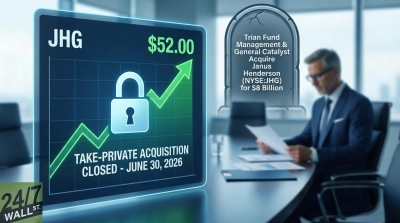
Nelson Peltz’s Trian Fund Management, alongside General Catalyst, closed its take-private acquisition of Janus Henderson (NYSE:JHG) on June 30, 2026, at roughly $52 a share and around $8 billion in total value. The vote that mattered came in April 2026, when shareholders overwhelmingly approved the deal. What makes this transaction interesting to a retirement investor is what Peltz did next.
Trian first disclosed its stake in late 2020 and spent the following five years in constructive engagement pushing Janus Henderson toward the same thing every activist eventually wants from a subscale asset manager: consolidation, scale, cost discipline, and a re-rating. The re-rating never fully arrived in the public markets. So Peltz did the thing activists rarely do. He stopped trying to fix the company in public and bought it.
The price he paid is the first tell. Peltz raised his own bid from $49 to roughly $52 to get the transaction across the line, agreeing to pay more than double where the stock traded when Trian first appeared. The second tell is bigger. Rather than accept cash for the position Trian had built, Peltz rolled 25,136,205 shares into Jupiter Topco LLC, the private acquisition vehicle. That is a doubling down at a higher basis, in an illiquid wrapper, with a longer time horizon.
What He Owns Now
Janus Henderson finished the March quarter with roughly $480 billion in AUM, up 29% year over year, $690 million in Q1 2026 revenue, up 11%, and an adjusted operating margin of 31.5%. Long-horizon performance is respectable, with 66%, 67%, and 68% of AUM outperforming benchmarks on 3-, 5-, and 10-year windows. Short-term performance is the sore spot: only 37% of AUM is outperforming on a one-year basis, and performance fees turned negative by $7.1 million in the first quarter.
Which is where the strategic logic gets interesting. Bloomberg reported Peltz plans an AI overhaul of the business, an expensive, multi-year, headcount-disruptive rebuild that quarterly earnings calls tend to punish. Active managers are being squeezed by passive flows and by clients who now expect model portfolios and separately managed accounts wired into their advisor tech stacks. Fixing that under public scrutiny means every restructuring charge becomes a bear-case bullet point. Doing it privately means the P&L can absorb the rebuild without a quarterly referendum.
Should You Follow the Trade?
You cannot follow it. Janus Henderson delisted, the regular dividend was suspended, and earnings conference calls are being discontinued. Public shareholders received cash at $52, a price Peltz himself raised to secure. Anyone still holding JHG at the close received the exit Peltz declined to take.
The transferable lesson is what an activist rolling equity, rather than cashing out, actually means. It says the public market was mispricing what he thought the franchise was worth, and that the value creation from here needs privacy to happen. For a retirement investor, the read-through is toward the rest of publicly traded active asset management. If a five-year insider believes the fix requires escaping the quarterly cycle, the firms still stuck inside that cycle- Janus Henderson finished 2025 with $56.5 billion in full-year net inflows and still could not get the re-rating- are the ones to examine skeptically, not to chase.
Contact [email protected] for any questions or corrections.
Omor Ibne Ehsan is a writer at 24/7 Wall St. He is a self-taught investor with a focus on growth, cyclical, and dividend equities that have strong fundamentals, value, and long-term potential. He also has an interest in high-risk, high-reward investments such as penny stocks.