Why Bulls Remain High on Palantir As It Passes $170
Palantir just posted numbers that forced analysts to rethink what kind of company they are actually valuing, but the metric that defines the bull case also sets the exact threshold where the entire thesis falls apart.


At $172.01, Palantir Technologies (NASDAQ:PLTR | PLTR Price Prediction) screens constructively for research. The stock reclaimed the $170 handle after posting numbers that reframed what the business actually is.
Palantir sells three software platforms: Gotham, Foundry, and the Artificial Intelligence Platform (AIP), which increasingly serve as the operational backbone for how governments and enterprises deploy AI on their own data. After a 39.78% one-week gain and a 30.09% one-month gain, the stock is trading near where fundamentals argue it belongs.
Why the Post-Earnings Rerating Is Justified
Q2 delivered $1.935 billion in revenue, up 92.83% year over year, with EPS of $0.41 beating the $0.346 consensus and marking the ninth consecutive beat. U.S. commercial revenue accelerated 149% to $764 million, and net dollar retention expanded 700 basis points to 157%.
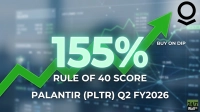
Profitability is the twist. Adjusted operating margin expanded from 46% to 62%, free cash flow reached $1.22 billion, and the Rule of 40 score hit 155%. Management raised FY2026 revenue guidance to $8.150 to $8.158 billion, an 11-point lift versus prior guidance. CRO Ryan Taylor called the quarter “unprecedented, but entirely unsurprising.”
Why the Multiple Terrifies Skeptics
Palantir trades at a trailing P/E of 147 and a forward P/E of 110, with a price-to-sales ratio of 67. That valuation assumes hypergrowth persists for years without stumble.
Stock-based compensation ran $265 million in the quarter, insider activity across 70 recent transactions skewed toward selling, and government contracts remain terminable for convenience. The stock is down 5.59% over one year and down 3.23% year to date, versus roughly flat action for the S&P 500 between $771.33 and $773.26.
Why Patience Has an Argument
The case for patience rests on entry timing. Shares round-tripped from a 52-week low of $106.37 to a high of $207.52, and prediction markets on Polymarket show 83%+ probability of the stock parking in the $171 to $174 zone this week, implying limited near-term slack.
Waiting for the next quarterly print to confirm U.S. commercial durability is defensible, especially with SBC dilution active and the 200-day moving average at $152.28. The cost of patience is missing further compounding if guidance proves conservative.
The Data Behind the Verdict
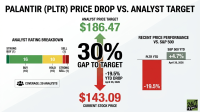
Palantir trades at $172.01 against a consensus analyst target of $189.90, implying roughly 10% upside. The ratings breakdown:
- Strong Buy: 1
- Buy: 19
- Hold: 10
- Sell: 1
- Strong Sell: 1
Over five years, the stock has returned 688.31%, dwarfing broad market indices. The put/call ratio sits at 0.43, a bullish tilt in options positioning.
The Verdict on Palantir at $172
At $172, the setup screens constructively based on the fundamentals below.
The thesis rests on the belief that Palantir is building the foundational software substrate for enterprise AI execution, and Q2 supplied the first quarter of hard evidence that scaling this substrate carries expanding, not compressing, margins. A 155% Rule of 40 reads as a category-definition metric, well beyond typical SaaS benchmarks.
The path to appreciation runs through the raised U.S. commercial floor of $3.424 billion, the $6.24 billion in U.S. commercial remaining deal value (up 124%), and Karp’s stated goal to “drive the business to grow at a rate equal or above to what we have in U.S. commercial for the next 18 months.” Miss that, and the multiple compresses fast. Hit it, and $172 will look like a coupon.
The thesis invalidates if U.S. commercial growth decelerates below 100% or if government renewals slip. Until then, the multiple is the price of admission for the only public pure-play on sovereign AI infrastructure generating $1.22 billion in quarterly free cash flow.
Contact [email protected] for any questions or corrections.
Alex Sirois is a financial writer with experience spanning both retail and institutional investing. He has written for InvestorPlace and held roles at BNY Mellon and Bernstein, giving him a perspective that bridges Main Street portfolios and Wall Street analysis.
Alex holds an MBA from George Washington University and has built his career across multiple industries, including e-commerce, education, and translation — a breadth of experience that informs how he breaks down complex financial topics for everyday investors. His writing is conversational, actionable, and grounded in long-term, buy-and-hold investing principles.
At 247 Wall St., Alex focuses on delivering analysis that is both accessible and useful, with a clear emphasis on helping readers make more informed decisions with their money.