Michael Burry Sounds the Alarm Again: AI Is a Circular Financing Web With Nvidia In the Middle
Michael Burry is pointing at a $770 billion AI spending wave and asking whether the money circling through hyperscalers, chip makers, and AI labs is creating real value or just the appearance of it.

This post may contain links from our sponsors and affiliates, and Flywheel Publishing may receive compensation for actions taken through them.

Corporate America is expected to pour some $770 billion into AI infrastructure in 2026, and the credit markets are starting to ask a pointed question: whose money is actually paying for it? The Bank for International Settlements addressed exactly that in its late-June Annual Report, warning that hyperscaler debt tied to AI buildouts is growing faster than the balance sheets carrying it.
That’s the backdrop for Michael Burry’s latest post on X, where the investor who shorted subprime mortgages before the 2008 crash shared a Bloomberg diagram tracing how AI revenue keeps showing up strong even as free cash flow turns negative. His conclusion: the money is circling, not multiplying.
The Circular Financing Loop, Mapped in Dollars
The Bloomberg diagram Burry shared traces roughly $46 billion in direct equity stakes and $879 billion in multi-year purchase commitments moving between Microsoft (NASDAQ:MSFT | MSFT Price Prediction), Oracle (NYSE:ORCL), Amazon (NASDAQ:AMZN), Google, Meta Platforms (NASDAQ:META), OpenAI, Anthropic, xAI, CoreWeave (NASDAQ:CRWV), Nvidia (NASDAQ:NVDA), and Advanced Micro Devices (NASDAQ:AMD).
Oracle alone committed $300 billion in purchases tied to OpenAI. Microsoft committed roughly $250 billion of its own. OpenAI then turned around and committed $90 billion to AMD while also taking a direct equity stake in Nvidia.
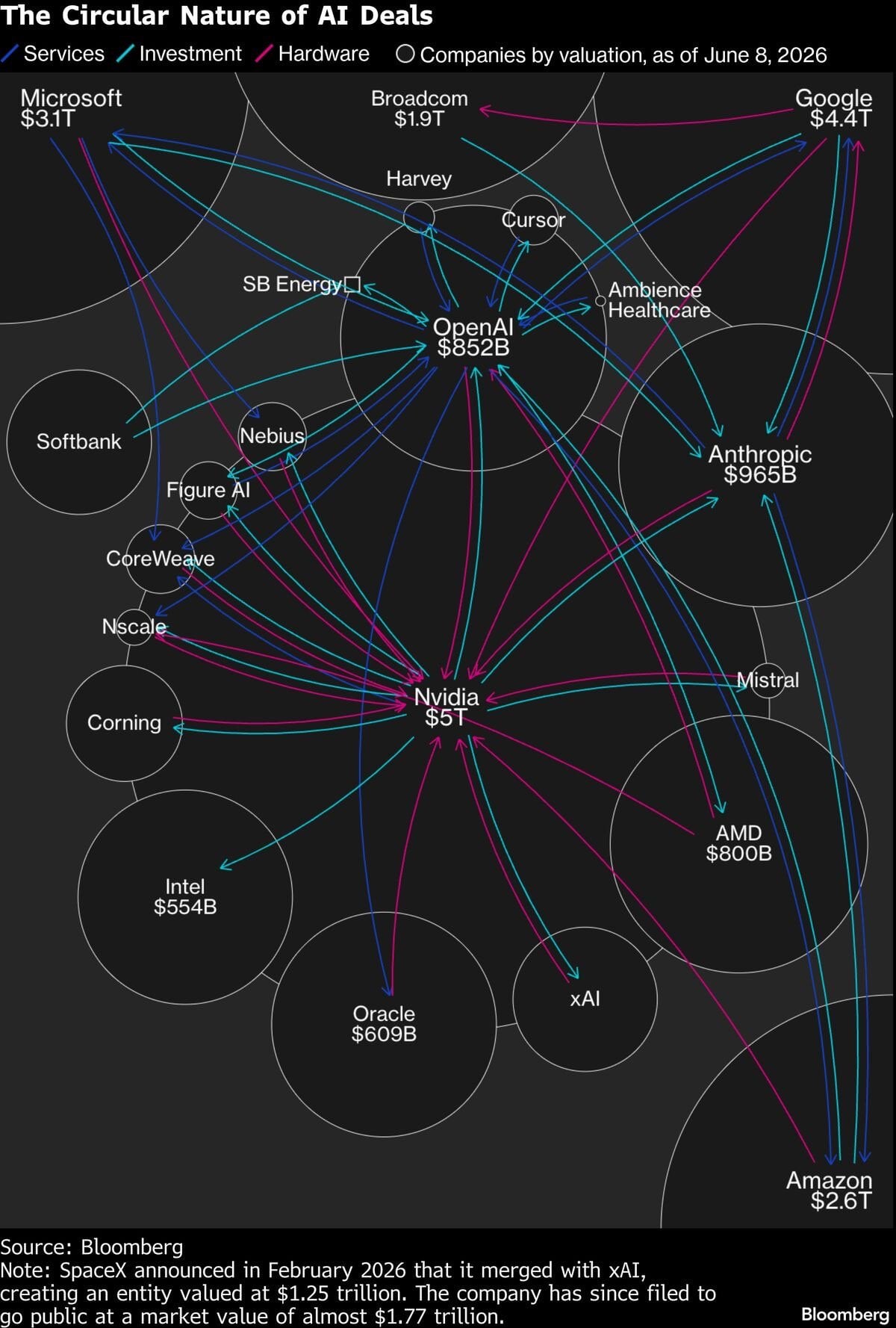
Nvidia sits dead center of the web at a $5.4 trillion valuation today. Every company on the list has lines running to Nvidia, either as an investor, a customer, or both. That’s not necessarily fraud — Jensen Huang has publicly called the circular financing label “ridiculous” — but it does mean the same dollar can show up as revenue at more than one stop on the chain.
Anthropic and OpenAI combined are worth roughly $1.8 trillion despite neither being profitable, and both depend on continued hyperscaler funding to keep buying the chips that justify those valuations.
The mechanics are simple, even if the spreadsheet isn’t: a hyperscaler funds an AI lab, the lab spends that money on compute from the hyperscaler, and the hyperscaler books the spending as revenue. Run that loop enough times and top-line growth stops telling you much about actual customer demand.
The Credit Market Is Already Pricing This In
The BIS estimates the five largest hyperscalers are carrying roughly $1.65 trillion in off-balance-sheet debt through special purpose vehicles and off-balance sheet arrangements, exceeding the $1.35 trillion they report directly.
That gap matters because SPV debt doesn’t show up in the leverage ratios investors typically screen for. It shows up instead in credit default swaps, and Nvidia’s five-year CDS spread has roughly doubled over the past two months, according to data Burry cited in his post.
Not every investor reads this as a red flag. Chris Camillo, the founder and CEO of TickerTags, a social data intelligence company, has argued the circular financing The money loop works fine as long as AI delivers enough actual value to justify the spending — and to be fair, Nvidia still generated close to $48 billion in free cash flow in a recent quarter, real cash, not accounting fiction.
That’s the counterargument in a nutshell: the vendor financing isn’t automatically a problem if the underlying product keeps selling itself.
Key Takeaway
In short, the concern isn’t that AI companies are lying about revenue — it’s that the revenue is increasingly self-referential, and the debt backing it is increasingly invisible on a standard balance sheet.
Investors holding Nvidia, Microsoft, or Oracle don’t need to panic-sell on a single post by Burry. But they should watch two numbers going forward: hyperscaler off-balance-sheet debt disclosures in coming 10-Qs, and Nvidia’s CDS spread as a real-time gauge of how credit markets are pricing this risk.
Ultimately, a portfolio concentrated in one end of this loop is making a bet on the whole web holding together — and that’s a bet worth sizing carefully, not avoiding entirely.
Contact [email protected] for any questions or corrections.
After two decades of patrolling the dark corners of suburbia as a police officer, Rich Duprey hung up his badge and gun to begin writing full time about stocks and investing. For the past 20 years, he’s been cruising the markets looking for companies to lock up as long-term holdings in a portfolio while writing extensively on the broad sectors of consumer goods, technology, and industrials. Because his experience isn’t from the typical financial analyst track, Rich is able to break down complex topics into understandable and useful action points for the average investor. His writings have appeared on The Motley Fool, InvestorPlace, Yahoo! Finance, Money Morning, and, of course, 24/7 Wall St. He has been featured in both U.S. and international publications, including MarketWatch, Financial Times, Forbes, Fast Company, and USA Today.