“I Think You Have a Winner” Cramer Excited About Hess Midstream’s 7% Dividend Yield
A Pennsylvania caller pitched Jim Cramer a midstream stock his son had been tracking, citing a dividend streak that stretches back 37 consecutive quarters without a single cut or flat payment. Cramer had a verdict, but the caller's own portfolio…

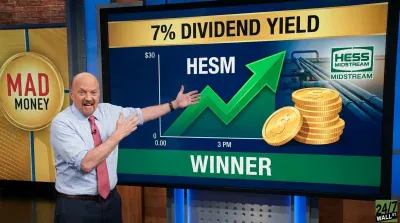
Brian, a caller from Pennsylvania, phoned in to Mad Money on August 13, 2026 with a stock his son had been researching. “My son has been following a stock that has over a 7% dividend yield, and they’ve historically raised the dividend every quarter,” he told Jim Cramer, before asking whether he should build a position in Hess Midstream (NYSE:HESM | HESM Price Prediction). Cramer’s verdict landed quickly: “I happen to like Hess Midstream. I happen to like the midstreams, especially Hess… I think you have a winner.”
The Caller’s Case
Brian built his question around two claims. The first was the yield: over 7%, as he described it on air. The second was more striking: Brian said the company had “historically raised the dividend every quarter.” That assertion about a partnership public since 2017 holds up cleanly when checked against the record. Brian also flagged something Cramer glossed past: “Chevron happens to make up about 3.5% of my portfolio.”
What the Distribution Record Actually Shows
Hess Midstream pays quarterly distributions, and the dataset contains 37 records going back to 2017. Every payment in that series is larger than the one before it. There is no cut and no flat quarter anywhere in the progression, which runs from $0.2703 in 2017 to $0.7888 today. That works out to an average annual growth rate of roughly 11% over nine years, which puts the consistency of the streak in sharper relief.
The most recent distribution was declared July 27, 2026, went ex-dividend on August 6, 2026, and was paid on August 14, 2026, at $0.7888 per share. The prior payout was $0.7792. Trailing twelve-month distributions total $3.0869, and the annualized forward figure sits at $3.1552. On the Q2 2026 earnings call, CEO Jonathan Stein reiterated a “targeted 5% annual distribution growth, which we expect to continue.” Past distribution growth does not guarantee future distributions.
The Q2 2026 Numbers Behind the Story
Hess Midstream’s second-quarter 2026 results gave income-focused holders a fresh look at the underlying finances. Net income came in at $173.7 million, with $96.4 million attributable to Class A shareholders, or $0.75 basic earnings per share. Adjusted EBITDA reached $314 million, producing a gross adjusted EBITDA margin of roughly 85%, well above the company’s stated 75% target. Revenue of $399 million slipped about 4% from $414 million a year earlier, as lower Bakken throughput from reduced new-well activity and planned maintenance at the Tioga Gas Plant offset higher tariff rates and growing third-party services.
Management kept its full-year 2026 guidance unchanged: adjusted EBITDA of $1.225 billion to $1.275 billion and adjusted free cash flow of $910 million to $960 million, which the company says represents roughly 20% growth at the midpoint from the prior year. Excess cash after distributions is targeted toward share repurchases and debt reduction, with leverage expected to decline from roughly 3 times toward 2.5 times by 2028.
Cramer’s Answer and the Chevron Link
Cramer stated a preference for the midstream category and for Hess Midstream in particular. He also connected the dots on the customer relationship: “Hess was bought by Chevron, which is why they had the related Chevron.”
Chevron (NYSE:CVX) closed its acquisition of Hess Corporation on July 18, 2025, in an all-stock deal valued at approximately $48 billion. Hess Midstream is a separate, publicly traded partnership that was not itself acquired. Its anchor customer is Hess Corporation, now a Chevron subsidiary, which holds an approximately 38% ownership interest in Hess Midstream as part of that transaction. One year after the close, Chevron CFO Eimear Bonner said on CNBC that the company is “fully integrated” and had already realized $1.5 billion in synergies, 50% more than initially targeted and six months ahead of schedule.
Midstream operators handle gathering, processing, transportation and storage of oil and gas rather than drilling for it, and revenue typically comes from fee-based contracts with producers. That fee-based structure is central to why these partnerships attract income-focused holders: cash flows are relatively predictable even when commodity prices move. The flip side, visible in Q2’s revenue dip, is that throughput volumes depend directly on how much the anchor customer drills.
The Question Cramer Did Not Answer
Brian effectively asked two questions on that call, and Cramer answered the one about the stock. The other was buried in the setup: he already holds Chevron at about 3.5% of his portfolio, and he is considering adding a company whose principal customer relationship runs through Chevron. As Hess Midstream itself noted in its Q2 2026 filings, its results depend materially on Chevron’s drilling plans, nominated volumes, and ability to meet its contractual obligations to the partnership.
A reader in a similar position might reasonably think about what that stacking looks like. Both names sit in energy. Both depend, to different degrees, on Chevron’s Bakken development pace and capital allocation choices. This is a consideration to weigh, not a criticism of Cramer’s view on the stock itself and not advice on what any particular investor should do.
Where the Stock Stands
Hess Midstream closed on August 13, 2026 at $39.78, down 0.75% on the day. The units were up 22.58% year to date from $32.45 at the end of 2025, up 2.62% over the prior year from $38.77 on August 13, 2025, and up 137.7% over five years from $16.74 on August 13, 2021. Market capitalization sits at approximately $5.14 billion.
The Kicker
A distribution record that runs uninterrupted across 37 quarterly payments, with every payment larger than the one before, is unusual in any corner of the market. That is the part of Brian’s case that stands on its own regardless of whose verdict you find persuasive, and it is the part any prospective holder can verify without taking anyone’s word for it. This article is informational and not a recommendation on either stock.
Editor’s note: This update adds Hess Midstream’s Q2 2026 financial results (net income of $173.7 million, adjusted EBITDA of $314 million, and full-year guidance of $910 million to $960 million in free cash flow), the confirmed close date and purchase price of Chevron’s acquisition of Hess Corporation, Chevron’s approximately 38% ownership stake in Hess Midstream, and the one-year integration milestone of $1.5 billion in realized synergies. The nine-year average annual distribution growth rate of roughly 11% was also added to contextualize the 37-quarter streak.
Contact [email protected] for any questions or corrections.
AJ spent 10 years writing about financial markets at The Motley Fool. His coverage centers on technology stocks and the broader macroeconomic trends, from interest rates to geopolitics, that shape where markets are headed next. AJ is drawn to the stories where big-picture economics and individual companies collide.