Is NVIDIA’s $500 Billion Fund Jensen Huang’s Best Chess Move Yet or a Red Flag?
Jensen Huang just structured a $500 billion compute fund with a design that one Wall Street CEO compared to the invention of mortgage-backed securities, and that reference alone should make every AI investor stop and think carefully about what comes…

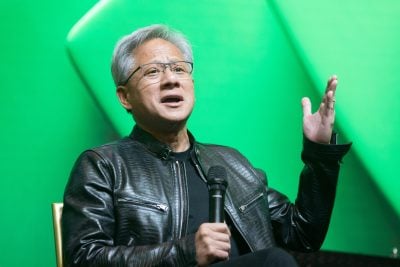
This article recaps a segment from The AI Investor Podcast, where hosts Eric Bleeker and Austin Smith unpacked NVIDIA’s newly announced $500 billion investment partnership and what it means for the pecking order of AI infrastructure. The conversation moves across three tickers investors should be watching: NVIDIA (NASDAQ:NVDA | NVDA Price Prediction), Nebius Group (NASDAQ:NBIS), and Goldman Sachs (NYSE:GS). The framing question: is Jensen Huang engineering a durable financing flywheel for the AI buildout, or planting the seed of a structured credit problem that echoes an earlier era of Wall Street engineering?
Watch The Full Segment
Below is the embedded episode from The AI Investor Podcast, A New Portfolio Add In Our Most Important Episode Of The Year, hosted by Eric Bleeker and Austin Smith. The compute fund discussion is one segment of a wider conversation on NeoCloud economics and portfolio positioning.
If you can’t view this video, you can copy and pate the following URL in your browser: https://youtu.be/98dk_2os6sg?si=sa3KmDy4bGBJAXWC
What The $500 Billion Compute Fund Actually Is
24/7 Wall St. Analyst Eric Bleeker walked through the plumbing first. The fund is structured with NVIDIA providing a 25% backstop, putting roughly $125 billion of capital at risk, while the remaining exposure sits inside special purpose vehicles (SPVs). In plain language, an SPV is a legal entity created to hold specific assets and specific debt, separated from the parent company’s balance sheet. Lenders finance the SPV, the SPV owns the GPUs and data center capacity, and NeoCloud operators lease that compute. NVIDIA’s 25% backstop is essentially a first-loss cushion that makes senior lenders comfortable enough to fund the rest.
The strategic goal Bleeker identified is diversification. Hyperscalers currently account for roughly half of NVIDIA’s business, a concentration that reads clearly in the company’s own filings. NVIDIA reported Data Center revenue of $75.25 billion in Q1 FY2027, up 92% year over year, with hyperscale contributing roughly 50% of data center revenue. Financing the second tier of buyers, the NeoClouds, gives NVIDIA a way to keep the demand curve extending even if hyperscaler capex plateaus.
The Bull Case Bleeker Made
Bleeker’s framing was that this is a strategic move to broaden the base of NVIDIA’s revenue stream. New financing mechanisms are one of the key ways the AI industry can push its spending ceiling past $1.5 to $2 trillion and sustain growth through 2028 to 2030. That thesis lines up with Jensen Huang’s own framing on the most recent call, where he described “the buildout of AI factories, the largest infrastructure expansion in human history” and pointed to hyperscale capex forecast of $1 trillion in 2027 and AI infrastructure spending projection of $3 to $4 trillion annually by end of decade.
Jensen’s own language on the earnings call made the NeoCloud case explicit. He described NVIDIA’s architecture as “the most rentable of any computing platform in the world”, and added that it is “the easiest to finance.” A $500 billion financing vehicle turns that claim into infrastructure.
The Discomfort Smith Raised
Austin Smith accepted the strategic logic and directed his pushback at the framing coming out of Wall Street. A Goldman Sachs CEO compared the moment to the birth of mortgage-backed securities in the 1970s, and Smith flagged that as a poor choice of words given how the mortgage-backed securities story ended in 2008. The point Smith made is a comparison problem worth examining on its own terms. Any SPV-heavy financing stack that securitizes cash flows from a single asset class carries structural risk that investors should understand before capital gets deployed at scale.
Goldman Sachs itself has been a direct beneficiary of the AI financing boom with recent quarters showing strong results in Global Banking & Markets and investment banking fees. CEO David Solomon has framed the environment as supportive of continued deal flow. Goldman shares trade at $1,039.42 as of August 14, 2026, up 19.38% year to date.
Why Nebius Is The Cleanest Read On The Thesis
The NeoCloud tier is where the compute fund will likely land, and Nebius is the clearest listed proxy. The week served as a microcosm of NeoCloud volatility: SpaceX’s planned 2027 buildout announcement caused selloffs, then the NVIDIA fund news and Nebius reporting higher compute rates in its earnings sent the stocks back up.
The Q2 2026 earnings report from Nebius supports the pricing story Bleeker referenced. Group revenue reached $582 million, up 454% year over year, with the Nebius AI Business generating $575 million, up 514% year over year. Management flagged a capacity auction that cleared at 15% above the highest price previously charged for Blackwell generation chips, and reported short-term premium capacity pricing in the $40 to $50 million per megawatt range. NVIDIA has already put capital into the company directly through a strategic equity investment via pre-funded warrants, and a multi-year Meta agreement anchors the demand side.
The market response has been sharp. Nebius shares trade at $277.68 as of August 14, 2026, up 47.73% over the past week, 231.74% year to date, and 305.61% over the past year. Analyst consensus sits at a target of $250.75 with 10 Buy ratings and 5 Hold ratings in the last check.
The Holding Question
The headline question deserves both readings, and the hosts kept both on the table. Bleeker’s case is that NVIDIA is engineering a financing rail that turns compute into an investable asset class, extending demand well beyond hyperscaler wallets and pushing the AI capex ceiling higher into the back half of the decade. Smith’s flag is that the reference point Wall Street reached for should give investors pause about the plumbing under the hood, particularly when SPV structures carry a specific historical pattern of masking concentration risk.
Subscribe To The AI Investor Podcast
If you enjoyed this segment, subscribe to The AI Investor Podcast for weekly breakdowns of the stocks, suppliers, and infrastructure names powering the AI buildout. New episodes are available on YouTube, Apple Podcasts, Spotify, and all major podcast providers. Recent episodes are linked below. We’ve recommended more than 50 stocks (for free!) on the podcast, and our average recommendation is up 147%. Don’t miss out on the biggest news in the investing world and new stock recommendations each week!.
Contact [email protected] for any questions or corrections.
Eric Bleeker, CFA has been investing for more than 20 years. He began his career working at Microsoft before joining Motley Fool, one of the largest publishers of financial research. In his 15 years at Motley Fool Eric served as the General Manager for Fool.com and led coverage in the Technology & Telecom sector. In addition, he was a featured columnist and has hosted dozens of investing seminars attended by more than a million total investors. Eric has more than 1,000 financial bylines to his name and has been featured in The Wall Street Journal, CNBC, Fox Business, and many other leading publications. He is currently focused on artificial intelligence investing and is a CFA Charterholoder.