Goldman Sachs Just Paid $2.25 Billion for the Family Behind Your 14% Income Fund
Goldman Sachs just wrote a $2.25 billion check for the firm behind a beloved 14% income ETF, and the reason they paid that price says something uncomfortable about who that yield actually benefits.

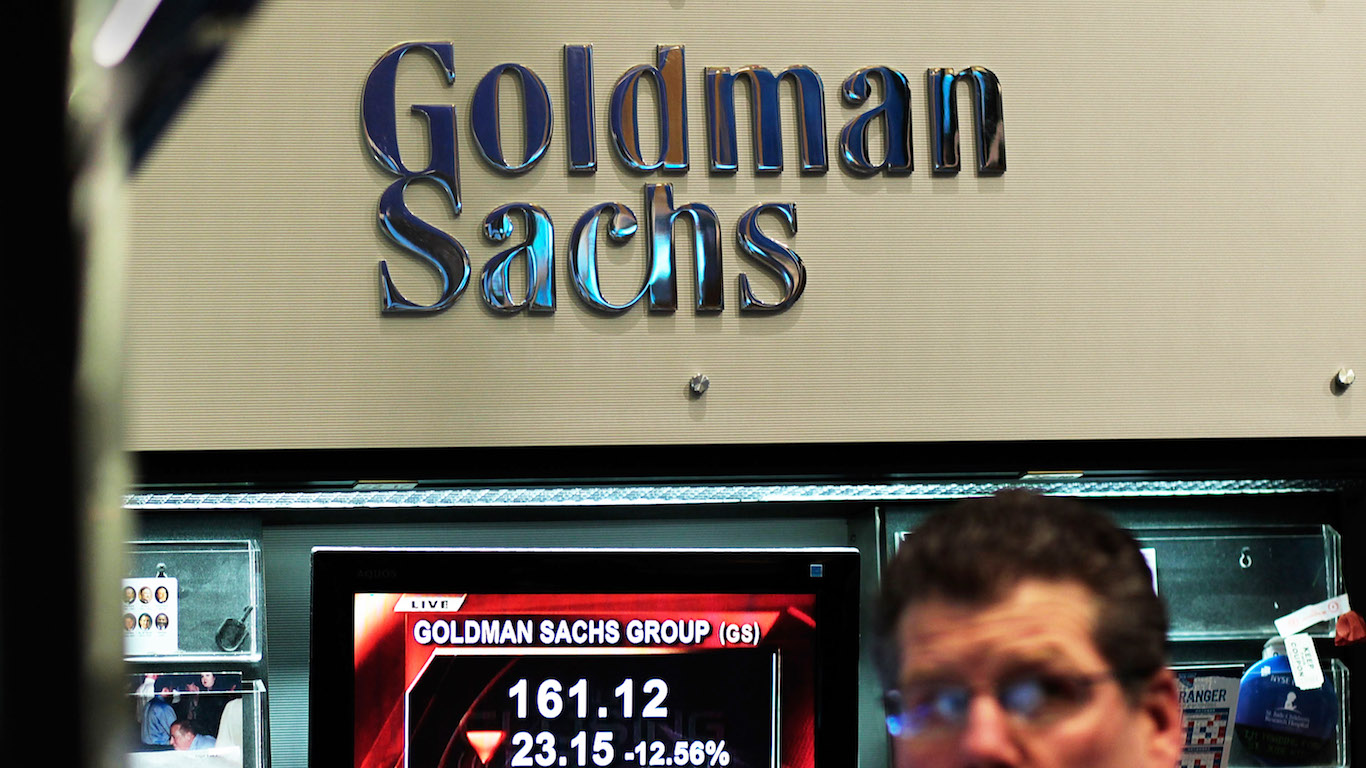
Goldman Sachs (NYSE:GS | GS Price Prediction) is paying up to $2.25 billion for NEOS Investments, the issuer behind NEOS Nasdaq-100® High Income ETF (NASDAQ:QQQI). The deal adds roughly $30 billion in active income ETFs to Goldman Sachs Asset Management and instantly makes QQQI part of one of the largest asset managers in the world. If you own QQQI for the fat monthly checks, this is a good moment to reassess what you actually hold, because the alternative sitting right next to it may serve you better than the covered-call wrapper Goldman just bought.
QQQI attracted its base for obvious reasons. It writes index call options against the Nasdaq-100, kicks off a distribution every month, and uses Section 1256 tax treatment to soften the tax bite. The forward annualized payout of $7.6152 on a $54.34 share price works out to a roughly 14% distribution yield. For retirees and income-focused investors, that headline number is hard to look past.
Where the Covered-Call Wrapper Quietly Costs You
The mechanism that generates QQQI’s yield is also what caps its returns. By selling call options against a Nasdaq-100 exposure, the fund trades away most of the index’s upside during strong rallies in exchange for premium income. In a year when large-cap tech advances, that tradeoff is expensive.
Look at the last twelve months. QQQI delivered a total return (price plus reinvested distributions) of 19.06%. Over the same window, Invesco QQQ Trust, Series 1 (NASDAQ:QQQ) returned 25.79% on price alone, before its small dividend. That is a gap of roughly 6.7 percentage points in a single year, and the 14% distribution is already inside the QQQI number. The covered-call overlay did not just cap the upside; it left real money on the table.
And the fee gap widens the drag. QQQI charges a 0.68% expense ratio. QQQ charges roughly 0.20%. On a $100,000 position, that difference is about $480 a year, every year, compounded against your total return.
A Cleaner Alternative: Own the Index, Manufacture Your Own Income
The cleaner swap for most QQQI holders is straightforward: own QQQ (or the cheaper Invesco Nasdaq 100 ETF (NASDAQ:QQQM) if you prefer, though QQQ has deeper liquidity) and sell shares as needed to fund the same cash flow you were getting from distributions. Selling roughly 14% of the position per year replicates QQQI’s payout, and the underlying exposure to Nvidia, Microsoft, Apple, Broadcom, and Amazon is essentially identical.
The difference is what the wrapper does to your growth. QQQ has returned 94.73% over five years and 510.68% over ten. QQQI has only existed since early 2024, so it has no comparable long-run record, but its structure is engineered to underperform QQQ in strong markets by design. That has now shown up in the numbers.
Tradeoffs You Should Actually Weigh
This swap is not without risk. Three things are real.
- Behavior risk. QQQI pays you whether or not you would have sold shares. If you know you would panic-hold in a drawdown rather than trim, the automatic distribution has behavioral value.
- Tax treatment. QQQI’s index-option strategy uses 60/40 long/short-term capital gains treatment on its options income, which is often more tax-efficient than ordinary dividends. Selling QQQ shares generates capital gains taxed by holding period.
- Sequence risk in retirement. Selling shares during a bear market locks in losses more directly than receiving a distribution funded partly by option premium.
Making the Switch Without Handing the IRS a Bonus
In a tax-advantaged account (IRA, 401(k), Roth), rotating from QQQI into QQQ triggers no tax and is a mechanical trade. In a taxable account, check your cost basis first. If you bought QQQI recently and it has moved with the market, the embedded gain may be modest and worth realizing. If you have a large gain, consider swapping in tranches, or redirecting new contributions to QQQ while letting QQQI run down through distributions.
What Goldman’s Check Really Signals
Goldman paid $2.25 billion because $30 billion in sticky, high-yield distribution products is a valuable asset for a fee-based manager. For your own portfolio, the calculation runs the other way. If you want Nasdaq-100 exposure and can manufacture your own income, QQQ has quietly done more for shareholders over the past year than the 14% headline suggests. If you specifically value the monthly check, the tax-managed distribution, and the discipline of not touching principal, QQQI still earns a seat (we walked through how to build a dividend ladder that lives off the checks without selling shares in a free guide). Just do not confuse the yield with a total-return edge, because the last twelve months say it isn’t one.
Contact [email protected] for any questions or corrections.
Ryne Mauck is an investment writer covering exchange-traded funds, retirement planning, and portfolio strategy. Through his work at 24/7 Wall St. and other investment platforms, including Seeking Alpha, he aims to provide clear, research-driven insights that help investors make more informed decisions while maintaining a long-term approach to investing.
Ryne holds a B.Sc. in Finance and an M.A. in Political Science. He is a formerly registered Municipal Advisor Representative and has passed the Series 50, Series 63, and Series 65 exams. His articles are not intended to be, nor should they be interpreted as, financial advice.