Pfizer and Starbucks: One Turnaround Is Built to Last, and One Isn’t
Pfizer and Starbucks both raised their outlooks this summer, but a louder recovery and a quieter one are not the same thing, and for investors who need a portfolio to fund actual withdrawals, the difference matters enormously.

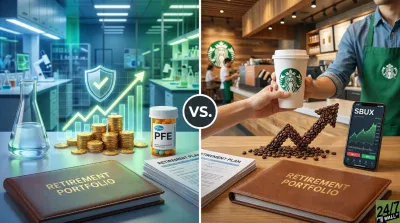
Both Pfizer (NYSE:PFE | PFE Price Prediction) and Starbucks (NASDAQ:SBUX) raised or improved their forward outlooks this summer, which is the clearest evidence a recovery is genuine. The question for income-focused investors right now is which one belongs in a portfolio that has to fund withdrawals, not just chase upside. The tiebreaker is what each pays a holder to wait and how far along each turnaround actually is.
Dimension 1: Evidence Each Turnaround Is Genuine
Starbucks is the louder story. Under CEO Brian Niccol, the company posted global comparable sales up 7.9% in fiscal Q3 2026, with transaction growth of 4.2% and non-GAAP operating margin expanding 430 basis points to 14.4%. Non-GAAP EPS of $0.85 exceeded expectations by 30.79%, and management raised fiscal 2026 guidance to non-GAAP EPS of $2.55 to $2.65. Niccol called Q2 “the turn in our turnaround.”

Pfizer’s turnaround is quieter but further along in dollars. Q1 2026 revenue of $14.45 billion exceeded consensus expectations by 4.7%, with launched and acquired products growing 22% operationally. In Q2, CEO Albert Bourla noted this was “the ninth time we exceeded consensus expectations for revenues in the last ten quarters.” Pfizer raised the midpoint of full-year revenue guidance by $500 million to a range of $60.5 billion to $62.5 billion.

Winner: Pfizer. Starbucks’ sales momentum is impressive, but reporting through the summer indicates the recovery has shown up in traffic and outlook well before it has shown up in profits. Pfizer’s turnaround already shows up in the income statement.
Dimension 2: Durability of the Recovery
Each recovery depends on very different things. Pfizer must scale newer drugs fast enough to outrun continuing COVID declines and a $1.5 billion loss-of-exclusivity headwind. The Vyndamax patent settlement extending U.S. exclusivity to June 2031 bought real time, and Bourla flagged “a clear line of sight to our aim of delivering a risk-adjusted, high single-digit revenue CAGR from year end 2028 through year end 2033.”
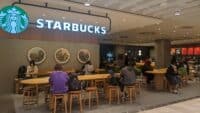
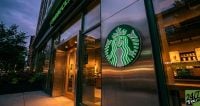
Starbucks’ recovery depends on store operations, remodels, and consumer behavior. Management surpassed 1,000 total uplifts across North America, and U.S. 90-day active Starbucks Rewards members reached 35.8 million. However, the balance sheet shows shareholders’ equity of negative $7.6743 billion.
Over five years, Starbucks stock is up only 5.5% while Pfizer is down 21.75%. Over one year, Starbucks leads at 25.68% versus Pfizer’s 21.66%.
Winner: Starbucks, narrowly. Comps are accelerating and operating margin is expanding. Pfizer’s patent-cliff math is the harder execution problem.
Dimension 3: What Investors Are Paid to Wait
Pfizer’s forward annualized dividend is $1.72 per share at a yield of 6.2%, paid quarterly at $0.43. That is the kind of income a retiree can spend without touching principal (the same setup we laid out in a free guide on building a dividend ladder that lasts a lifetime). Bourla was direct: “We feel extremely confident that we will, even the most stretched scenarios that we are running, we will be able to maintain our dividend.”
Starbucks pays a quarterly dividend of $0.62 per share, an annualized $2.48, for a yield of 2.3%. It has now paid 65 consecutive quarters of dividends. Valuation is the other side of the coin. Pfizer trades at a far cheaper P/E multiple (37x) than Starbucks (62x). A retirement investor draws income from cash flow, not valuation multiples.
Winner: Pfizer, decisively.
Verdict: Pfizer for the Retirement Portfolio
Keep in mind that this is a suitability call, not a prediction of who wins the next 12 months. For a retirement-focused investor drawing down a portfolio, Pfizer fits. Its recovery is further along in earnings, it trades at a cheaper multiple, and it compensates the holder while the transition plays out. Starbucks has been the stronger price performer over the past year and is a defensible choice for a younger investor with a long horizon and tolerance for waiting on profits to catch up to sales. Pfizer, though, still carries real patent-cliff and pipeline risk that one strong quarter does not erase.
There are two falsifiable checkpoints from here. For Pfizer, it is whether newer-drug growth keeps outpacing legacy declines and whether the raised 2026 revenue guidance range of $60.5 billion to $62.5 billion holds. For Starbucks, it is whether the operating margin keeps climbing toward historical levels rather than comps alone doing the work.


Contact [email protected] for any questions or corrections.
Trey has been an editor and author at 24/7 Wall St. for more than a decade, where he has published thousands of articles analyzing corporate earnings, dividend stocks, short interest, insider buying, private equity, and market trends. His comprehensive coverage spans the full spectrum of financial markets, from blue-chip stalwarts to emerging growth companies.
Beyond 24/7 Wall St., Trey has created and edited financial content for Benzinga and AOL's BloggingStocks, contributing additional hundreds of articles to the investment community.
Trey's editorial expertise extends across multiple publishing environments. He served as production editor at Dearborn Financial Publishing and development editor at Kaplan, where he helped shape financial education materials. Earlier in his career, he worked as a writer-producer at SVE. His freelance editing portfolio includes work for prestigious clients such as Sage Publications, Rand McNally, the Institute for Supply Management, the American Library Association, Eggplant Literary Productions, and Spiegel.
Outside of financial journalism, Trey writes fiction and has been an active member of the writing community for years, moderating workshop sessions at regional conventions.