Broadcom Has Floundered For Several Months: A Respected Wall Street Team Expects 80% Returns Ahead
Broadcom sits 25% below its peak while 44 Wall Street analysts line up behind a price target that towers above the current price, and one respected firm sees something in the backlog numbers that the broader market appears to be…


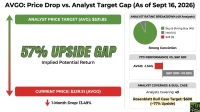
Broadcom (NASDAQ:AVGO | AVGO Price Prediction) trades at $370.34 while the average Wall Street price target sits at $525.97, a gap of roughly 42%.
Broadcom designs custom AI accelerators and Ethernet switching silicon for hyperscaler data centers and owns VMware’s private-cloud software franchise. It ranks second only to NVIDIA (NASDAQ:NVDA) in AI chip scale, with AI semiconductor revenue up 143% year-on-year last quarter. Google, Meta, OpenAI, and Anthropic are locked into multi-gigawatt supply commitments.
BNP Paribas Exane, a respected sell-side shop, carries a Street-high $675 target with an Outperform rating, implying roughly 82% upside, consistent with a full re-rating.
Why AVGO Slid 25% From Its Peak
Broadcom retreated roughly 25% from the 52-week high of $494.18 to $370.34, slipping 4.87% over the past month while the S&P 500 climbed, driven by AI capex sentiment.
Reddit’s wallstreetbets churned out bearish AVGO posts in early August, sparked by a viral thread titled “How The F*ck is OpenAI Going to Pay 1.4 Trillion??” and anxiety over whether hyperscaler capex has peaked. Broadcom got caught in that debate despite reporting record Q2 FY26 revenue of $22.2 billion, up 48% year-on-year and beating estimates. The move tracked a broader rotation out of high-multiple AI names.
Why BNP Paribas Exane and 43 Peers Still See a Buy
Analysts stayed constructive because the operating story keeps improving. Coverage skews heavily bullish: 7 strong-buy ratings, 37 buys, 4 holds, and zero sells. Recent revisions run one direction. FY27 EPS consensus drifted up from $18.22 ninety days ago to $19.53, with three upward revisions in the last 30 days and zero cuts.
BNP Paribas Exane holds the Street-high at $675. Their thesis rests on three pillars: custom AI silicon acceleration through the XPU/ASIC business supplying Google TPU, Meta, and ByteDance; networking dominance via Tomahawk 5 and Jericho 3-X Ethernet switching silicon serving as the scale-out fabric for AI data centers; and VMware margin expansion as customers convert to subscription-based private cloud.
Forward numbers support that case. Broadcom guided Q3 FY26 revenue to $29.4 billion, up 84% year-on-year, with AI semiconductor revenue of $16 billion, up over 200% year-on-year. CEO Hock Tan said AI bookings exceeded $30 billion in Q2 against only $10.8 billion shipped, with visibility running to 2028. Management reiterated AI silicon revenue in excess of $100 billion for fiscal 2027 and called demand for XPUs and networking “simply insatiable.”
If bookings convert on schedule, the $675 target aligns with roughly a 34x multiple on 2027 consensus EPS of $19.53, supported by the pipeline.
Where AVGO Ranks Against NVIDIA, AMD, and Marvell
NVIDIA trades at $220.78 against a $323.42 consensus target, roughly 47% upside. Coverage is overwhelmingly bullish with 58 buy-equivalents versus 2 holds and 1 sell, and data-center revenue was guided to $108 billion for the current quarter. Wall Street sees slightly more consensus upside here than in AVGO’s average target.
Advanced Micro Devices (NASDAQ:AMD) sits at $470.72 versus a $613.84 target, about 30% upside. AMD is up 119.8% year to date on Instinct MI350/MI450 momentum and the Anthropic 2-gigawatt deal, with 41 analysts rate it Buy against 10 Holds. Implied upside is smaller than AVGO’s.
Marvell Technology (NASDAQ:MRVL) trades at $211.66 against a $278.89 target, roughly 32% upside. Coverage skews 38 Buy versus 5 Hold. The stock is off 7.69% this past week alone.
The largest analyst-implied upside in the group belongs to BNP’s $675 call on Broadcom at 82%. Even the AVGO consensus gap of 42% edges NVIDIA’s. On analyst math, Broadcom is the outlier.
Consensus, Estimates, and Performance Diverge
Broadcom trades at $370.34 with a $525.97 consensus target across 44 analysts, implying 42% upside. BNP Paribas Exane’s $675 Street-high stretches that to 82%. Ratings break down as 7 Strong Buy, 37 Buy, 4 Hold, and 0 Sell.
AVGO is up 7.4% year to date versus 12.48% for the S&P 500, and slipped 4.87% over the past month. Forward FY27 EPS estimates now sit at $19.53, up from $18.22 ninety days ago.
Broadcom Verdict: Bullish, With One Eye on Hyperscaler Capex
The bull case holds if the $30 billion AI backlog converts on schedule, Google, Meta, OpenAI, and Anthropic multi-gigawatt commitments deploy as contracted, and fiscal 2027 AI revenue clears $100 billion as guided. That path reaches consensus $525 and, aggressively, BNP’s $675. The bear case builds if hyperscaler AI capex is peaking, custom TPU margins compress the semiconductor mix, or customer concentration around Google, Meta, and ByteDance turns problematic. All of that buildout still has to be powered, cooled, and networked by somebody beyond the chipmakers, and we profiled seven of those suppliers in a free AI infrastructure report.
I lean bullish. Insider selling and the 25% drawdown are legitimate caveats, and analyst targets are estimates rather than guarantees. But backlog-to-shipment ratios like the one Broadcom just reported, combined with rising estimate revisions and a Q3 report landing this week, usually reward patient buyers.
Contact [email protected] for any questions or corrections.
Alex Sirois is a financial writer with experience spanning both retail and institutional investing. He has written for InvestorPlace and held roles at BNY Mellon and Bernstein, giving him a perspective that bridges Main Street portfolios and Wall Street analysis.
Alex holds an MBA from George Washington University and has built his career across multiple industries, including e-commerce, education, and translation — a breadth of experience that informs how he breaks down complex financial topics for everyday investors. His writing is conversational, actionable, and grounded in long-term, buy-and-hold investing principles.
At 247 Wall St., Alex focuses on delivering analysis that is both accessible and useful, with a clear emphasis on helping readers make more informed decisions with their money.