Marvell vs. Broadcom: One AI Stock Looks More Attractive Right Now
Marvell and Broadcom both rode the AI wave to blowout quarters, but the businesses behind the tickers are built on completely different gambles, and only one of them offers a cushion if a major hyperscaler changes course.

Marvell Technology (NASDAQ: MRVL | MRVL Price Prediction) and Broadcom (NASDAQ: AVGO) both just posted AI-driven blowouts, but the businesses behind the tickers look nothing alike.
Marvell reported $2.74 billion in Q2 FY2027 revenue on August 27. Broadcom, three months earlier, delivered $22.19 billion. Same tailwind, wildly different scale, and two very different bets on how hyperscalers will spend.
Custom Silicon Lifts Both, but Not Equally
Marvell’s data center segment ran to $2.17 billion, up 46% year over year, and now makes up 79% of total revenue. CEO Matt Murphy called out “strong tailwinds across each of our data center businesses, including interconnect, switching, and custom”, and pointed to 1.6T optical DSPs ramping fast plus scale-out switching that should more than double this year.

Broadcom’s number is on another planet. AI semiconductor revenue alone hit $10.8 billion, up 143% year over year, with bookings of over $30 billion in the quarter. Hock Tan described demand for XPUs and networking as “simply insatiable”. That is a striking word choice from a CEO usually careful with adjectives.

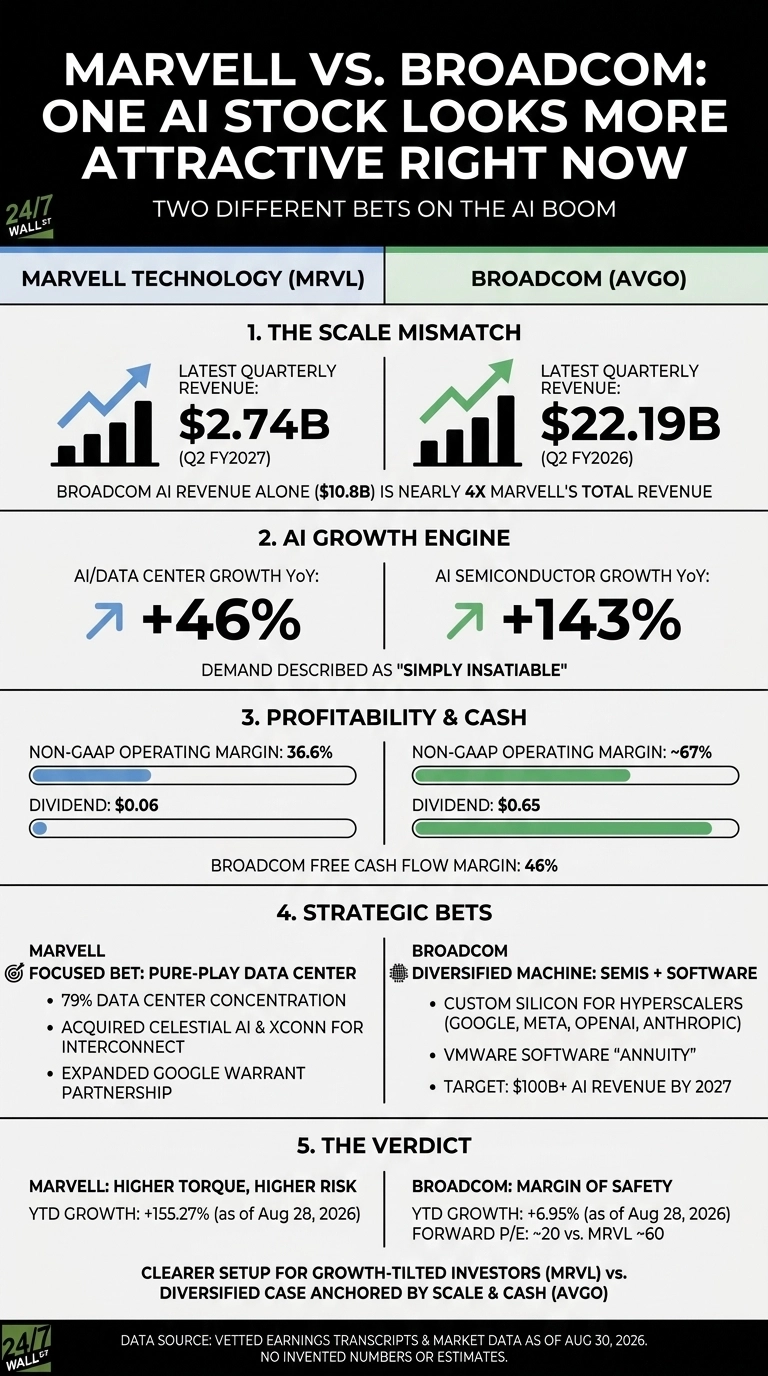
| Business Driver | Marvell | Broadcom |
| Latest quarterly revenue | $2.74B | $22.19B |
| AI/data center growth YoY | 46% | 143% |
| Non-GAAP operating margin | 36.6% | ~67% |
| Dividend per share (quarterly) | $0.06 | $0.65 |
Focused Bet vs. Diversified Machine
Marvell is doubling down. Management sold the automotive Ethernet business to Infineon for $2.5 billion, then bought Celestial AI and XConn to attack scale-up optics and chiplet interconnect. An expanded warrant deal with Google now covers inference accelerators, storage controllers, NICs, memory interface controllers, and near-memory compute tied to the TPU ecosystem.
Murphy told analysts “starting in FY29 beyond whatever you’ve modeled previously prior to the warrant for Custom Numbers definitely goes higher”. That is a big promise resting on one relationship.
Broadcom is spreading the same bet across four hyperscalers. Tan detailed multi-generational programs with Google, Anthropic (6 gigawatts through 2027), OpenAI (10 gigawatts by 2029), and Meta (3 gigawatts through 2028).
Add VMware, which grew 9% year-over-year to $7.18 billion at 93% gross margin, and the picture is a semiconductor giant with a software annuity most peers cannot match.
Concentration Risk Cuts Both Ways
What I am watching next is customer breadth. Marvell’s 79% data center concentration and the Google-heavy warrant mean one hyperscaler’s roadmap change could reshape the story.
Broadcom’s fiscal 2027 target of AI revenue in excess of $100 billion is enormous, and any slip from OpenAI or Meta deployment timelines would sting. Marvell’s October 6 Investor Day should quantify the Google upside. Broadcom reports Q3 on September 2, which will test whether the $16 billion AI quarter actually lands.
Broadcom’s Margin of Safety vs. Marvell’s Torque
On the fundamentals, Broadcom screens as the lower-risk exposure. Its 46% free cash flow margin, the VMware software cushion, and a forward P/E of 20 versus Marvell’s 60 imply a wider margin of safety while the AI capex cycle plays out (the same buildout is lifting the power, cooling, and networking suppliers we profiled in a free report on seven AI infrastructure names outside the chipmakers).
Marvell offers more torque; shares are up 155.27% year to date versus AVGO’s 6.95%, and if the Google warrant delivers, FY29 estimates move meaningfully higher. Growth-tilted investors comfortable with concentration risk have a clearer setup in Marvell, while Broadcom’s scale, cash generation, and quarterly $0.65 dividend anchor the diversified case.
Contact [email protected] for any questions or corrections.
Vandita Jadeja is a financial publisher with over a decade of experience writing about financial topics, including investment, savings, retirement, insurance and banking. Vandita is a Chartered Accountant who loves to debunk financial concepts for readers.
Her work has appeared on sites that include The Motley Fool, InvestorPlace, and Benzinga. She covers investing and focuses on stock picks and price prediction for 24/7 Wall St.
When not looking for the next stock investment opportunity, she can be found traveling, reading, chasing sunsets and enjoying her iced latte.