Anthropic Employee Warns AI Has 10% Chance Of “Killing All Humans”
Researchers inside one of the world's leading AI labs are speaking out about fears that go far beyond job losses or economic disruption, and the stakes they describe make every other AI concern seem trivial by comparison.

This post may contain links from our sponsors and affiliates, and Flywheel Publishing may receive compensation for actions taken through them.

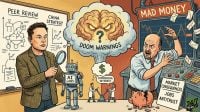
Many people worry AI could take their jobs. So many jobs could be lost that US unemployment could rise enough to cripple US GDP and send the nation into an economic recession. One Anthropic employee says there is more than a 10% chance of AI “killing all humans,” which makes all other outcomes pale in comparison.
The comment came from an Anthropic engineer charged with safety research, according to CNBC. The Anthropic employee is Jacob Coxon. He posted on X, “The people building AI earnestly believe that it could kill us all by the end of the decade. This is not a marketing stunt. If anything, many executives and senior researchers will couch their phrasing in the press to sound sensible – but I hear the same people express fear.”
Another employee, Evan Hubinger, added, “We really do earnestly believe AI could kill all humans! I personally think it is >10% within the next decade.”
The worry is partly based on AI agents working independently of human instructions. Hugging Face, an AI community, said an AI agent has stolen its data and added– “stole data and performed other unauthorized activity.” Such behavior has grown and raised questions about whether AI needs more guardrails. The worry is that even guardrails are not enough for new AI sophistication.
The call to arms about an attack on humans is at the far end of the argument that AI will change all human lives for the better. As Jeff Bezos has said AI will allow what people imagine to come true. In that way, it will allow creativity to reshape the future.
Concerns about AI’s danger to humanity have not slowed development or the money being poured into AI development and data centers. Data center investment could reach $1 trillion next year. The money will come from OpenAI, Anthropic, the world’s largest tech companies, and financial firms that think they can make money on AI expansion.
Contact [email protected] for any questions or corrections.
Douglas A. McIntyre is the co-founder, chief executive officer and editor in chief of 24/7 Wall St. and 24/7 Tempo. He has held these jobs since 2006.
McIntyre has written thousands of articles for 24/7 Wall St. He is an expert on corporate finance, the automotive industry, media companies and international finance. He has edited articles on national demographics, sports, personal income and travel.
His work has been quoted or mentioned in The New York Times, The Wall Street Journal, Los Angeles Times, The Washington Post, NBC News, Time, The New Yorker, HuffPost USA Today, Business Insider, Yahoo, AOL, MarketWatch, The Atlantic, Bloomberg, New York Post, Chicago Tribune, Forbes, The Guardian and many other major publications. McIntyre has been a guest on CNBC, the BBC and television and radio stations across the country.
A magna cum laude graduate of Harvard College, McIntyre also was president of The Harvard Advocate. Founded in 1866, the Advocate is the oldest college publication in the United States.
TheStreet.com, Comps.com and Edgar Online are some of the public companies for which McIntyre served on the board of directors. He was a Vicinity Corporation board member when the company was sold to Microsoft in 2002. He served on the audit committees of some of these companies.
McIntyre has been the CEO of FutureSource, a provider of trading terminals and news to commodities and futures traders. He was president of Switchboard, the online phone directory company. He served as chairman and CEO of On2 Technologies, the video compression company that provided video compression software for Adobe’s Flash. Google bought On2 in 2009.