Top 5 Stocks Poised to Profit From the CHIPS Quantum Incentive Wave
Washington just handed out $2 billion in quantum manufacturing incentives, and the money landed in some very unexpected places. Five stocks are quietly positioned to capture the fallout, and most investors have no idea they qualify.


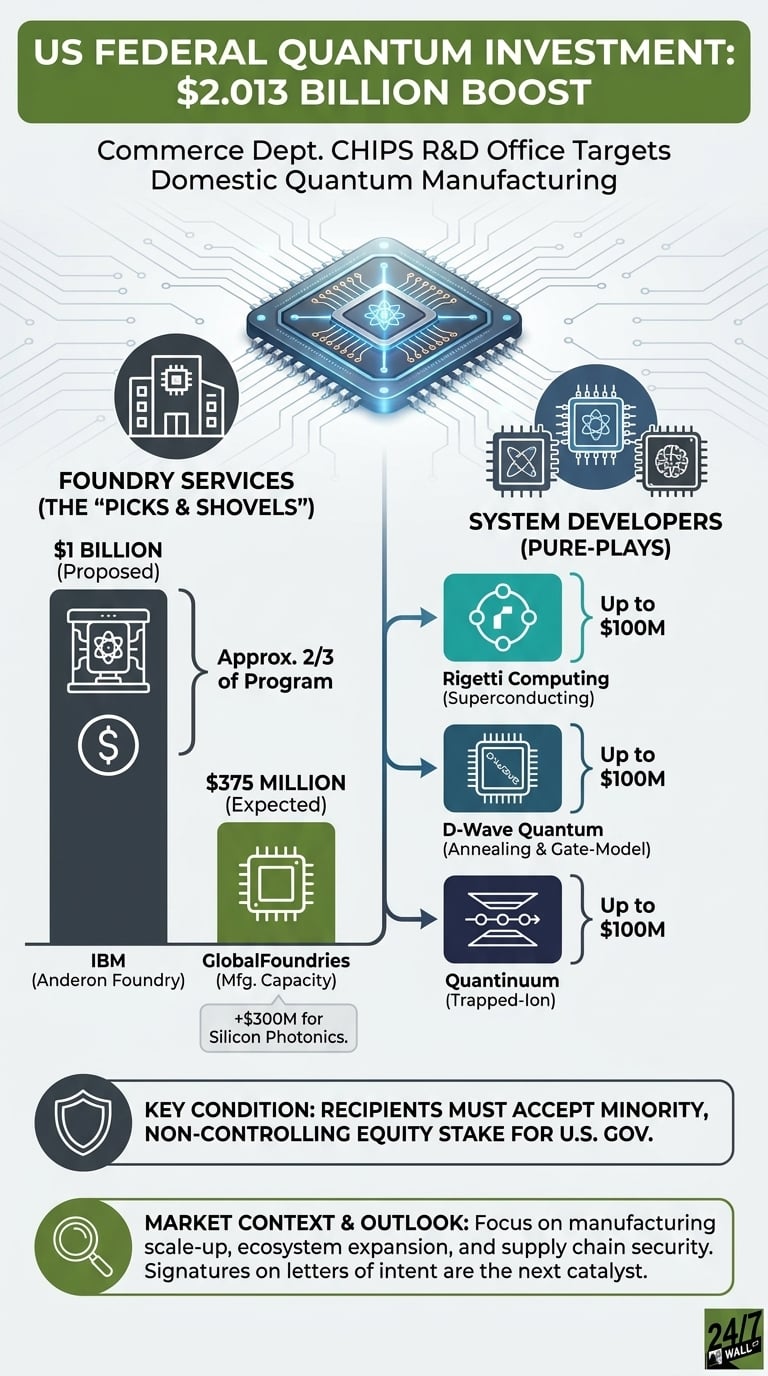
The Commerce Department’s CHIPS Research and Development Office has signed nine letters of intent to provide $2.013 billion in federal incentives for domestic quantum, and the money did not fan out evenly. Two foundry awards, $375 million for GlobalFoundries and $1 billion for IBM, alone account for roughly two-thirds of the entire program, each single check dwarfing the largest system-developer award. Every recipient must accept a minority, non-controlling equity stake for the U.S. Department of Commerce as a condition of the funds. Washington is buying the picks and shovels in quantum, and taking paper in return.
1. GlobalFoundries: The Foundry Nobody Filed Under “Quantum”
Retail screens for quantum exposure rarely surface GlobalFoundries (NASDAQ:GFS | GFS Price Prediction). They should. GlobalFoundries is a pure-play U.S. contract foundry, and CEO Tim Breen used the second-quarter call to discuss the launch of Quantum Technology Solutions, a dedicated group built to move the industry “from prototypes to high-volume production” across superconducting, trapped ion, photonic, topological, and spin modalities. That is the whole board, one fab.
The dollar case is stacked. GlobalFoundries has an expected $375 million grant from the Commerce Department to build out domestic quantum manufacturing capacity, layered on top of a separate $300 million letter of intent tied to its Scale silicon photonics platform. Meanwhile, the picks-and-shovels flywheel is already spinning: Communications Infrastructure & Datacenter revenue hit $277 million in the second quarter, up 62.0% year over year on silicon photonics and SiGe demand.
The stock is not pricing this in. GlobalFoundries is up 24.3% year to date as of September 9, 2026, but it has fallen 8.4% over the past month. Every trapped-ion, superconducting, and photonic developer chasing scale eventually walks into someone’s fab. The next name on this list is one of GlobalFoundries’ biggest customers, and it is about to open its own.


2. IBM: The $10 Billion Bet That Turns the Program Into a Foundry Business
IBM (NYSE:IBM) is the heavyweight in this program and the largest single recipient. On the second-quarter call, Arvind Krishna said IBM announced a letter of intent with the Commerce Department to build Anderon, “the world’s first pure-play quantum foundry,” supported by a billion dollars in CHIPS incentives and a billion-dollar cash contribution by IBM. As of that call, the award was proposed, not a signed definitive agreement.
The scale behind Anderon is what changes the math. IBM disclosed plans to invest more than $10 billion in quantum over the next five years, spanning R&D, capital expenditure, manufacturing scale-up, M&A, and ecosystem expansion, all pointed at Starling in 2029, the world’s first large-scale, fault-tolerant quantum computer. IDC evaluated 11 quantum computing vendors and ranked IBM first overall. This is a serious industrial commitment.
The share price is the mispricing. IBM is down 20.8% for the calendar year, weighed down by a 42% mainframe decline in the second quarter that overshadowed $2.54 billion of free cash flow. MarketWatch is already framing the selloff as an opportunity. If Anderon signs, the sector’s biggest customer becomes its biggest fab operator.


3. Rigetti Computing: Superconducting Pure-Play With a Nine-Figure Federal Backstop
Rigetti Computing (NASDAQ:RGTI) is the superconducting gate-model pure-play whose roadmap now has federal underwriting. Under the May program, the Commerce Department named Rigetti for up to $100 million in planned funding to address next-generation superconducting quantum computing, including miniaturized readout electronics. That is the exact chip work a foundry like GlobalFoundries is being paid separately to fabricate. The picks-and-shovels linkage is direct.
The balance sheet speaks for itself. Rigetti posted second-quarter revenue of $5.14 million, up 185.3% year over year, ended the quarter with $541.29 million in cash and investments, and no debt, and has a Cepheus-1-108Q system live on Rigetti QCS, Amazon Braket, Microsoft Azure Quantum, and qBraid at roughly 99.1% median two-qubit gate fidelity. Analyst target price stands at $28.81, well above the current share price.
Rigetti has given back 28.8% year to date, and that is precisely where the setup can be found. If the letter of intent converts to a signed agreement, the milestone-contingent payout still lands over three years, but the reputational floor lifts immediately. The next name plays a different quantum game entirely.
4. D-Wave Quantum: The Only Recipient Playing Both Sides of the Modality Fight
D-Wave Quantum (NYSE:QBTS) is the only company in the CHIPS quantum portfolio pursuing both annealing and gate-model architectures. The Commerce Department named D-Wave for $100 million in planned funding for advancements in annealing and gate-model superconducting quantum systems, including qubit counts, error rates, and coherence through dielectric material optimization and high-density advanced packaging. That last phrase, advanced packaging, is where GlobalFoundries’ cryogenic packaging roadmap intersects the D-Wave device stack.
The commercial mix is where D-Wave stopped looking like a research prop. Second-quarter bookings for the first half of 2026 surged to $35.5 million versus $2.9 million a year earlier, anchored by a $20 million system sale, while remaining performance obligations expanded 668% year over year to $40.7 million, and commercial customers rose to 62.4% of revenue from 45.1%. The $546.2 million cash and investments balance covers the run rate through the roadmap.
Wall Street sees it: the analyst target price is $35.24, with 14 Buy ratings and one Strong Buy against a single Hold. D-Wave is off 35.2% year to date. The last name on this list has more cash than any of them, is newer than all of them, and just walked into the program with a signed letter tied to a supply chain nobody else can touch.
5. Quantinuum: The Newest IPO Sitting on the Biggest War Chest
Quantinuum (NASDAQ:QNT) is the trapped-ion leader, and the Commerce Department named it in the same May tranche for $100 million in planned funding to address critical bottlenecks for scaling fault-tolerant trapped-ion computers, including low-loss integrated photonics and reliable optical components at trapped-ion wavelengths. Those are photonic components. On the GlobalFoundries call, management named Quantinuum specifically among the eight leading quantum players it is working with. The picks-and-shovels loop closes here.
The numbers are why this slot is the payoff. Quantinuum reported first-quarter-as-public revenue of $8.00 million, up 279% year over year, ended the quarter with $2.11 billion in cash after a $1.70 billion gross IPO, the largest war chest among quantum pure-plays, and issued initial FY2026 revenue guidance of $28 million to $32 million. The Helios system is live inside Oracle Cloud Infrastructure, Sol trap chips are back from fabrication targeting 2027, and Apollo remains on schedule for 2029.
Quantinuum closed most recently at $50.47 and was last seen down 27.3% from its June 4, 2026, starting price. Newest name, deepest cash, direct Commerce letter, and a fab partner already collecting its own federal check—that is the whole thesis in one ticker.
Close the Loop
The Commerce Department concentrated the money in the manufacturing layer, and the fabs are already collecting checks the pure-plays still need to earn. Every letter of intent still has to convert to a signed definitive agreement, and every dollar still has to clear milestone gates against a minority equity stake for the government. That is the price of admission. Spotting the next monster tech winner early tends to come down to a few recurring signals (we cataloged them in a free playbook here: The Next Nvidia Playbook). The order of the queue is set. The signatures are the catalyst.
Contact [email protected] for any questions or corrections.
Trey has been an editor and author at 24/7 Wall St. for more than a decade, where he has published thousands of articles analyzing corporate earnings, dividend stocks, short interest, insider buying, private equity, and market trends. His comprehensive coverage spans the full spectrum of financial markets, from blue-chip stalwarts to emerging growth companies.
Beyond 24/7 Wall St., Trey has created and edited financial content for Benzinga and AOL's BloggingStocks, contributing additional hundreds of articles to the investment community.
Trey's editorial expertise extends across multiple publishing environments. He served as production editor at Dearborn Financial Publishing and development editor at Kaplan, where he helped shape financial education materials. Earlier in his career, he worked as a writer-producer at SVE. His freelance editing portfolio includes work for prestigious clients such as Sage Publications, Rand McNally, the Institute for Supply Management, the American Library Association, Eggplant Literary Productions, and Spiegel.
Outside of financial journalism, Trey writes fiction and has been an active member of the writing community for years, moderating workshop sessions at regional conventions.