3 Stocks With Below-Average Yields and Above-Average Dividend Growth. Why That Trade-Off Wins Long Term
Chasing the biggest dividend yields can quietly sabotage long-term income, and three mega-cap businesses with some of the smallest payouts on the market reveal exactly why the math works against most income investors.


Income investors who chase the highest yields often lock in the slowest raises. The stronger long-term math sits in businesses that start below the market yield but push the payout higher every year. Consider that Visa (NYSE:V | V Price Prediction) has taken its quarterly dividend from 10 cents in late 2008 to 67 cents today, a compounding pattern that a static high-yield name simply cannot replicate. This bundle covers three mega-cap dividend growers where scale, moat durability and cash generation do the heavy lifting. It is a real trade-off: less income now, materially more later.
Visa: A Payments Toll Booth Compounding the Payout
Visa yields 0.72% on a $2.68 annualized dividend, well below the S&P 500 average. The safety read is pristine. Trailing EPS of $11.74 against that $2.68 payout leaves an enormous cushion, and operating margin runs at 66.1% with a 50.8% profit margin. Return on equity sits at 61.2%. The dividend record backs the thesis: the quarterly payout has stepped up in an uninterrupted sequence, moving from 45 cents in late 2022 to 52 cents, then 59 cents and now 67 cents as of the ex-date of Aug. 11.
The bull case is that Visa is still shareholder-return machine first, dividend payer second, and both grow together. CFO Chris Suh disclosed the company “bought back $4.9 billion in stock and distributed $1.3 billion in dividends” in the fiscal third quarter, with $28.4 billion remaining on the buyback authorization. Fiscal Q3 net revenue rose 14.4% YoY to $11.63 billion, and CEO Ryan McInerney said “The opportunity ahead is significant.” Every incremental transaction on the network drops through at extraordinary margin, which is what funds a payout that can keep doubling.
The risk: Litigation and regulation. Visa took a $563 million severance charge and client incentives ran +18% YoY, both reminders that even a toll booth faces friction. Shares are up 11.44% over the past year and 390.67% over 10 year.
S&P Global: Benchmark Cash Flow Feeding a Growing Payout
S&P Global (NYSE:SPGI) yields 0.94% on a $3.86 annual dividend, another sub-market starting point paired with best-in-class economics. The regular quarterly dividend has moved from 77 cents during 2021 to 85 cents, 90 cents, 91 cents, 96 cents and now 97 cents. A large $21.08 distribution around July 1 ties to the Mobility spin-off and should not be read as part of the regular payout.
Coverage is comfortable: trailing EPS of $16.43 against a $3.86 dividend, and the company generated $2.4 billion in adjusted free cash flow in the first half of the year. Adjusted operating margin expanded 200 basis points to 54.3%, and management raised its 2026 buyback target to more than $7 billion. CEO Martina Cheung said that would allow the company to repurchase “the equivalent of more than 5% of our current market capitalization.” The bull case for income growth is the mix: benchmark businesses (Ratings, Indices, Platts) account for nearly two-thirds of revenue and more than 80% of operating profits, and Indices just posted its 13th consecutive record quarter. Adjusted EPS guidance of $17.50 to $17.75 gives the board ample room to keep raising.
The risk: The price action. SPGI is down 15.27% year to date and 18.48% over the past year, and the Ratings segment remains tied to debt-issuance cycles that ebb and flow. Long term, the forward P/E of 20 is well off recent highs, which is why the shares screen better for income growth investors now than a year ago.
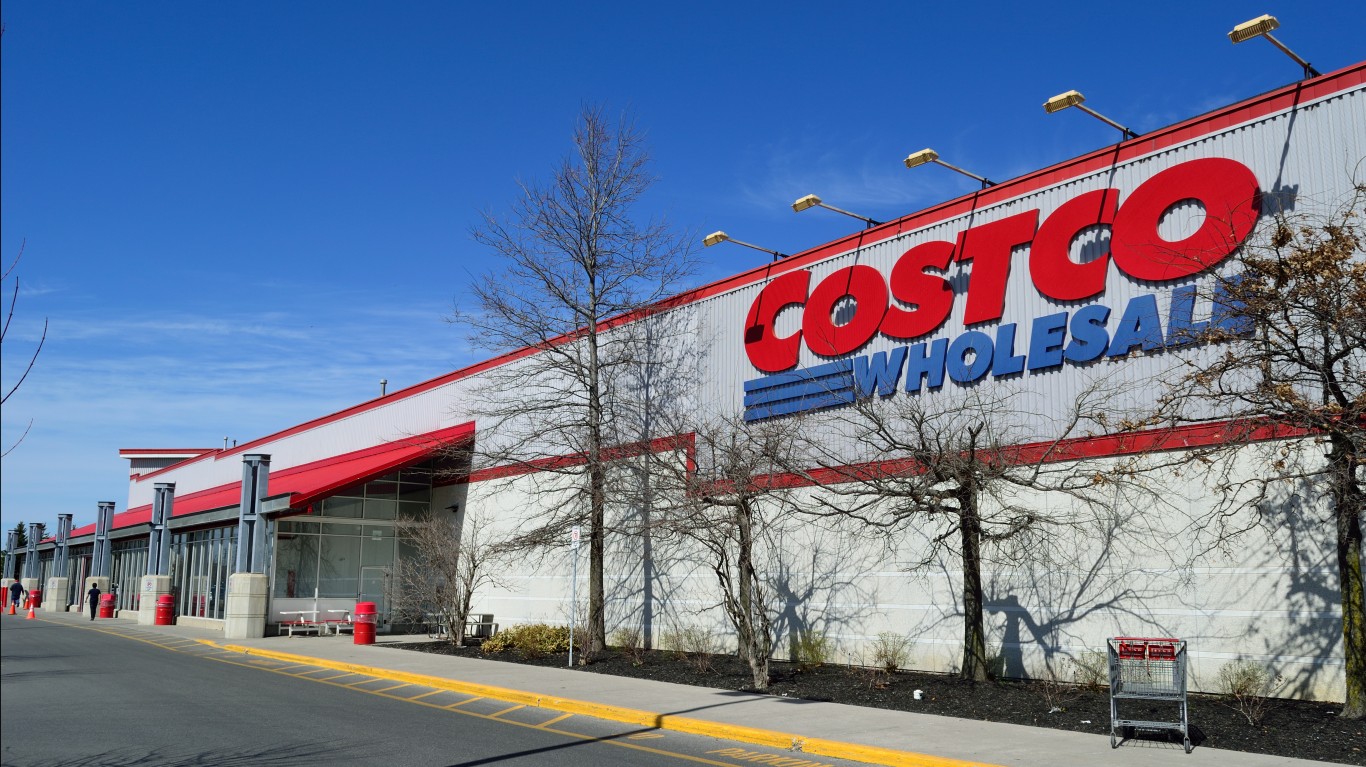
Costco: The Lowest Yield, the Best Membership Flywheel
Costco (NASDAQ:COST) yields 0.65% on a $5.88 annualized dividend, the smallest starting yield in this group and, by design, the least of the story. What matters is the growth cadence and the periodic specials. The regular quarterly payout progression: 79 cents during much of 2021, 90 cents in 2022, $1.02 in 2023, $1.16 in 2024, $1.30 in 2025 and $1.47 beginning with the May 2026 ex-date. Layered on top, Costco has paid large specials of $15 in late 2023, $10 in December 2020, and $7 in 2017, among others.
Coverage is not in question. Trailing EPS of $19.90 against a $5.88 payout, cash and equivalents of $18.946 billion, and a fiscal Q3 that delivered $1.373 billion in membership fee income at a 89.7% worldwide renewal rate. That membership stream is annuity-like recurring revenue, and executive members now number 41.2 million, up 9.6% year over year. CFO Gary Millerchip framed the capital plan clearly, saying a special dividend is “typically the most effective way to return excess cash without giving up the flexibility to keep investing in growth.” The bull case is that this compounding machine reinvests first (roughly $6.5 billion in fiscal-year capex), grows the regular dividend on a steady step function, and periodically empties the cash box on shareholders.
The risk: Valuation. A forward P/E of 40 demands continued execution, and the stock is down 4.51% over the past year even as it holds 613.38% gains over ten years. Income investors who need every cash-flow point today will find the 0.6% yield hard to accept, and that critique is fair.
What Ties These Three Together
Visa, S&P Global, and Costco each start well below the market yield and each has pushed the payout up at a rate that makes yield-on-cost the metric that matters. The businesses share the same DNA: dominant networks or memberships, extraordinary margins, and free cash flow that grows faster than obligations. Retirees who need the biggest check in the mail this quarter may prefer higher-yielding alternatives (we ranked ten 50-year dividend raisers by valuation in a free Dividend Kings report for readers who want that side of the ledger too). For an investor with a runway, a modest yield compounding at Visa’s, SPGI’s and Costco’s pace tends to lap the static high-yield alternative and keep going.
Contact [email protected] for any questions or corrections.
Joel South covers large-cap stocks, dividend investing, and major market trends, with a focus on earnings analysis, valuation, and turning complex data into actionable insights for investors.
He brings more than 15 years of experience as an investor and financial journalist, including 12 years at The Motley Fool, where he served as an investment analyst, Bureau Chief, and later led the Fool.com investing news desk. He has also co-hosted an investing podcast and appeared across TV and radio discussing market trends.