Only 1 of These 2 BDCs Keeps Raising Its Monthly Payout. Here’s Which Belongs in Your Roth IRA.
Two BDCs both promise generous income for retirement investors, but inside a Roth IRA the payout trajectory matters far more than the current yield, and only one of these picks is built to compound the way a Roth demands.

This post may contain links from our sponsors and affiliates, and Flywheel Publishing may receive compensation for actions taken through them.

For a retirement investor, the choice between Main Street Capital (NYSE:MAIN | MAIN Price Prediction) and Ares Capital (NASDAQ:ARCC) comes down to one plain question: which business development company (BDC) belongs in your Roth IRA right now? A BDC is a publicly traded lender to middle market firms that passes most of its earnings to shareholders as dividends.
The differentiator is payout trajectory. Main Street pays monthly and keeps stepping the regular monthly rate higher. It then layers quarterly supplemental dividends (extra cash distributions funded by realized gains and excess earnings) on top. Ares Capital pays a quarterly check that has been unchanged since its December 2022 ex-dividend date.
Why the Roth Wrapper Matters More for BDCs
BDC distributions are generally taxed as ordinary income instead of at the lower qualified dividend rate most common stock payouts enjoy. Inside a Roth, that heavier tax drag disappears. Every reinvested distribution compounds free of federal tax, and qualified withdrawals in retirement are untaxed. That makes the reinvestment growth rate, not just the headline yield, the variable that decides outcomes here.
Dimension 1: Dividend Trajectory (Winner: Main Street)
Main Street declared a regular monthly dividend of $0.265 per share for the fourth quarter of 2026, a 3.9% increase from the regular monthly dividends paid in the fourth quarter of 2025. The September supplemental of $0.30 per share was its 20th consecutive quarterly supplemental, with trailing 12-month supplementals totaling $1.20 per share, an additional 38% paid on top of regular monthly dividends. Main Street even held its regular monthly payout unchanged through 2020 rather than reducing it.
Ares Capital has paid stable or increasing regular quarterly dividends for 67 consecutive quarters, but the amount has held at $0.48 per share since that December 2022 ex-date. Long record, flat cadence. That gives the edge to Main Street.
Dimension 2: Portfolio and Structure (Winner: Ares)
Ares Capital is the largest publicly traded BDC, externally managed (fees paid to an outside adviser, in this case a subsidiary of Ares Management) with a $29.3 billion portfolio at fair value across 619 portfolio companies spanning 20 industries. Non-accruals stand at 2.4% at cost and 1.4% at fair value, both below the roughly 3% historical average since the global financial crisis. Ares also holds approximately $6 billion of liquidity.
Main Street is internally managed, which lowers the cost structure and aligns fees with shareholders. However, it concentrates in 94 lower middle market companies at $3.2 billion of fair value plus 86 private loan investments at $2.1 billion, and it takes equity alongside its debt. Non-accruals run lower at 1.1% of the portfolio at fair value, but the smaller company count means less diversification. Ares Capital narrowly edges Main Street.
Dimension 3: Total Return and Valuation (Split)
Ares wins the recent windows:
| Year to Date | One Year | |
| Ares Capital | +3.57% | +1.36% |
| Main Street | −1.32% | −6.37% |
Ares also carries the higher current yield at 9.8%, versus Main Street’s 5.6%, and a cheaper price-to-book of 1.0 versus Main Street’s 1.6.
Extend the horizon and Main Street takes over:
| Five Years | Ten Years | |
| Ares Capital | +57.27% | +223.48% |
| Main Street | +101.86% | +252.26% |
Analyst coverage is broader on Ares, with a $20.77 consensus price target, and thinner on Main Street, with a $59.50 consensus price target.


On coverage, Main Street’s Q2 2026 distributable net investment income (DNII) before taxes of $1.08 per share comfortably covered three months of regular monthly payouts. (Net investment income is the recurring interest and fee income a BDC uses to fund its dividend.) Ares posted Q2 2026 core earnings of $0.47 per share in a single quarter against the $0.48 dividend, though management noted core earnings exceeded the regular dividend over the preceding 12 months with $1.38 per share of taxable-income spillover in reserve. A split decision, but the edge goes to Main Street on long-horizon compounding.
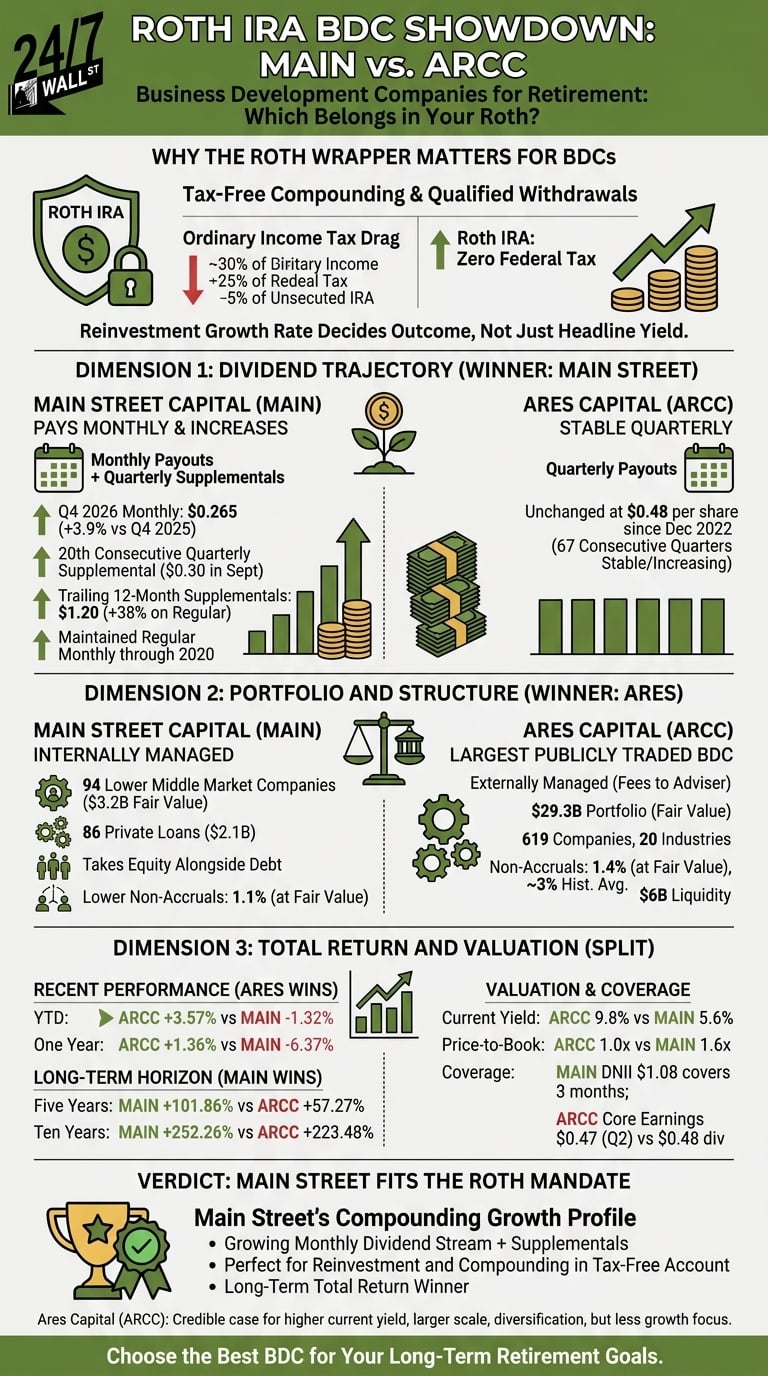
Verdict: Main Street Fits the Roth Mandate
A Roth is a compounding account, and the variable that decides outcomes is whether the reinvested distribution stream actually grows. Main Street’s does, month after month, with a quarterly supplemental stacked on top. That is the profile a Roth IRA was built for. (We rounded up seven other names that pay every 30 days in a free report.)
Ares Capital has a credible case. It pays the higher current yield, it is larger and more diversified, and an investor who wants the biggest quarterly check today rather than the fastest-growing monthly one can reasonably own it. But for the retirement saver reinvesting distributions to fund withdrawals decades out, Main Street fits the mandate.


Contact [email protected] for any questions or corrections.
Trey has been an editor and author at 24/7 Wall St. for more than a decade, where he has published thousands of articles analyzing corporate earnings, dividend stocks, short interest, insider buying, private equity, and market trends. His comprehensive coverage spans the full spectrum of financial markets, from blue-chip stalwarts to emerging growth companies.
Beyond 24/7 Wall St., Trey has created and edited financial content for Benzinga and AOL's BloggingStocks, contributing additional hundreds of articles to the investment community.
Trey's editorial expertise extends across multiple publishing environments. He served as production editor at Dearborn Financial Publishing and development editor at Kaplan, where he helped shape financial education materials. Earlier in his career, he worked as a writer-producer at SVE. His freelance editing portfolio includes work for prestigious clients such as Sage Publications, Rand McNally, the Institute for Supply Management, the American Library Association, Eggplant Literary Productions, and Spiegel.
Outside of financial journalism, Trey writes fiction and has been an active member of the writing community for years, moderating workshop sessions at regional conventions.