HSBC Upgrades Synopsys to Buy, Sees 28% Earnings Growth Through 2028
HSBC just flipped its rating on Synopsys with a price target that towers above Wall Street consensus, and the reasoning behind it reframes the chip design giant as something the market may not have priced in yet.


HSBC analyst Frank Lee upgraded Synopsys (NASDAQ:SNPS | SNPS Price Prediction) to buy from hold and raised his price target to $700 from $490. Lee argues that a change in the chip design software leader’s business model could lift annual earnings growth from 7% to 28% through 2028.
Synopsys stock rose 4.38% in premarket trading to $443.50. The analyst upgrade presents Synopsys as an AI growth story, and near-term volatility remains a real risk.
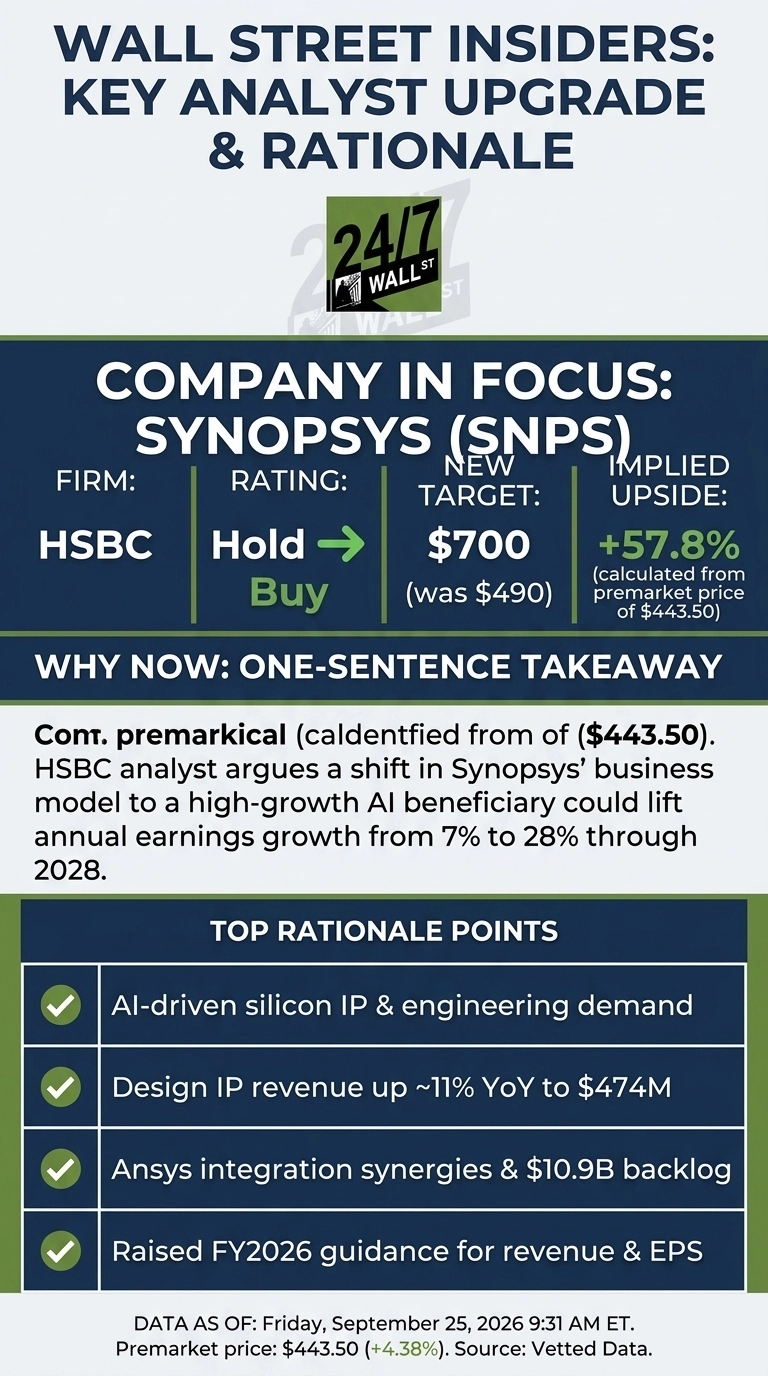

| Ticker | Company | Firm | Action | Old Rating | New Rating | Old Target | New Target |
|---|---|---|---|---|---|---|---|
| SNPS | Synopsys | HSBC | Upgrade | Hold | Buy | $490 | $700 |
HSBC’s Royalty Thesis Could Reset Synopsys’ Growth Curve
In a research note, Lee said the new business model will turn Synopsys from a “slow-growth software play to a high-growth AI beneficiary,” with the faster earnings growth “creating significant re-rating potential.” He sees the design intellectual property royalty model as the main driver of that earnings growth.
Management has described the same shift. On the third-quarter call, the chief executive said Synopsys is in advanced talks to move from a traditional IP license to “a license plus a royalty” with customers that include hyperscalers and ASIC vendors. He added, “We are in active discussions with multiple Factory 2 customers.”
Design IP revenue reached $474 million, up about 11% year-over-year. The die-to-die business is “on pace to double year over year,” and Synopsys won more than 95% of PCIe 7 opportunities.
Company Snapshot: Synopsys One Year After Ansys
Synopsys is a leading provider of electronic design automation (EDA) software and semiconductor IP. It expanded into wider engineering software when its $35B Ansys acquisition closed in fiscal Q3 2025.
Fiscal Q3 2026 revenue rose 42.4% YoY to $2.48B. Non-GAAP EPS came in at $3.91, beating the $3.67 consensus, and the non-GAAP operating margin was 41.6%. Management raised its full-year guidance to revenue of $9.69B to $9.74B and non-GAAP EPS of $15.04 to $15.10. Backlog stood at $10.9 billion.

Why Wall Street Is Rethinking Synopsys Right Now
Shares have gained 16.35% over the past week but remain down 5.58% year to date. The stock trades at about 23x forward earnings, compared with a trailing P/E near 72.
Analysts’ estimates are moving higher. The consensus fiscal 2027 EPS estimate rose to $17.5259 from $17.2343 90 days ago.
Over the past 30 days, there were 17 up updates and just 1 down updates. HSBC’s $700 target is well above the consensus target of $545.55. Synopsys also announced an agentic AI partnership with TSMC (NYSE:TSM) this week.

What It Means for Your Portfolio
Synopsys offers retirement-focused investors exposure to AI chip design complexity through recurring software and IP revenue. The stock pays no dividend, so any return depends on earnings growth.
The risks are real:
- Export controls and Entity List restrictions
- Customer concentration
- Ansys integration
- Fourth-quarter restructuring charges
- Total debt of about $10 billion
Key signals to watch include signed Factory 2 royalty deals and the updates to the long-term IP growth outlook that management has promised for Investor Day.
The royalty shift is really an AI infrastructure story, since Synopsys gets paid every time a hyperscaler or ASIC vendor produces new silicon (we featured seven companies riding the same expansion, outside the chipmakers themselves, in a free report here: 7 Stocks Powering the AI Boom (That Aren’t Chipmakers)).
Contact [email protected] for any questions or corrections.
Vandita Jadeja is a financial publisher with over a decade of experience writing about financial topics, including investment, savings, retirement, insurance and banking. Vandita is a Chartered Accountant who loves to debunk financial concepts for readers.
Her work has appeared on sites that include The Motley Fool, InvestorPlace, and Benzinga. She covers investing and focuses on stock picks and price prediction for 24/7 Wall St.
When not looking for the next stock investment opportunity, she can be found traveling, reading, chasing sunsets and enjoying her iced latte.