3 Beaten-Down Dividend Stocks Wall Street Abandoned That Still Pay You 7%
Wall Street has soured on UPS, General Mills, and Best Buy for very different reasons, but all three still send out checks that yield as much as 7%. Whether that income is a trap or a rare opportunity depends on…

This post may contain links from our sponsors and affiliates, and Flywheel Publishing may receive compensation for actions taken through them.
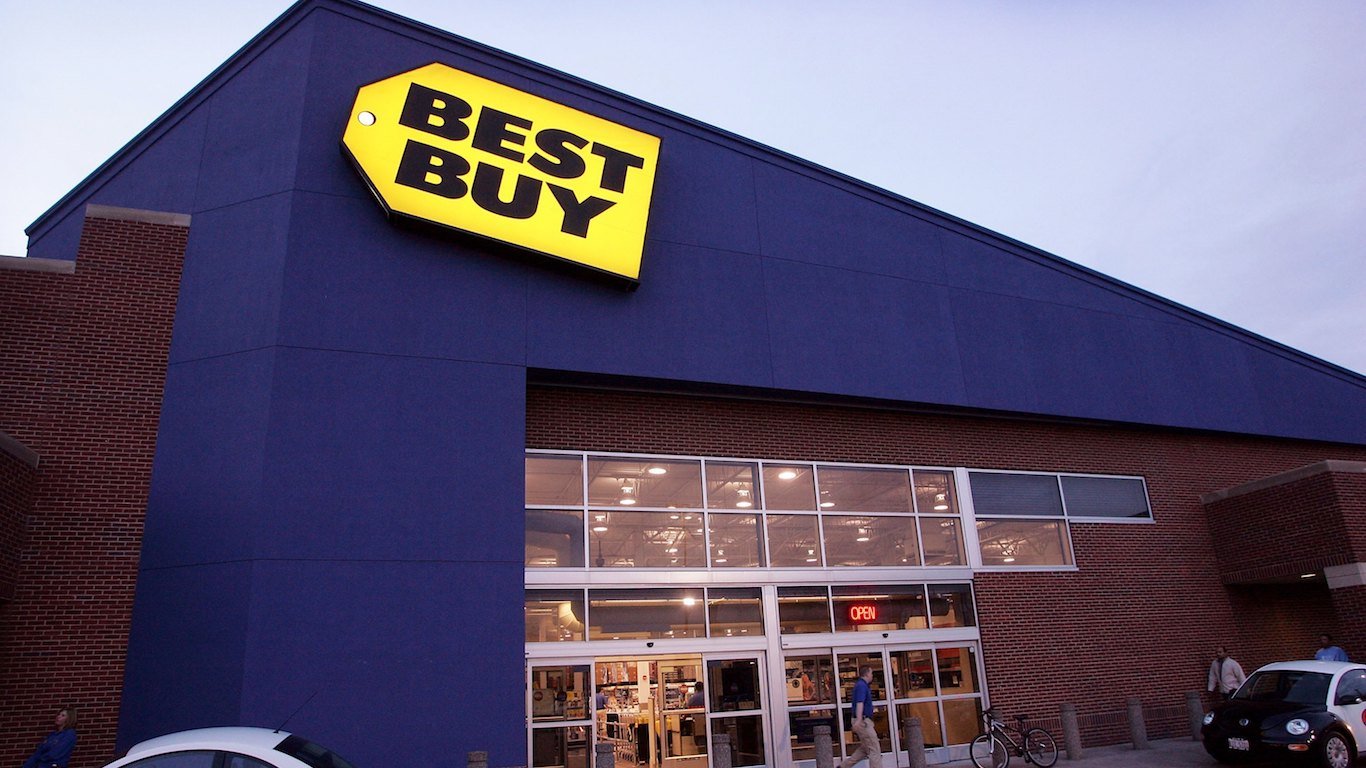
Some of the market’s most reliable dividend checks now come from stocks investors have stopped wanting to own. UPS (NYSE:UPS | UPS Price Prediction), General Mills (NYSE:GIS) and Best Buy (NYSE:BBY) each carry a long payout record, and each has given Wall Street a different reason to hesitate: a delivery network in the middle of a rebuild, a food portfolio shrinking its way toward growth, and a retailer changing chief executives with tariffs still hanging overhead. The clearest case is General Mills, down 27.77% over the past year. The question running through all three is whether that cold shoulder has opened an income opportunity or whether the market is pricing a real problem correctly.
UPS: An Ultra-High Yield Priced for a Rebuild Still in Progress
UPS lost the market’s trust over a long, difficult stretch. Shares trade at $93.95, 36.72% below where they stood five years ago, and well under the 52-week high of $116.86 after an 11.06% slide over the past month. In fairness, the stock has also climbed 21.34% over the past year off a 52-week low of $76.95, so this discount is a long-term one. The deterioration came from shrinking volume: UPS by choice walked away from Amazon packages, second-quarter volume fell 3.6%, and $1.17 billion in pre-tax transformation costs dragged GAAP EPS down to $0.71.
At a quarterly payout of $1.64, or $6.56 annualized, UPS yields 7.13%, which puts it firmly in ultra-high-yield territory. That rate has held flat through every payment in 2025 and 2026 after $1.63 in 2024, so the long climb from $0.45 in 2008 and 2009 has paused. Income investors should price this as a frozen dividend.
Coverage is tight. Trailing GAAP EPS of $5.38 sits below the annual dividend, leaving the payout looking stretched on a reported basis. Management’s adjusted numbers improve the picture: full-year adjusted EPS guidance of roughly $7.22 covers the $6.56 payout. Cash flow is thinner. UPS generated $5.470 billion in free cash flow in 2025 against dividend payments of about $5.5 billion, and first-quarter free cash flow of $1.280 billion came in under the $1,352 million paid to shareholders. The company still plans roughly $5.4 billion in dividend payments this year, subject to board approval.
The case for the payout holding rests on the back half of the transformation. Revenue per piece rose 11.3% last quarter, revenue of $22.83 billion exceeded the $21.84 billion estimate, and adjusted EPS of $1.76 beat the $1.66 consensus. UPS booked about $1.2 billion in transformation benefits in the first half and expects roughly $3 billion for the year. In its second-quarter release, CEO Carol Tomé said the company “entered the second half of the year with strong momentum” as it raised guidance. At 12 times forward earnings, the market is paying little for that recovery.
The risk: costs are running hot while the cash buffer slims. Fuel expense jumped 60.4%, purchased transportation rose 26.4%, and cash fell to $4.653 billion from $5.887 billion at year-end 2025. If savings stall, the dividend budget starts leaning on the balance sheet.
General Mills: 127 Years of Dividends Against a Shrinking Earnings Base
General Mills fits the written-off label cleanly. Shares trade at $33.65, down 24.15% this year and 23.23% over ten years, far closer to the 52-week low of $31.21 than the high of $48.26. The market soured on earnings power. Management guides fiscal 2027 adjusted EPS to $3.00 to $3.20, below the $3.55 earned in fiscal 2026, with adjusted operating profit expected down 13% to 8% in constant currency. Last fiscal year also absorbed $1.75 billion in goodwill and intangible impairments, mostly tied to North America Pet, which pushed trailing GAAP EPS to -$1.64.
The quarterly dividend of $0.61 annualizes to $2.44, a 7.01% yield that also lands in ultra-high-yield territory. The company describes this as its “127th consecutive year of uninterrupted dividends.” That kind of streak is rare enough that we ranked ten similar long-run payers by valuation in a free Dividend Kings report. The raise record is real but slowing: the payout moved from $0.54 in early 2023 to $0.59, then $0.60, then $0.61, and the last five payments have all held at $0.61.
On adjusted earnings, the dividend is covered: even the $3.00 low end of guidance sits above the $2.44 annual payout. Management expects free cash flow conversion of about 95% of adjusted after-tax earnings. Fiscal 2026 free cash flow was $1.626 billion, down 29.07%, and first-quarter fiscal 2027 dividends paid totaled $330.5 million. Buybacks show where the priority sits: repurchases dropped to $500 million in fiscal 2026 from $1.2 billion a year earlier, leaving more room for the dividend.
The bull case is a defensive business trading at 12 times forward earnings while cost cuts kick in. General Mills is targeting at least $750 million in savings this fiscal year on the way to $3 billion cumulative by fiscal 2030. Second-quarter adjusted EPS of $0.75 beat the $0.72 estimate, and organic net sales were roughly flat despite the yogurt exit. In the latest earnings release, CEO Jeff Harmening said, “Based on our progress and the actions underway, we remain confident in our ability to deliver our fiscal 2027 guidance.”
The risk is input-cost inflation outpacing the savings program. Adjusted gross margin slid 90 bps to 33.3% last quarter, and management flags category growth running below its long-term historical rate. If that gap remains, the dividend stays frozen for longer.
Best Buy: A Rallying Stock That Analysts Still Won’t Embrace
Best Buy breaks the pattern, and that deserves to be said simply: the stock is up 40.51% this year and 28.42% over the past twelve months, trading at $90.50, within reach of its 52-week high of $96.53. Where Best Buy looks written off is analyst sentiment. Hold ratings outnumber buys 18 to 5, and the average price target of $86.70 sits below the share price. The longer view explains the caution: shares are up just 9.11% over five years, and tariffs plus a leadership change leave analysts questioning how long the rally can run.
The quarterly dividend of $0.96 annualizes to $3.84 for a 4.2% yield: high-yield, though below the ultra-high tier of the other two. Its track record is the strongest in this group. The regular quarterly rate has stepped higher in every year of the listed record, from $0.28 in 2016 to $0.70 in 2021 and $0.96 today, although the latest raise was just 1%.
Coverage is comfortable. Raised fiscal 2027 adjusted EPS guidance of $6.70 to $6.90 sits well above the $3.84 annual dividend. Best Buy produced $1.258 billion in free cash flow in fiscal 2026 and $215 million in the first quarter of fiscal 2027. Cash rose 31.64% to $2.255 billion, and the company still plans roughly $300 million in buybacks this year on top of the dividend.
The operating momentum supports the payout. Second-quarter adjusted EPS of $1.47 beat the $1.36 estimate for a fifth straight beat, enterprise comparable sales rose 4.1%, and Domestic comps gained 4.5% on computing, home theater and AI glasses. Online sales reached 33.1% of Domestic revenue. At 14 times forward earnings, the stock still prices in modest expectations. In the second-quarter release, CEO Corie Barry said Best Buy “outperformed expectations in the second quarter.”
The risk is a leadership change at a delicate moment. Barry is stepping down, and Jason Bonfig takes over as CEO on November 1, 2026. A new chief executive can reset capital-allocation priorities, and dividend growth has already slowed to a crawl.
Which Out-of-Favor Payer Fits Your Income Plan
Being out of favor has created a genuine income opening in UPS and General Mills, while Best Buy’s discount lives mostly in analyst skepticism. UPS suits those seeking a 7.13% yield who can live with a frozen payout while transformation savings rebuild free cash flow. General Mills fits retirees who prize a 127-year payment record and a defensive business at 12 times forward earnings, accepting a flat dividend while earnings reset. Best Buy belongs with dividend-growth investors, offering the smallest yield of the three alongside the widest coverage and the most recent raise.
Contact [email protected] for any questions or corrections.
Chris Lange is a financial and geopolitical writer with more than a decade of experience covering a myriad of topics. He has published thousands of articles for 24/7 Wall St., with past coverage focused heavily on stocks, IPOs, healthcare, defense, global affairs, and technology.
His work has been quoted, or referenced by a number of outlets including Business Insider, USA Today, Yahoo Finance, MSN, The Motley Fool, and many other publications. A graduate of Southwestern University, he studied business with a focus on investments and has previous experience in banking and startups.
When not reading or writing the news, he is following his passion for Lacrosse, playing chess, or building solar projects with his dad.