McDonald’s Dividend Is Funded by Something Other Than Burgers
McDonald's just raised its dividend again even as its stock hit a multiyear low and U.S. foot traffic turned negative. The reason has almost nothing to do with selling burgers.

This post may contain links from our sponsors and affiliates, and Flywheel Publishing may receive compensation for actions taken through them.
Shares of McDonald’s (NYSE:MCD | MCD Price Prediction) have fallen 21.1% year to date to $236.51, and Business Insider reported the stock hit a multiyear low after investors shrugged at a restaurant makeover plan. Yet on September 17, 2026, the board declared a quarterly dividend of $1.93, up from $1.86. That confidence rests on landlord math more than burger math.

Franchisees Pay the Rent That Pays You
Franchised restaurants generate roughly 90% of restaurant margin dollars. In Q2 2026, franchised revenue reached $4.393B, up 4%, versus $2.525B, up 3% from company-operated stores. Franchised revenue is rent and royalties tied largely to sales. When an operator’s food and labor bills climb, McDonald’s still collects its cut of the top line. That structure explains a 46.1% operating margin. CFO Ian Borden framed it on the August 4 call:
“In the second quarter, we generated more than $4 billion in restaurant margins, and our year-to-date adjusted operating margin was 46.9%, highlighting the resiliency of our business model.”
The mix is shifting further toward franchising. Management said company-owned restaurant sales occurred in the quarter and are expected to continue in 2026 and beyond.
Free Cash Flow Covers the Check
In 2025, McDonald’s produced $10.551B of operating cash flow and $7.186B of free cash flow after $3.365B in capex. Dividends cost $5.115B, alongside $2.056B in buybacks. Q2 2026 followed the pattern: $2.81B of operating cash flow against $834M of capex and $1.317B in dividends.

Stress tests matter. In the June 2020 quarter, operating cash flow was negative $213.1M while dividends totaled $929.7M. The quarterly rate still rose from $1.25 to $1.29 that year.
Debt Is the Price of the Landlord Model
Buybacks and leverage have pushed shareholders’ equity to negative $1.79B. Interest expense hit $1.582B in 2025, and management guides 2026 interest expense up 4-6%. Even so, the quarterly dividend has climbed from $0.375 in 2008 to $1.93, with an increase in every year of the record (the kind of multi-decade raise run we screened for in our free Dividend Kings guide).
How Yum! Brands and Burger King’s Parent Stack Up
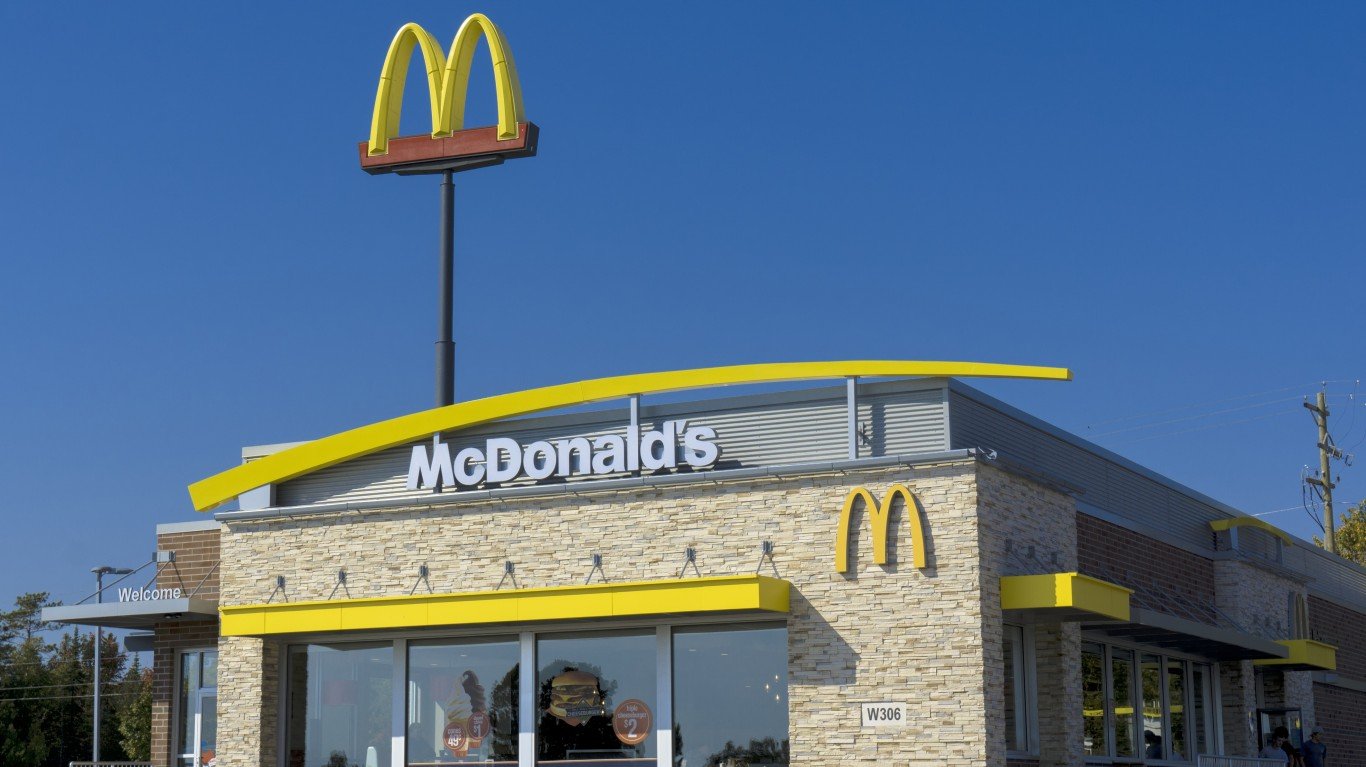
Yum! Brands (NYSE:YUM) and Restaurant Brands International (NYSE:QSR) also run heavily franchised systems, collecting royalties from KFC, Taco Bell, Burger King and Tim Hortons operators. McDonald’s adds a property layer, controlling much of the land under its restaurants and charging franchisees rent on top of royalties. That second stream gives it a stronger floor than its asset-lighter peers, though it also demands higher capex, guided at $3.7-$3.9B for 2026.
Where the Soft Spot Sits
Royalties still track franchisee sales. Global comps slowed to 1.3% in Q2 from 3.8% a year earlier, U.S. comps rose just 0.8%, and Borden said U.S. comps were slightly negative in July. CEO Chris Kempczinski admitted execution slipped:
“If it looks great on paper but you can’t execute it, it doesn’t matter.”
U.S. operators remain healthy, he added: “When we look at their balance sheets, they’ve got a lot of borrowing capacity still.”
Verdict: Durable Payout, Thinner Growth Cushion
The dividend is durable. The stock yields about 3.06%, the forward annualized payout is $7.72, and 2025 free cash flow covered dividends with room to spare. The real threat is a extended U.S. traffic slump that drains franchisee profits, strains their borrowing capacity and forces rent relief, all while interest costs rise on a balance sheet with negative equity. Keep an eye on Investor Day refranchising details and U.S. comps through year-end.

Contact [email protected] for any questions or corrections.
Chris Lange is a financial and geopolitical writer with more than a decade of experience covering a myriad of topics. He has published thousands of articles for 24/7 Wall St., with past coverage focused heavily on stocks, IPOs, healthcare, defense, global affairs, and technology.
His work has been quoted, or referenced by a number of outlets including Business Insider, USA Today, Yahoo Finance, MSN, The Motley Fool, and many other publications. A graduate of Southwestern University, he studied business with a focus on investments and has previous experience in banking and startups.
When not reading or writing the news, he is following his passion for Lacrosse, playing chess, or building solar projects with his dad.