Domino’s Keeps Raising Its Dividend—But What About All That Debt?
Domino's has raised its dividend every year for over a decade and just approved another hefty increase, yet the balance sheet carries nearly $5 billion in debt and a stockholders' deficit that would alarm most retirees. Before you count on…

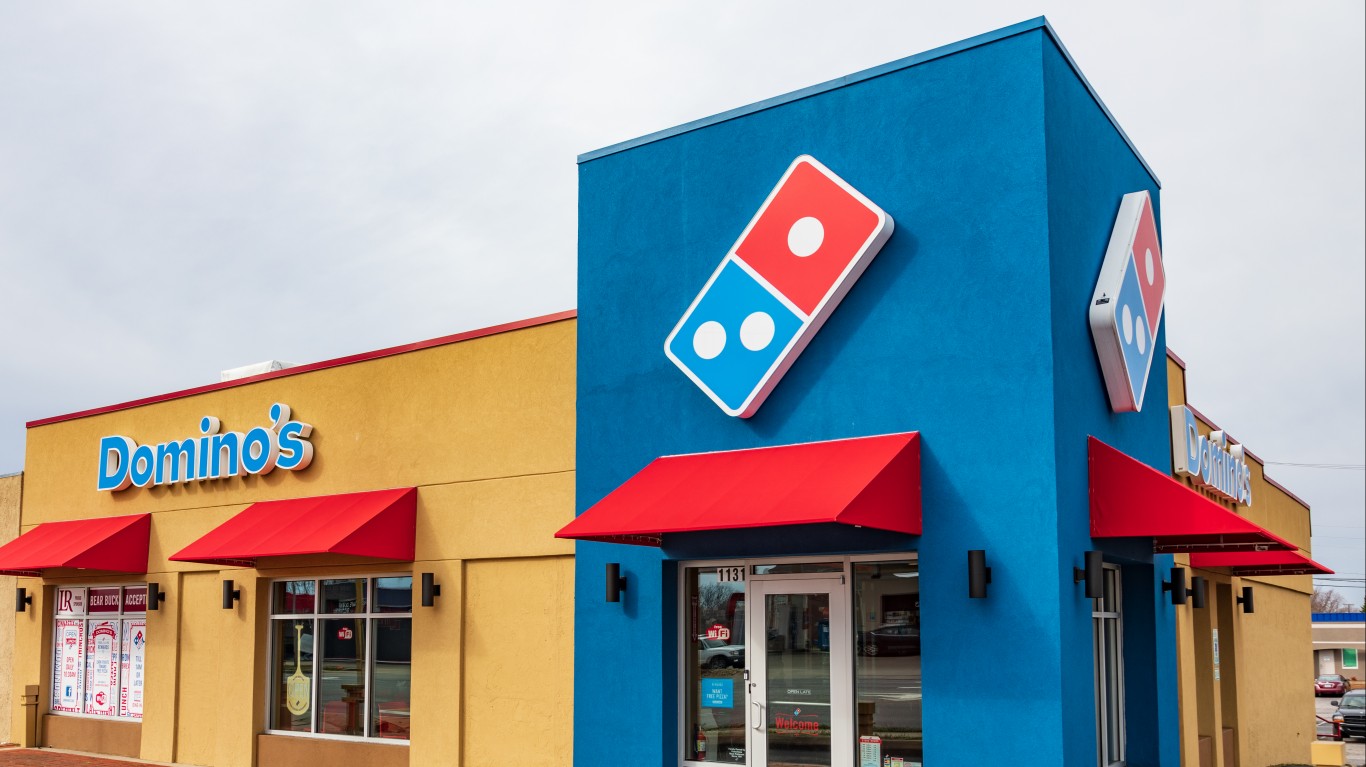
Income investors who own Domino’s Pizza (NASDAQ:DPZ | DPZ Price Prediction) just got their next check confirmed. The board declared a quarterly cash dividend of $1.99 per share on July 14, 2026, with an ex-dividend date of September 15, 2026 and a payment date of September 30, 2026. That payout sits on top of a trailing twelve month dividend of $7.46 per share, and it caps off one of the more aggressive dividend ramps in the restaurant group.
The tension for a retiree evaluating this stock is right there in the numbers. The dividend is rising quickly, the yield is modest, and the balance sheet carries the kind of leverage that makes conservative income investors nervous. This scorecard works through whether the payout is actually dependable.

A Four-Year Dividend Ramp on Full Display
Look at the declared quarterly rate over four years and the pace is unmistakable:
- 2023: $1.21 per quarter
- 2024: $1.51 per quarter
- 2025: $1.74 per quarter
- 2026: $1.99 per quarter
The February 2026 hike from $1.74 to $1.99 represented a 15% year-over-year dividend increase. That is a hefty raise for a mature restaurant chain, and it continues a multi-year growth streak that started when the dividend was initiated in 2013. A fast-rising payout looks great on a screener. It also demands scrutiny on whether cash flow is keeping pace.
Current Yield: Modest Despite the Raises
With shares trading at $346.76 as of September 3, 2026, the dividend yield sits at 2.19%. That is not a rich income number. Domino’s has been raising the payout aggressively, but the starting yield is low enough that retirees comparing DPZ to REITs, utilities, or dividend aristocrats with 3.5% to 5% yields will notice the gap. Yield-hungry buyers usually get more elsewhere. What DPZ offers is dividend growth, provided that growth is sustainable.
It’s worth pointing out that DPZ is down 15.8% year to date and 24.2% over the past year, well off a 52-week high of $458.38. The pullback has lifted the yield somewhat but has not turned this into a high-yield name.

Why the Franchise Model Matters for Cash Flow
Domino’s does not operate most of its stores. Franchisees do. Domino’s collects royalty streams, supply chain revenue, and franchise fees, then leaves store-level labor, food, rent, and remodel costs on the franchisee’s books. That produces a very asset-light parent company with high margins and consistent cash conversion. Operating margin runs at 19.1% and return on assets at 33.9%.
The upside of that model is what you see in the cash flow statement. In fiscal 2025, Domino’s generated operating cash flow of $792.06 million, spent $120.56 million on capex, and paid out $236.86 million in dividends. Free cash flow of $671.5 million covered the dividend with meaningful room to spare.
Payout Coverage: The Scorecard
FY2025 diluted EPS came in at $17.57 against an annualized payout of roughly $7.96 based on the current quarterly rate. Trailing twelve month EPS is $17.96, and Domino’s trades at a 19 PE with a forward PE of 16.
On cash flow, the dividend is also well covered by the roughly $671 million of free cash flow generated last year. The dividend program consumed less than half of free cash flow in 2025.
The catch is that dividends are competing with a very large buyback program. In Q2 2026 alone, Domino’s repurchased 443,917 shares for $156.2 million, and the board authorized an additional $1.0 billion in buybacks in April 2026. Remaining authorization stood at $1.23 billion as of mid-June. Between dividends and buybacks, Domino’s is returning nearly all of its free cash flow to shareholders every year.
Debt on the Books
As of the quarter ended June 30, 2026, total liabilities stood at $5.746 billion, long-term debt at $4.876 billion, and total shareholders’ equity at negative $3.98 billion. Domino’s has funded years of buybacks with securitized notes, and the equity account has been in deficit in every annual report from 2006 through 2025.
Cash on hand was $164.8 million at quarter end, down 39.6% year over year. The company carries roughly $4.77 billion in fixed-rate securitized notes. Domino’s regulatory filings have flagged “substantial indebtedness with negative stockholders’ equity” as a repeated risk factor.
For an income investor at or near retirement, that language matters. Negative book value is a byproduct of aggressive share repurchases here, and the interest burden is real. Any material deterioration in same-store sales or franchisee health could tighten the cash flow cushion in a hurry.
Business Behind the Coupon: Comps Decelerate
Recent operating results give both bulls and bears something to point at. Q2 2026 revenue rose 4.3% to $1.194 billion, beating the $1.179 billion consensus. Diluted EPS of $4.07 missed the $4.17 consensus. U.S. same-store sales grew a barely visible 0.1%, decelerating from 3.4% in the prior year period. International same-store sales fell 0.1%.

CFO Sandeep Reddy said on the July 20 call: “We had a one-quarter blip on ticket. We’re not going to have another blip.” CEO Russell Weiner, who is transitioning to executive chairman with Joe Jordan taking over as CEO, added: “My conviction in Domino’s long-term growth potential remains as strong as ever.”
Domino’s added 183 international stores during Q2 and expects roughly 800 net international stores for the year, with the U.S. outlook trimmed to approximately 175 net stores.
Risks Retirees Should Weigh Carefully
- Leverage: roughly $4.9 billion of long-term debt against a stockholders’ deficit means limited balance sheet flexibility if operating results weaken.
- Same-store sales sensitivity: U.S. comps at +0.1% and international at -0.1% leave very little margin for error.
- Delivery aggregators: management is pursuing growth on Uber and DoorDash while trying to keep franchisee economics “profit neutral” on those orders. Execution risk is real.
- Franchisee health: a pressured pipeline and reduced U.S. store outlook reflect franchisee profitability strain.
- Food and labor inflation: cost pressure at the store level eventually reaches the parent through slower unit growth.
- Buyback competition: with $1.23 billion in remaining repurchase authorization, buybacks are competing with the dividend and debt service for the same free cash flow.
Verdict on Dependability
The dividend is dependable in the near and medium term. Free cash flow of $671.5 million comfortably funds the roughly $237 million dividend program, the securitized note structure is fixed rate, and management has an established record of raising the payout. A retiree who owns DPZ for income should expect the check to arrive on September 30, 2026 and expect further raises.
The dividend is less attractive as a primary income vehicle. A 2.19% yield is thin compensation for accepting a stockholders’ deficit, decelerating comps, and buybacks that consume the majority of surplus cash. This is a dividend growth story with balance sheet baggage. It earns a solid dependability grade for the next several years and a cautionary grade for the decade beyond, particularly if same-store sales cannot reaccelerate.
Contact [email protected] for any questions or corrections.
Chris Lange is a financial and geopolitical writer with more than a decade of experience covering a myriad of topics. He has published thousands of articles for 24/7 Wall St., with past coverage focused heavily on stocks, IPOs, healthcare, defense, global affairs, and technology.
His work has been quoted, or referenced by a number of outlets including Business Insider, USA Today, Yahoo Finance, MSN, The Motley Fool, and many other publications. A graduate of Southwestern University, he studied business with a focus on investments and has previous experience in banking and startups.
When not reading or writing the news, he is following his passion for Lacrosse, playing chess, or building solar projects with his dad.