Cloud 2027: Can Oracle’s Fastest-Growing Engine Bridge the AWS Gap?
Oracle's cloud arm is growing at triple the rate of AWS, yet the gap in raw revenue remains enormous and Oracle is burning cash fast. What happens when both bets on 2027 datacenter capacity finally come due?

This post may contain links from our sponsors and affiliates, and Flywheel Publishing may receive compensation for actions taken through them.
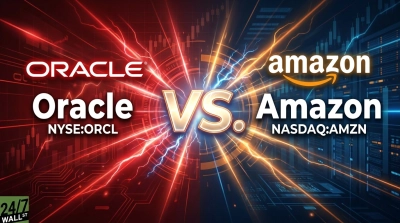
Oracle (NYSE:ORCL | ORCL Price Prediction) and Amazon (NASDAQ:AMZN) just reported earnings that raise the same question: Oracle’s infrastructure arm is growing far faster than AWS, yet AWS still brings in far more money. Both are spending heavily on AI datacenters, so capacity built for 2027 will decide how much of that gap closes.
OCI Doubles While AWS Hits an 18-Quarter High
Oracle Cloud Infrastructure revenue reached $7.388 billion, up 121%. Oracle delivered 850 megawatts and more than 300,000 GPUs, with usage hitting 97.9%. GPUs up for renewal went back out at a 20% premium, showing older hardware still commands higher prices.
AWS posted $42.232 billion, up 37%, far ahead of OCI’s quarter. CEO Andy Jassy explained: “They want their AI inference to reside near their other applications and data, and more of it resides in AWS than anywhere else.”
| Business Driver | Oracle OCI | Amazon AWS |
|---|---|---|
| Quarterly Revenue | $7.388B | $42.232B |
| Growth | 121% | 37% |
| Backlog | $664B RPO (company-wide) | $496B |
| Silicon Approach | Chip neutral, NVIDIA (NASDAQ:NVDA) Vera Rubin | Trainium and Graviton plus NVIDIA |
Oracle Rides Inside AWS While Amazon Builds Its Own Chips
Oracle’s sharpest move runs through AWS itself. Multicloud database revenue grew 353%, Oracle Interconnect for AWS is now generally available, and Oracle runs 70 multicloud database regions. Clay Magouyrk stated: “We believe that our customers should be able to run their Oracle databases in any cloud they choose.”
Amazon competes on cost. Graviton runs at 98% of the top 1,000 EC2 customers. Anthropic committed up to 5 GW of Trainium capacity, and OpenAI committed about 2 GW starting in 2027. Oracle must buy its GPUs from outside suppliers.
Cash Burn Decides Who Funds 2027
Oracle’s free cash flow came in at -$5.4 billion, and the company expects fiscal 2027 capex of $90 billion to $95 billion. Interest expense rose 55%, and management gave no timeline for positive free cash flow. All that capex has to be powered, cooled, and networked by someone, and we rounded up seven of those suppliers in a free AI infrastructure report. Amazon’s trailing free cash flow also turned negative at -$7.6 billion, but Jassy said most 2027 capacity is “largely reserved.” I will be watching for Oracle’s first Vera Rubin deliveries and its December 14 report.
Why Amazon Leads on Durability While Oracle Offers Upside
Oracle fell 49.79% over the past year, while Amazon gained 16.02%. Oracle trades near 18x forward earnings versus 24x for Amazon. That discount shows real concerns about debt and funding.
For durability, Amazon holds the edge. Its custom chips, profitable core cloud business, and reserved capacity give AWS an advantage unlikely to close by 2027. Oracle offers more upside alongside higher risk. My view changes if Oracle shows a credible path to positive free cash flow.
Contact [email protected] for any questions or corrections.
Alex Sirois is a financial writer with experience spanning both retail and institutional investing. He has written for InvestorPlace and held roles at BNY Mellon and Bernstein, giving him a perspective that bridges Main Street portfolios and Wall Street analysis.
Alex holds an MBA from George Washington University and has built his career across multiple industries, including e-commerce, education, and translation — a breadth of experience that informs how he breaks down complex financial topics for everyday investors. His writing is conversational, actionable, and grounded in long-term, buy-and-hold investing principles.
At 247 Wall St., Alex focuses on delivering analysis that is both accessible and useful, with a clear emphasis on helping readers make more informed decisions with their money.