Lucid’s Major Failure
Lucid's new CEO made one public promise after taking over, and investors responded by sending the stock deeper into penny-stock territory. What exactly is happening inside this troubled EV maker, and how much longer can it survive?

This post may contain links from our sponsors and affiliates, and Flywheel Publishing may receive compensation for actions taken through them.
Lucid (NASDAQ: LCID | LCID Price Prediction), the troubled EV company, produced 2,954 vehicles and delivered 3,806 vehicles during the third quarter. As an afterthought, management also gave a long list of excuses for delivering only 63 cars a day over the period. BNP Paribas looked at the figures and said Lucid has a “long and difficult journey” to fix itself.
Investors have been repeatedly reminded that Lucid cannot make the case that it will survive as an independent company. It might be bought for its technology or its products. But that seems an unlikely stretch. Its stock has crashed 60% this year. It is down 37% in the last three months.
Silvio Napoli has been CEO since early June. Investors have already voted on whether this was a good choice. The answer is a resounding “no”. He has not uttered a single convincing sentence about any plan that might turn Lucid around.
Instead of improvement, it has fallen to $4.16, into penny-stock territory. Napoli’s primary contribution so far was, in July, to tell the world that Lucid would not declare bankruptcy. The fact that he had to do so says a lot.
Rather than listening to Napoli’s restructuring plan, investors have focused on financial results. In the most recent quarter, Lucid had a net loss of $1.26 billion, on revenue of $405 million. It is hard to imagine how many cars Lucid would need to sell to break even.
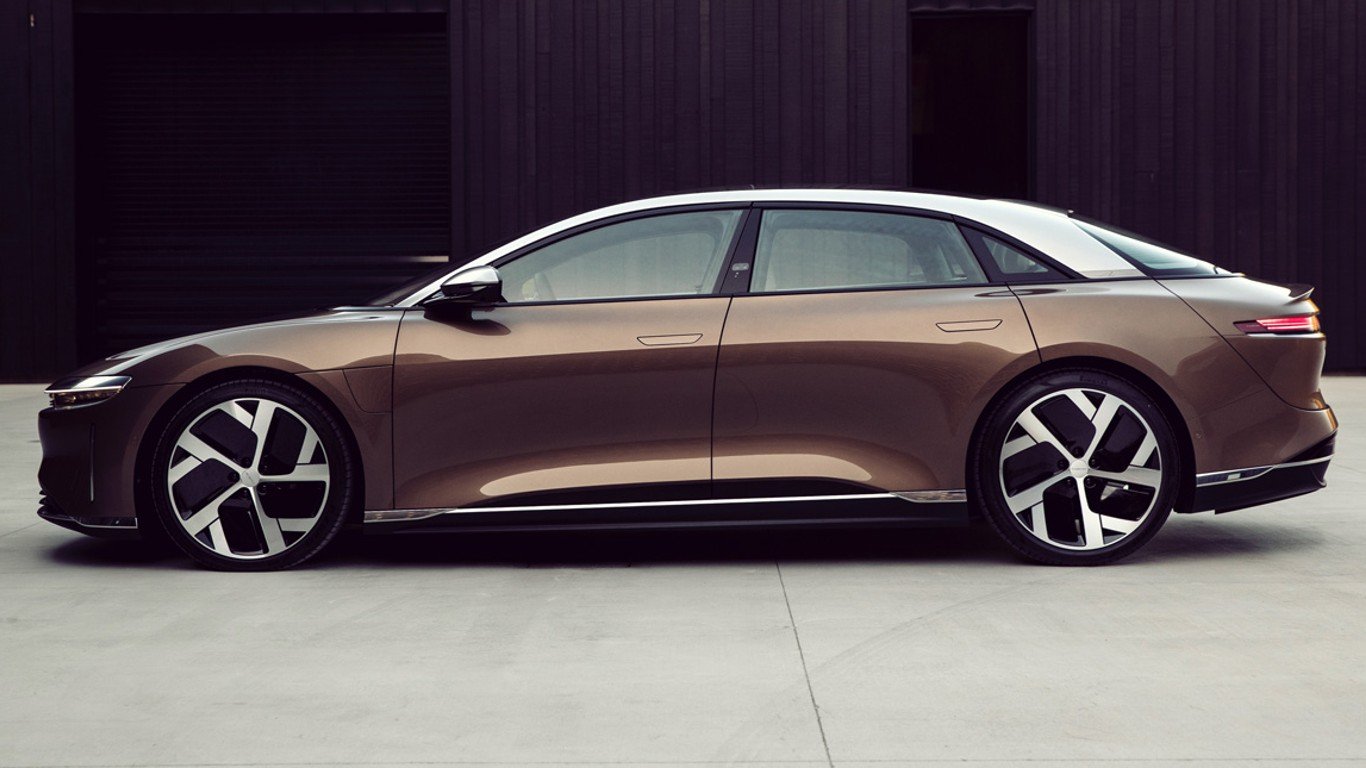
Among the worst decisions Lucid made early in its history was its car pricing. The Lucid Air is priced between $70,000 and $115,000. The Lucid Gravity is priced between $76,000 and $126,000. There is no market for EVs priced that high.
Lucid’s market cap has fallen to $1.6 billion. That remains well above where it should be.
Contact [email protected] for any questions or corrections.
Douglas A. McIntyre is the co-founder, chief executive officer and editor in chief of 24/7 Wall St. and 24/7 Tempo. He has held these jobs since 2006.
McIntyre has written thousands of articles for 24/7 Wall St. He is an expert on corporate finance, the automotive industry, media companies and international finance. He has edited articles on national demographics, sports, personal income and travel.
His work has been quoted or mentioned in The New York Times, The Wall Street Journal, Los Angeles Times, The Washington Post, NBC News, Time, The New Yorker, HuffPost USA Today, Business Insider, Yahoo, AOL, MarketWatch, The Atlantic, Bloomberg, New York Post, Chicago Tribune, Forbes, The Guardian and many other major publications. McIntyre has been a guest on CNBC, the BBC and television and radio stations across the country.
A magna cum laude graduate of Harvard College, McIntyre also was president of The Harvard Advocate. Founded in 1866, the Advocate is the oldest college publication in the United States.
TheStreet.com, Comps.com and Edgar Online are some of the public companies for which McIntyre served on the board of directors. He was a Vicinity Corporation board member when the company was sold to Microsoft in 2002. He served on the audit committees of some of these companies.
McIntyre has been the CEO of FutureSource, a provider of trading terminals and news to commodities and futures traders. He was president of Switchboard, the online phone directory company. He served as chairman and CEO of On2 Technologies, the video compression company that provided video compression software for Adobe’s Flash. Google bought On2 in 2009.