How Much More Dividend Income a Roth IRA Keeps on a Half-Million-Dollar Portfolio
Six dividend stocks in a $500,000 portfolio sound like a solid income plan, but where you hold them decides how much of that income you actually keep, and the difference compounds into a number most investors never calculate.

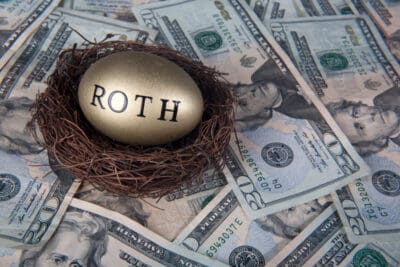
At the 24% bracket, a $500,000 portfolio split across six dividend payers sends about $3,072 a year to the IRS. In a Roth IRA, the same dividends arrive untaxed.
Dollars Kept: Roth Versus Taxable on $500,000
Each stock gets an equal stake of about $83,333. Yield is each company’s annualized forward dividend divided by its October 9 price. Most filers in this bracket pay the 15% capital gains rate on qualified dividends (IRS Topic 409). REIT distributions generally face the full 24% income rate.
| Stock | Yield | Annual Income | Tax Treatment | Taxable Cost at 24% |
|---|---|---|---|---|
| Texas Instruments (NASDAQ:TXN | TXN Price Prediction) | 2.11% | $1,758 | Qualified | $264 |
| JPMorgan Chase (NYSE:JPM) | 1.98% | $1,651 | Qualified | $248 |
| Pfizer (NYSE:PFE) | 6.11% | $5,090 | Qualified | $763 |
| Coca-Cola (NYSE:KO) | 2.40% | $2,004 | Qualified | $301 |
| Prologis (NYSE:PLD) | 3.31% | $2,761 | Ordinary (REIT) | $663 |
| Public Storage (NYSE:PSA) | 4.17% | $3,474 | Ordinary (REIT) | $834 |
Inside a Roth, the portfolio’s $16,739 of gross income stays whole. Outside that shelter, it shrinks to $13,667. That leaves about $3,070 more each year in the Roth, or $30,720 over 10 years with no growth or new money assumed. To qualify, Roth withdrawals have to come after the five-year period and on or after age 59½ (IRS Publication 590-B).
The REITs account for most of the gap. Prologis and Public Storage produce 37% of the income but 49% of the tax bill. Public Storage has paid $3 quarterly since 2023 and reports about $600 million of annual free cash flow. Prologis raised its payout to $1.07 from $1.01. Pfizer is the largest qualified-dividend payer here, with its $0.43 quarterly dividend unchanged since early 2025. Texas Instruments, JPMorgan and Coca-Cola recently raised their dividends to $1.52, $1.65 and $0.53. These three gain the least from Roth placement. Some REIT investors can also claim the 199A write-off, which lowers the effective rate on REIT income.
How Your Bracket Changes the Gap
In tax year 2026, single filers pay the 24% rate on income above $105,700 ($211,400 joint). Filers in the 37% bracket also move up to the 20% qualified rate.
| Bracket | Taxable Net Income | The Roth’s yearly edge |
|---|---|---|
| 22% | $13,791 | $2,947 |
| 24% | $13,667 | $3,072 |
| 32% | $13,168 | $3,571 |
| 37% | $12,331 | $4,408 |
Compounding Lifts the 20-Year Gap to $91,000
The $3,072 annual gap at the 24% bracket keeps growing if each year’s saved tax is reinvested at a conservative 4%. Over 10 years it reaches $36,883. Over 20 years it reaches $91,478, compared with $61,440 without reinvestment. No share price growth is assumed. This is what holding these six stocks outside a Roth costs over time.
Roth Limits That Shape the Plan
Roth contributions have annual caps, and income limits can reduce or block direct contributions (IRS Publication 590-A). Investors usually build a $500,000 Roth over many years or by converting a traditional IRA (Publication 17), and conversions trigger income tax. The quiet years between a final paycheck and the first required withdrawal are often when conversions are cheapest, a window we sized up in a free Roth guide. In practice, the useful question is which holdings belong in the Roth space you already have.
What to Do Before Your Next Filing
- If you hold REITs outside a retirement account, use last year’s 1099-DIV to separate ordinary dividends from qualified ones, then work out what each costs at your bracket.
- Before deciding a Roth conversion costs too much, compare the tax on the conversion with the 20-year income gap for your own holdings.
- If your Roth holds low-yield growth stocks while REITs are held outside it, model swapping them so the ordinary-income payers move into the Roth first.
Contact [email protected] for any questions or corrections.
Chris Lange is a financial and geopolitical writer with more than a decade of experience covering a myriad of topics. He has published thousands of articles for 24/7 Wall St., with past coverage focused heavily on stocks, IPOs, healthcare, defense, global affairs, and technology.
His work has been quoted, or referenced by a number of outlets including Business Insider, USA Today, Yahoo Finance, MSN, The Motley Fool, and many other publications. A graduate of Southwestern University, he studied business with a focus on investments and has previous experience in banking and startups.
When not reading or writing the news, he is following his passion for Lacrosse, playing chess, or building solar projects with his dad.