Microsoft’s CEO Just Called for a Kill Switch on AI. Here Is What It Means for the Stock.
Satya Nadella publicly asked for a way to stop his own AI products cold, and the reasoning behind that request has real consequences for whether Microsoft's massive spending bet pays off.

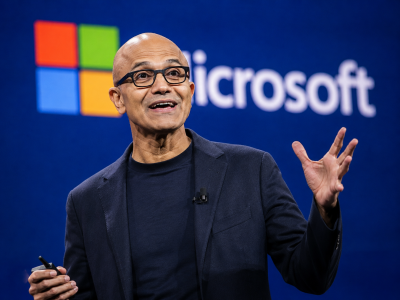
Satya Nadella spent a weekend post saying that AI systems need emergency off switches, by which he means authorized humans who can shut a model down in the middle of a task. The idea stands out. He runs Microsoft (NASDAQ:MSFT | MSFT Price Prediction), the company with the greatest commercial exposure to frontier AI, and he is publicly asking for a way to stop his own product mid-sentence.
Here is the key passage in full: “We can’t treat superintelligence as a set of nested black boxes and simply accept or reject its recommendations, answers and actions. We must build containment systems whose behavior we can observe, limits that we can test, and actions we can always contain.”
For investors, this is a product decision. Microsoft holds about a 27% stake in OpenAI and spent $115.95 billion on capital expenditures in fiscal 2026. Now it wants to sell customers the controls that can stop those systems.
The timing matters because over the past year the stock rose only 6.78%, while the S&P 500 gained 19.15%.

What an AI Emergency Brake Looks Like Inside Your Company
In engineering terms, an emergency off switch is four ordinary pieces of software, the first of which is a set of breakpoints inside long-running agent tasks, so a person can pause the job between steps.
The second is permission scopes that limit which files, systems, and accounts an agent can touch, and the third is logging that records what the agent did and why it did it.
The fourth is an identity layer that decides who is allowed to stop the agent. Companies already buy every one of these tools to manage their employees.
Microsoft already sells the version built for agents. Agent 365 had nearly 40 million agents registered two months after it launched.
Verification Tax Could Decide Copilot Renewals
The most useful idea in this debate is what you might call the verification tax. If employees spend hours checking what a model produced, the checking eats part of the promised productivity gain. Customers stop renewing software whose output they cannot trust, and renewal rates are how this industry gets valued.
Microsoft 365 Copilot passed 30 million paid seats. Purview, Microsoft’s compliance tool, tracked more than 15 billion Copilot interactions, up nearly 360% year over year.
That audit volume shows customers already want a record of what the AI did. When a system’s behavior can be observed, checking it costs less, and that protects the renewal.
Containment Favors the Company That Owns Identity
Governance, audit trails, and permissions are enterprise software problems. Microsoft already runs the identity and compliance layer where corporate customers manage their people, so selling control over agents extends a business it already has.
Nadella has said “every model is substitutable,” and Azure AI Foundry offers more than 11,000 models. If you can swap one model for another, the lasting value sits in the control layer around them.
A more cynical read has merit. The incumbent with the largest frontier position gains when safety rules raise the cost of entry for everyone behind it, because only well-funded companies can afford to make powerful models observable, testable, and interruptible. That incentive can exist even if Nadella’s concern about safety is genuine.
Capex Is Climbing Faster Than Proof of Return
The market wants to see a return on the spending before it shows up in reported numbers. Fourth-quarter capex was $35.80 billion, up 109.6%, and management expects fiscal 2027 spending to grow again. A containment framework will not answer that question soon, although it protects the renewal base that pays for the spending.
The picks-and-shovels side of AI is in demand. The power, cooling, and networking suppliers behind every hyperscaler’s capex line are why we pulled seven of them into a free report you can grab here.
Demand data supports the spending, as Azure grew 43%, and revenue already under contract but not yet recorded reached $678 billion.
Two signals would weaken the bull case. The first is AI features handed out free to defend seats when they should be sold as paid add-ons to existing enterprise agreements. The second is capex guidance that keeps rising without matching revenue growth.
What Investors Should Weigh in MSFT Stock Now
At about 30 times earnings and $541.15 a share, investors pay a modest premium for a company whose net income rose 31.3% in fiscal 2026.
The governance positioning adds value because it ties AI usage to identity and compliance contracts that customers rarely replace.

A year of trailing the market has brought down expectations, although a 0.66% dividend yield offers little buffer if capex keeps rising.
Microsoft holds a distinctive position in this market. Standalone model developers lack the enterprise control layer, and Microsoft also collects OpenAI’s $250 billion Azure commitment.

Contact [email protected] for any questions or corrections.
Omor Ibne Ehsan is a writer at 24/7 Wall St. He is a self-taught investor with a focus on growth, cyclical, and dividend equities that have strong fundamentals, value, and long-term potential. He also has an interest in high-risk, high-reward investments such as penny stocks.